

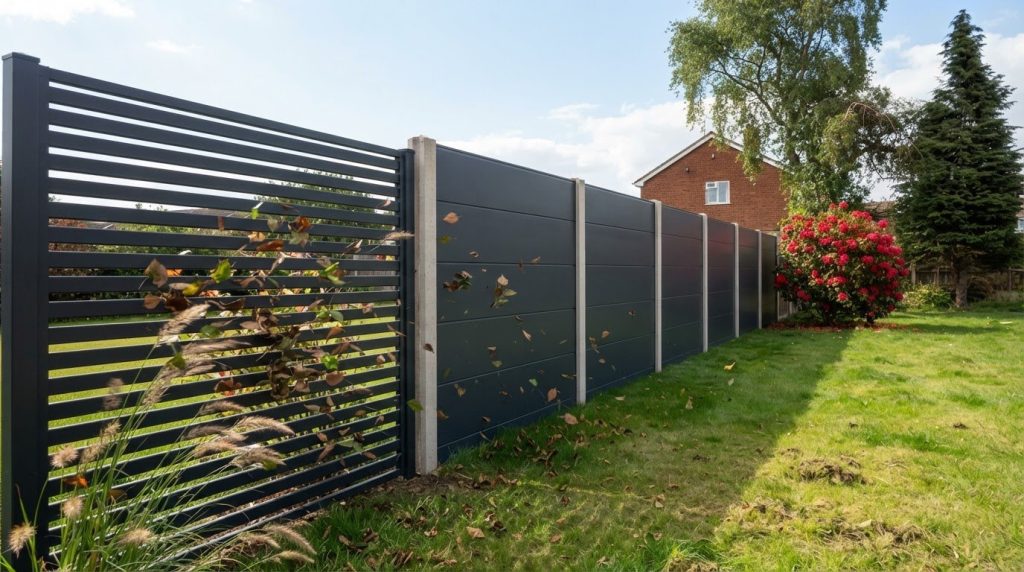
Fencing for Windy Sites: How Slatted Panels Reduce Wind
A fence that allows some wind through can be more resilient than a solid barrier. When choosing fencing for windy and exposed sites, slatted panels let gusts pass through their gaps, while closeboard fencing catches more wind. Neither design suits every boundary: exposure and the strength of the whole fence structure both matter.
It’s understandable to want privacy and a sturdy boundary without worrying about every spell of bad weather. This guide explains how slatted and closeboard fences behave in the wind, why resistance matters, and what separates wind-resistant fencing from a truly windproof design.
You’ll also learn why closeboard fencing needs careful consideration on exposed sites, and how fence height, openings and support affect your choice. By the end, you’ll have a clearer basis for deciding which design suits your garden.
Key Takeaways
- Assess how much air can pass through a fence: slat spacing affects the wind pressure the structure faces.
- Factor in the boundary’s exposure and fence height when weighing privacy against wind resistance.
- Understand why wind-resistant describes reduced wind impact, not a guarantee that a fence is windproof.
- Explore what makes closeboard fencing more vulnerable to gusts and which design choices can help on exposed sites.
Do Slatted Fences Reduce Wind?
Yes. Gaps between slats let gusts pass through, reducing pressure compared with solid closeboard panels. The cost of wind-resistant fencing in the UK depends on the material, panel dimensions, slat spacing, boundary length and whether existing supports can be reused.
Slatted Panels and Airflow
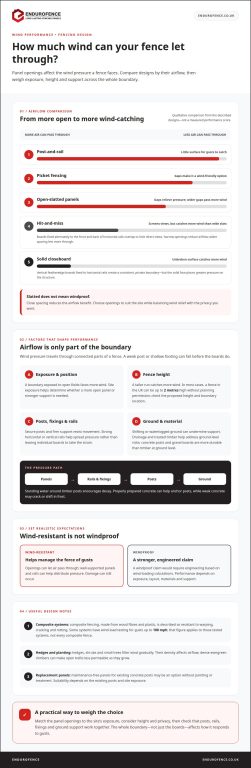
Slatted panels have openings that allow some air to pass through instead of pushing against an unbroken surface. This can reduce strain on panels and posts, particularly in windy areas. Wider gaps generally let more wind through; narrow gaps can make a fence behave more like a solid barrier. For an exposed garden, spacing is a practical design choice as well as a visual one. Timber slatted fencing can provide privacy while retaining airflow, but timber needs regular upkeep to maintain its appearance and strength.
Hit-and-Miss Slatted Designs
Hit-and-miss fencing uses boards fixed alternately to the front and back of horizontal rails. This overlapping arrangement limits direct views while leaving routes for air to pass between the boards. It can suit a garden where privacy matters, but it catches more wind than widely spaced slats. On exposed sites, consider how tightly the boards overlap: narrow openings reduce airflow, while wider spacing lets more air through. The layout determines the balance between screening and wind resistance.
Open Slats Compared with Solid Panels
Open-slatted panels generally face less wind resistance than solid panels because air can pass through the gaps. Solid closeboard fencing catches more wind, placing greater pressure on the structure. In high-wind conditions, an open design is usually more suitable if its spacing and construction match the site’s exposure. Slats do not make a fence windproof, and close spacing reduces their airflow benefit. In UK gardens, balance the privacy you want against the openness needed to relieve wind pressure.
Why Is Wind Resistance Important in Garden Fencing?
Wind pushes against fence panels and transfers force to the posts, fixings and ground around them. In a windy garden, a weak post or shallow footing can fail before the boards do. Strong rails help spread pressure across a panel instead of leaving individual boards to take the strain. Ground that shifts or holds water can also undermine support, so footing design matters alongside the fence material.
Posts need secure depth and firm support to resist movement during gusts. Properly prepared concrete can help anchor them, but weak concrete may crack or shift in frost. Standing water around timber posts encourages decay; drainage and treated timber help address this ground-level risk. Concrete posts and gravel boards are alternatives to consider on exposed boundaries, as they are more durable than timber at ground level.
Height and position affect the forces a fence faces. A taller run catches more wind, so a boundary exposed to open fields may need stronger support or a more open panel design. According to the UK Government, in most cases, a fence in the UK can be up to 2 metres high without planning permission. Check how the proposed height and boundary location relate to that rule before planning a change.
Horizontal or vertical rails can reinforce panels by reducing pressure on individual boards. Composite fencing, made from wood fibres and plastic, is described as resistant to warping, cracking and rotting. Some composite systems have wind-load testing for gusts up to 100 mph, but that figure applies to those tested systems, not every composite fence. Material, support and airflow all contribute to performance.
For an existing concrete-post boundary, maintenance-free panels for concrete posts can offer a replacement option without painting or treatment. Their suitability depends on the existing posts and the site’s exposure.
Wind-resistant versus windproof fencing
Wind-resistant fencing helps reduce the force gusts place on a boundary; windproof suggests a stronger, engineered claim. When choosing fencing for windy and exposed sites, understanding this distinction helps set realistic expectations and guide the design.
Wind Pressure on Fences
Gusts push against a fence’s surface, transferring pressure through its panels and fixings to the posts and ground. A broad, solid barrier gives wind more surface to catch, increasing strain on the structure. Openings let some air pass through, while well-supported panels help distribute pressure. Horizontal rails also support individual boards, reducing the load concentrated on each one.
Wind-resistant describes a design that helps manage this force, not a promise that damage cannot occur. By contrast, a fence described as windproof would require engineering based on wind-loading calculations. The site’s exposure, fence layout, materials and support all affect how it responds to gusts. A sturdy design accounts for the whole boundary, not just the panels.
Hedges and Fence Types
Hedges, shrubs and small trees filter wind gradually rather than stopping it at a solid face. This can reduce turbulence immediately behind the boundary. A hedge can also sit alongside a fence to create a softer screen, though its density affects how much air passes through.
Fence designs differ in how much air they let through. Picket fencing leaves gaps between its pales, making it a wind-friendly option for an open front garden. Post-and-rail fencing offers little surface for gusts to catch, which can suit larger boundaries where views matter. Slatted screening balances privacy with airflow, while solid closeboard panels catch more wind. For fencing for windy and exposed sites, a lower fence with planting or carefully positioned slatted screening may suit a particularly exposed garden better than a high, solid barrier. Dense evergreen climbers can also make open trellis less permeable as they grow.
Close board fencing for exposed sites
Closeboard fencing creates a solid boundary from vertical featheredge boards fixed to horizontal rails, often with gravel boards at the base. This construction provides excellent privacy and a consistent appearance, but its unbroken surface catches more wind than open designs. On an exposed boundary, pressure travels from the boards through the rails and fixings to the posts. The whole structure needs to work together.
Timber closeboard panels can suit gardens where screening matters, but exposure changes the trade-off. Wind cannot pass through solid boards, so gusts place greater force on the fence. Posts are often the point of failure rather than the panels themselves. Secure support, sound fixings and well-supported corners are therefore important, particularly along open boundaries with little shelter.
Ground-level durability is another consideration. Gravel boards separate fence panels from ground moisture, while concrete posts and gravel boards can provide a more durable option than timber at ground level. Pressure-treated timber can improve longevity in different weather conditions, but treatment does not reduce wind pressure. After bad weather, look for loose fixings, split boards, movement around posts and damage to rails.
For a very exposed garden, decide whether complete screening is essential. A lower fence or a more open design can reduce the surface catching gusts; a high, solid run may face greater strain. If you prefer closeboard, sound posts, rails and ground support become especially important. The practical takeaway is to balance privacy and appearance against the boundary’s exposure, rather than assuming solid panels suit every site.
For an existing concrete-post boundary, explore fence panel replacement options as an alternative to rebuilding the whole fence.
EnduroFence
EnduroFence offers a practical option for homeowners replacing worn garden fencing, including on exposed boundaries where panel design matters. Its Maintenance-Free Fence Panels are designed to fit existing concrete posts, so a panel swap can refresh the boundary without replacing those posts. The panels have profiled steel outer sheets on both sides and a high-density insulated core. They are powder-coated, with no painting or treating needed.
For a windy garden, the fence layout and existing supports still matter: a solid panel does not become windproof simply because it is durable. EnduroFence’s Retro Fitting Panel Swap suits homeowners replacing timber panels in compatible existing posts. Installation is straightforward, and no training or qualification is needed.
To discuss your fencing needs, contact EnduroFence.
Plan Your Boundary for the Long Term
Planning fencing for windy and exposed sites is easier when you start with how the garden needs to work, not just the panel style. Consider where you want privacy, which views you want to keep, and how the boundary fits with paths, planting and outdoor seating. These priorities can help you choose a practical solution without solving one concern at the expense of another.
Before deciding, consider whether you’re replacing an existing fence or planning a new layout. The condition of the current boundary and the changes you want to make can guide your next step. A clear idea of your priorities also makes it easier to choose suitable options for your garden.
If you’re ready to consider your fencing options, contact EnduroFence about your fencing. A considered choice can help you create a boundary that works for your garden and feels right for the years ahead.
Frequently Asked Questions
How Do You Build a Fence That Can Withstand Strong Winds?
Plan for the whole boundary, not just the panels. Use posts suited to the ground, firm foundations and secure fixings, then support the boards with properly fitted rails. On an exposed stretch, choose an open design if your privacy needs allow, as gaps reduce the surface catching gusts. Before installation, assess ground drainage and fence height, since both affect the support the structure needs.
What Are the Best Fence Panels for Windy Areas?
Open-slatted panels are a practical choice where reducing wind pressure matters, while hit-and-miss designs offer screening with some airflow. The right fit also depends on your existing posts and desired level of privacy. For example, panels designed for slotted concrete posts can suit a replacement project that keeps those posts. Solid closeboard panels allow less airflow, so their supporting structure needs careful consideration in exposed gardens.
How Do You Stop a Fence Blowing Down?
Start by addressing movement at the posts, since loose or unstable supports can let panels shift during gusts. After severe weather, look for loose screws, split boards, rotten rails and movement around post bases. If panels rattle in concrete post slots, that movement can damage the posts over time. Repair damaged parts and secure loose connections before the next spell of strong wind.
What is the strongest type of garden fence?
There isn’t one strongest fence type for every garden: overall strength depends on the panels, posts, fixings, foundations and ground. A solid panel may be durable yet catch more wind, while a more open design can reduce pressure on the structure. For instance, a well-supported fence matched to firm ground may perform better than a heavier panel fixed to unstable posts.
What types of fencing are best for windy and exposed sites in the UK?
Slatted, picket and post-and-rail designs allow more airflow than solid panels, making them options for exposed boundaries. Hedges and shrubs can also filter wind gradually. Choose according to the site and purpose: an open front garden may suit picket fencing, while a boundary needing privacy may call for carefully spaced slats. A lower fence combined with planting can be an alternative to a tall, solid screen.
How does wind load affect fence design, post spacing and foundations?
Wind load is the force gusts place on a fence, and greater exposure or a taller, more solid design increases the support required. Posts, rails and foundations need to work together to transfer that force into the ground. Weak or shallow footings can shift, while unsuitable spacing leaves panels less supported. Ground conditions and the fence’s openness help guide the design.

Leave a Reply