


How Much Profit Can a Fencing Business Make in the UK?
Turnover isn’t profit. These are estimates, not take-home pay: how much profit a fencing business makes in the UK depends on its costs, workload, business structure and tax position.
The value of booked jobs is only part of the picture. What remains after materials, fuel, tools, insurance and other allowable expenses gives a clearer view of profitability. This article explains the main factors that affect profit, the difference between turnover and taxable profit, and how UK tax and National Insurance can affect what you keep. It also shows how to use annual invoices and expenses to calculate a taxable-profit figure.
Key Takeaways
- Separate turnover from profit by accounting for the costs of running the business before judging its financial performance.
- Track how materials, travel, tools, insurance and workload affect the margin left on each fencing job.
- Understand how allowable expenses and your business structure affect taxable profit and what you take home.
- See how maintenance-free panels and retrofit swaps can be relevant to fencing businesses focused on reducing ongoing upkeep.
How Profitable Is a Fencing Business?
To judge profitability, review individual job results alongside the wider business picture. To understand how much profit a fencing business makes in the UK, look for patterns over time rather than relying on a busy week or month.
Overheads and Business Expenses
Overheads support the business across multiple jobs, while job expenses relate to specific work. Separating them shows whether a job is profitable in its own right or whether wider running costs are affecting the overall result. For example, compare one completed job’s margin with the business’s figures for the same period.
Reviewing a profit-and-loss statement monthly or quarterly can reveal changes in income and spending. One busy period may not show whether work is consistently profitable. Comparing statements across several periods can help identify whether the mix of jobs or operating costs is changing the result.
Allowable Business Expenses
Allowable business expenses are costs that can be deducted when calculating taxable profit. Keep records showing the business purpose of each cost and separate these from personal spending. Clear records make it easier to review the accounts and avoid including costs that should not be treated as business expenses.
Record expenses consistently and review them alongside invoices and completed jobs. A cost tied to a specific project can be assessed against that job’s results, while a shared business cost should be considered across the wider trading period.
Job-level margins offer another useful view. A fencing business guide sets a target of 40-50% profit margin on each job. Treat that as a benchmark for reviewing quotes and completed work, not as a guarantee of what every job will return. The materials, labour required and scope of each project shape its result.
Compare the quoted scope with the work completed. If a job takes longer than expected or needs extra materials, record why alongside the final figures. Reviewing different types of work can show which estimates need refining and which jobs meet the business’s margin aims.
Look at trends, too. Reviewing six months of profit-and-loss statements can give insight into a fencing business’s longer-term health. This helps distinguish a one-off change from a continuing pattern and provides a stronger basis for planning than relying on one unusually good or poor period.
So, how much profit does a fencing business make in the UK? For an individual contractor, the practical answer comes from tracking job margins and reviewing business records over time, then using that information to guide pricing and workload decisions.
Factors affecting fencing business profitability
Profit depends on more than the number of jobs completed. Job type, materials, travel, labour and payment arrangements all affect what remains after costs. Comparing similar jobs helps reveal which types of work support a stronger margin.
Materials and job scope: A quote needs to account for the materials required for the specific boundary, as well as labour and waste. Replacing a short garden fence is different from installing a long run with changes in ground level or access. If the scope changes once work begins, extra materials or time can reduce the margin unless the price is adjusted accordingly.
Travel and scheduling: A job’s location affects fuel use and travel time. Grouping nearby bookings can make better use of working hours than travelling between distant sites for separate small jobs. Allow for time spent collecting materials and moving equipment, too. These hours affect how much paid work fits into the week.
Labour and capacity: The number of people available, their skills and the work involved all affect how long a job takes. A contractor working alone may handle a straightforward repair efficiently, while a larger installation may need additional labour. More bookings help only if the work can be completed without raising labour costs or delaying other jobs.
Quoting and rework: Accurate measurements and a clear scope reduce the risk of overlooking materials, access issues or finishing work. A quote that includes removing old fencing, for example, is different from one covering replacement panels only. Avoidable return visits use time and materials that could otherwise go towards another paid job.
Payment and CIS deductions: Timing affects cash available for wages, materials and fuel, even when a job is profitable on paper. In the UK, a registered CIS subcontractor in the fencing trade has 20% deducted from their labour payments, according to HM Revenue & Customs. That deduction affects the payment received, so contractors need to account for it when managing cash flow and tax records.
Review each completed job against its quote, comparing the planned scope with materials used, labour time and travel. Record the reason for any difference, such as extra work agreed with the customer or an unexpected return visit. Comparing multiple jobs can show whether pricing, scheduling or job selection is putting pressure on profit.
Material performance can also shape the work a fencing business takes on. For example, maintenance-free fence panels may suit customers looking to replace timber panels while keeping existing concrete posts.
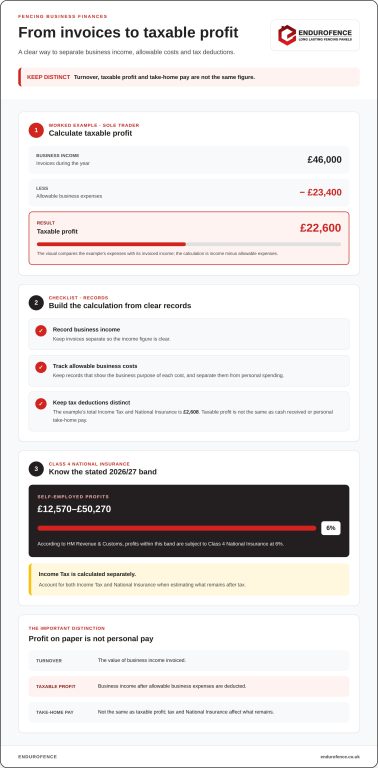
How fencing contractors calculate taxable profit
For a sole trader, taxable profit is generally calculated by subtracting allowable business expenses from business income. A worked example starts with £46,000 invoiced during the year and deducts £23,400 in allowable expenses, leaving £22,600 taxable profit.
That £22,600 is not the same as cash received or personal take-home pay. In the example, total Income Tax and National Insurance are £2,608. Keep the calculation clear by separating invoices, business costs and tax deductions in the records.
For 2026/27, UK self-employed profits between £12,570 and £50,270 are subject to Class 4 National Insurance at 6%, according to HM Revenue & Customs. Income Tax is calculated separately, so a contractor needs to account for both when estimating what remains after tax.
A limited company’s accounts distinguish company profit from the money its owner receives personally. The estimates discussed earlier place limited-company earnings above sole-trader earnings, but that comparison alone does not show which owner keeps more. Business costs, taxable profit and how money is taken from the company all affect the outcome.
Contractors working through the Construction Industry Scheme should also distinguish deductions from expenses. An unregistered CIS subcontractor in the fencing trade has 30% deducted from labour payments, according to HM Revenue & Customs. The deduction reduces the payment received at the time; it is not a cost of materials or labour for calculating job profit.
For example, if a subcontractor completes a fencing job, record the labour income and CIS deduction separately. This keeps the job’s revenue visible while explaining why the amount received may differ. Mixing deductions with expenses can distort the profit calculation and make it harder to match payments to invoices.
Insurance, licensing and health-and-safety arrangements are separate from the tax calculation. Insurance premiums, relevant training and protective equipment can affect operating costs; requirements and costs depend on the work and contractual arrangements. Include applicable business costs in the accounts, but keep them distinct from tax withheld through CIS.
A practical record-keeping sequence is:
- Record each invoice and the income it represents.
- Log business expenses separately, with their purpose and supporting records.
- Show CIS deductions apart from both income and expenses.
- Subtract allowable expenses from income to calculate taxable profit, then account for tax and National Insurance.
This separation makes it easier to see whether a job generated a margin and how much tax remains due. For customers replacing fencing, explore maintenance-free panel options as a distinct product choice.
EnduroFence
EnduroFence offers homeowners and fencing businesses Maintenance-Free Fence Panels, EnduroSmart Post Covers and Retro Fitting Panel Swap for replacing or upgrading garden fencing. For contractors assessing which work fits their business, the steel panels provide an alternative to standard timber panel replacement. They are designed to fit existing concrete posts, with no painting or treating needed.
Choose products according to the job and the customer’s needs, and account for materials, labour and other costs when preparing a quote. EnduroFence also offers a franchise opportunity for people exploring a fencing business, rather than estimating profit for an existing operation.
For more information about the options available, contact EnduroFence.
Build your next business decision around the numbers
The question of how much profit a fencing business makes in the UK is most useful when it informs a practical decision. Use job records to identify work that suits your capacity, then consider whether your current offer meets the needs of your target customers. Understanding costs and demand can help you plan carefully rather than taking on more work without assessing its effect on the business.
For fencing businesses and homeowners considering a different approach to garden boundaries, EnduroFence offers maintenance-free options, including panels, post covers and retrofit panel swaps. These can suit customers who want to replace panels while keeping their existing concrete posts.
Contact EnduroFence to discuss fencing and explore the options that may suit your next project. A considered next step can help you move forward with greater clarity.
Frequently Asked Questions
What is the average annual profit of a fencing business in the UK?
These are calculated estimates, not a guaranteed average for every business. What an individual contractor keeps depends on their actual workload, costs, business structure and tax position.
What are typical profit margins for UK fencing contractors?
There isn’t a verified typical margin that applies to every UK fencing contractor. A fencing business guide gives a 40-50% profit margin on each job as its target, rather than a national average. To assess a job, compare its income with materials, labour, travel and other costs directly linked to the work. Different job scopes can produce different margins.
What are the typical materials and labour costs for a fencing job in the UK?
Materials and labour costs vary from job to job. The total depends on fence length, chosen materials, ground conditions, access, removal of existing fencing and the time needed to complete the work. A hard-to-access boundary, for example, may require more labour than a straightforward replacement. A useful estimate sets out material quantities and labour time separately.
What are the startup costs for a fencing business in the UK?
Startup costs depend on the equipment and business resources the contractor already has. A new operation may need to budget for a vehicle, fuel, tools and insurance, as well as setting up records and arranging supplies. Starting with equipment already on hand is different from buying everything at once. List essential purchases separately from ongoing expenses to understand the initial funding required.
How do UK fencing business profits vary by region and demand?
Profit can vary with demand, the types of fencing customers request and how efficiently the contractor schedules work. A busy order book does not automatically mean higher profit if jobs involve long journeys, difficult access or costly materials. Compare similar jobs and track travel and labour time to understand how the work mix affects what remains.
What ongoing overheads affect a UK fencing contractor’s profit?
Ongoing overheads include vehicle running costs, fuel, tools and insurance. Their impact depends on how often the business uses its vehicle and equipment, and how costs are spread across completed jobs. A tool replacement, for example, affects the business even if the tool is used on several jobs. Consistent records help distinguish general running costs from expenses tied to an individual job.

Leave a Reply