

Garden Fence Height Regulations UK: Check Your Limits
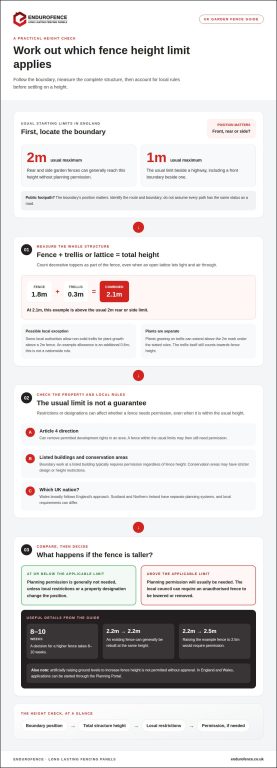
Back-garden fences can generally be up to 2 metres high without planning permission, while the usual limit beside a highway is 1 metre. These garden fence height regulations in the UK depend on where the boundary is and which part of the UK your home is in.
It’s easy to assume one height limit applies throughout a garden, but the rules can differ for front boundaries and those beside roads or public footpaths. Understand the distinction before choosing a fence height to avoid surprises.
This guide covers the usual limits for front and back gardens, how roads and public footpaths affect them, and where rules differ across the UK. It also explains when local restrictions may apply, so you can identify the factors to consider before deciding on a fence height.
Key Takeaways
- Rear and side garden fences can generally reach 2 metres without planning permission, but local restrictions may affect the limit.
- Front boundaries beside a highway usually have a lower limit, so the boundary’s position matters when planning a fence.
- Rules differ across the UK: Wales broadly follows England’s approach, while Scotland and Northern Ireland have separate planning systems.
- Include any trellis or lattice in your height calculations, and check whether local rules allow an exception.
How High Can a Garden Fence Be Without Planning Permission?
In England, rear and side garden fences can generally reach 2 metres without planning permission. The usual maximum beside a highway is 1 metre. These garden fence height regulations UK homeowners rely on are a starting point, because local restrictions and property designations can change the outcome.
Permission for Taller Fences
A fence above the permitted height usually needs planning permission from the local council. In England, the Town and Country Planning (General Permitted Development) Order 2015 is the legal basis for these rules, according to The National Archives. This matters if you plan a taller boundary or add a structure that increases its total height.
An Article 4 direction can remove permitted development rights in an area, according to the Local planning authority. Even a fence within the usual limits may then need permission. Applications in England and Wales can be started through the Planning Portal. A decision for a higher fence takes 8-10 weeks.
Designated Properties and Existing Boundaries
Special designations and a property’s history can affect permission. Boundary work at a listed building typically requires permission regardless of fence height. Conservation areas may also have stricter design or height restrictions. The garden fence height regulations UK property owners need to consider therefore depend on more than the fence’s measured height.
Existing fences can generally be altered, maintained or improved without planning permission. For example, an existing 2.2-metre fence can be rebuilt at the same height, while raising it to 2.5 metres would require permission. Artificially raising ground levels to increase fence height is not permitted without approval.
For a fence between neighbouring properties, ownership depends on the boundary and property deeds. A neighbour cannot require you to lower a fence at or below the applicable limit if it breaches neither local planning policies nor the deeds. The owner is responsible for maintaining a fence located solely on their property.
If a fence exceeds the permitted height, the council can require you to lower or remove it. You can reduce it to the applicable limit or apply for permission to keep a taller structure.
Do these fence height rules apply everywhere in the UK?
There is no single planning system for every UK nation. Wales follows a framework very similar to England’s standard fence-height rules, while Scotland and Northern Ireland have separate planning systems. Usual limits are a starting point, not a guarantee that every fence or topper is permitted.
That difference matters when planning trellis or lattice panels. A topper adds to the fence’s overall height, so measure the fence and addition together. For example, a 1.8-metre fence panel with a 0.3-metre trellis reaches 2.1 metres, above the usual 2-metre limit.
In England, trellis added to a rear or side fence should generally keep the combined height at or below 2 metres to avoid planning permission. The same calculation applies to decorative fence toppers: an open lattice still adds height, even if it allows light and air through. Check the boundary’s position as well, because the lower limit beside a highway may apply instead.
Some local authorities allow non-solid trellis for plant growth above a 2-metre fence. One example of the allowance described is an additional 0.6 metres, but this isn’t a nationwide rule. Local restrictions and the specific planning area determine whether that exception applies.
Conservation areas and listed buildings can bring additional design or height restrictions. An Article 4 direction can also remove permitted development rights in an area. In those cases, even a trellis within the usual limit may need an application or other permission from the local planning authority.
Plants growing on trellis can extend above the 2-metre mark without a permit, according to the stated rules. That does not mean the trellis itself is exempt from the fence-height calculation. Treat the structure and the planting separately, and account for the full fence-and-trellis height before choosing a topper. England, Wales, Scotland and Northern Ireland can apply different local requirements.
Maximum fence heights for front gardens and boundaries beside roads or public footpaths
Front boundaries generally have a lower height limit than back gardens. The boundary’s position matters, particularly when it is beside a road or public footpath.
Front Garden Fence Limits
In England, the usual maximum without planning permission is 1 metre beside a highway. A 6ft front-garden fence is usually above this limit and requires planning permission. This is why a fence that fits the usual back-garden allowance may not suit a front boundary.
Before installing a fence, identify which side faces the highway and measure the proposed height, including the full structure. If it is taller than the applicable limit, you may need planning permission from the local council.
Boundaries Beside Roads and Footpaths
For a boundary beside a road, the key distinction is whether it falls under the highway limit. In England, fences above the usual 1-metre front-garden or roadside limit will usually need planning permission. A public footpath beside your garden also makes the boundary location important.
Don’t assume every path has the same status as a road. Identify the route and boundary before choosing a height, then establish which limit applies. This can help you avoid planning a fence that exceeds the relevant allowance.
Fences Beside Vehicle Highways
A vehicle highway beside a front garden is subject to the usual 1-metre limit in England. A taller fence will usually need planning permission, so account for that before settling on a design. The same issue arises when adding height to an existing boundary.
For example, a 6ft fence at the front of a property is usually above the limit. A taller design may still be possible with permission from the local council, but it shouldn’t be treated as automatically permitted.
A garden room or shed doesn’t change the position of the fence boundary. Treat the proposed building and fence as separate parts of the layout, and assess the boundary height against the road or footpath limit. If the fence exceeds that limit, planning permission is usually required.
Maximum fence heights for back gardens
For a typical back garden, a fence can generally be up to 2 metres high without planning permission. This usual maximum is a useful starting point, but the boundary’s position and property restrictions can change the answer. A back boundary beside a highway, for example, may fall under the lower roadside limit instead.
Measure the full fence height from ground level, including additions that form part of the structure. On sloping ground, height can vary along the boundary, so assess the slope rather than relying on a single measurement. Some councils allow slight variations for steep gradients, but this allowance is not universal.
Check whether the property is in a conservation area or has an Article 4 direction. These restrictions can remove or limit permitted development rights, meaning the usual 2-metre allowance may not apply. Local planning policies can also affect a proposal, even when the fence is within the standard maximum.
Material and design matter too. A planning application might be needed for a brick, stone or concrete boundary structure. If you want a taller fence, planning permission will usually be required; in England and Wales, applications can be started through the Planning Portal. A higher fence decision takes 8-10 weeks.
Keep the practical takeaway clear: use 2 metres as the usual back-garden ceiling, then account for the highway, ground slope and local restrictions. Changes to ground levels can affect how fence height is assessed, so check the requirements before carrying out work. A fence above the applicable limit can lead to council enforcement, including a requirement to lower or remove it.
If you’re planning a back-garden boundary, explore maintenance-free fence panel options once you’ve established the height that applies to your property.
EnduroFence: Maintenance-Free Fence Panels
EnduroFence sells maintenance-free steel fence panels for homeowners replacing timber panels while keeping their existing concrete posts. The panels have profiled steel outer sheets on both sides and a high-density insulated core. They are powder-coated, with no painting or treating needed.
The Retro Fitting Panel Swap is designed for boundaries where existing concrete posts can be reused. The panels slot into compatible posts, and no additional tools, training or qualifications are needed. EnduroFence also sells post covers to finish existing posts.
Establish the permitted height for your boundary before choosing panels, especially beside a highway or in an area with local restrictions. Explore EnduroFence Maintenance-Free Fence Panels and the Retro Fitting Panel Swap to find an option for your existing concrete posts.
Plan your next fence with confidence
Understanding garden fence height regulations in the UK is a useful starting point. Next, consider how your boundary should work day to day: the balance you want between privacy, light, appearance and upkeep. Think about how the fence will sit alongside planting, seating and access, rather than choosing a panel in isolation. Knowing what matters most can help you shape a design that suits your garden.
Before settling on a solution, note which part of the boundary you’re updating, the look you want and any practical constraints around the existing structure. This gives you a clearer basis for weighing suitable options. Connecting the planning rules with your priorities can help you choose a fence that fits your home and routine while serving its intended purpose.
If you’re ready to explore an update, ask EnduroFence about your fence. A thoughtful next step can help you move towards a boundary that works well for your garden.
Frequently Asked Questions
How is fence height measured, and what about slopes?
Measure vertically from ground level on your side of the boundary; on sloping ground, use the lower natural ground level. Don’t add soil to raise the starting point and make a fence appear shorter. If the slope changes along the fence, note the different ground levels and assess the height at those points, rather than relying on one measurement for the whole boundary.
When does the 1 metre fence rule apply?
In England, the usual 1-metre limit applies to a fence beside a highway, including a front-garden boundary. A fence higher than this will usually need planning permission. For example, a 6ft fence at the front of a property beside a highway is usually above the limit. The boundary’s position is the key factor, not simply whether the fence faces the street.
Can my neighbour force me to lower my fence?
A neighbour cannot legally require you to lower or remove a fence at or below the applicable height limit if it breaches neither local planning policies nor property deeds. The position may differ if a restriction applies or the fence exceeds the relevant limit. Check your property deeds and confirm the boundary before deciding who is responsible for a fence.
Do you need permission to replace an existing fence?
Replacing an existing fence at the same height can generally be done without planning permission. For example, an existing 2.2-metre fence can be rebuilt at that height. The usual limits and local restrictions still matter, so a boundary beside a highway or in a conservation area may have different requirements. Raising the fence instead of replacing it at its existing height can change the permission position.
Does adding trellis to a 2m fence need permission?
Usually, yes, if the trellis takes the combined structure above 2 metres. Add the trellis height to the fence height: a 1.8-metre fence with a 0.3-metre trellis totals 2.1 metres. Some local authorities allow non-solid trellis for plants above a 2-metre fence, but this isn’t a nationwide exception. The property’s location and local restrictions determine whether that allowance applies.
How do I find local rules and restrictions for fencing?
Contact your local planning authority to find out whether local restrictions or an Article 4 direction affect your property. Check property deeds for covenants that may set a separate fence-height limit. Conservation-area or listed-building status can also bring additional requirements. If the property is in Scotland or Northern Ireland, account for its separate planning system rather than assuming England’s rules apply unchanged.

Leave a Reply