

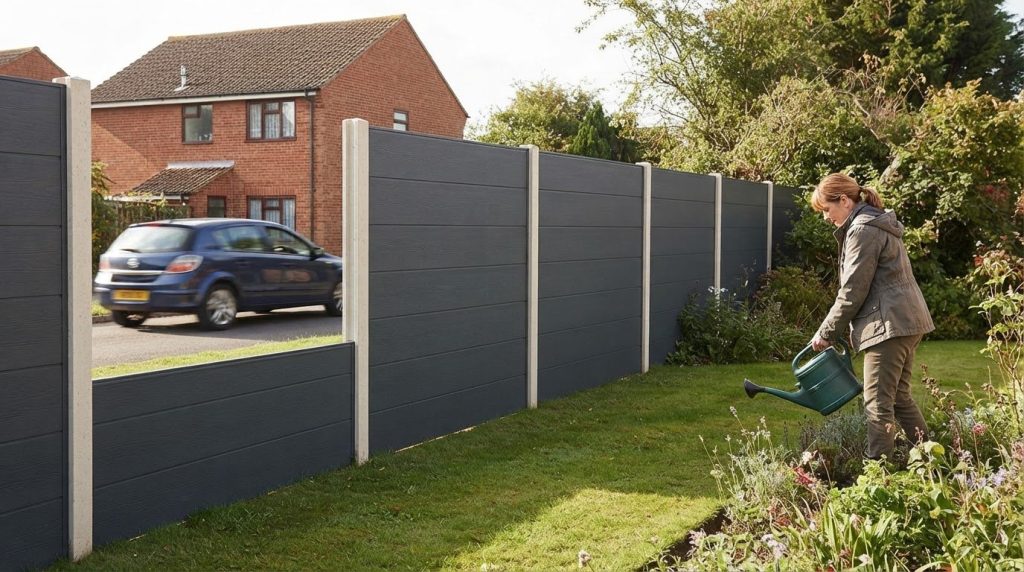
Fence panels to reduce traffic noise with closeboard options
A solid, gap-free fence can reduce traffic noise by blocking its path into your garden. A correctly installed closeboard fence around 1.8 metres high is estimated to reduce noise by 5dB to 10dB, although it won’t eliminate it entirely. Choosing fence panels to reduce traffic noise means considering their height, density and how closely they fit together.
A taller fence might seem like the obvious answer, but it also needs to block the line of sight between your garden and the road. Gaps let sound through, so the best fence panels to reduce traffic noise create a continuous barrier rather than relying on height alone.
This guide explains how acoustic fencing and closeboard panels can help, how fence height affects noise reduction, and which UK height rules to consider. You’ll also learn how fence panels to reduce traffic noise can fit an existing garden boundary.
Key Takeaways
- Prioritise a solid, continuous barrier: gaps can let traffic sound pass through and weaken its effect.
- Closeboard and feather-edge designs can help when boards meet closely and the fence is kept in good condition.
- Plan the fence to interrupt the line of sight between the road and your garden, while allowing for boundary height rules.
- Explore how barrier placement and surrounding planting can work together to make your garden feel quieter.
1. Does Acoustic Fencing Really Work?
Yes. A solid acoustic barrier interrupts the direct route between traffic and your garden. It reflects some sound towards its source, leaving a quieter acoustic shadow behind the fence. Purpose-built acoustic barriers can help reduce noise, although the result depends on their construction and installation. The result depends on the barrier’s construction, position and continuity.
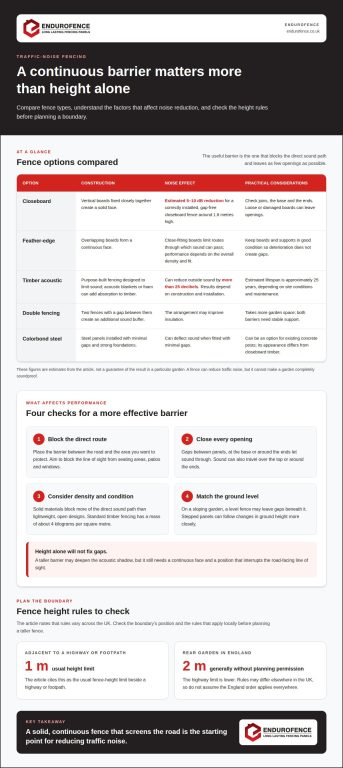
Acoustic fencing is designed specifically to limit sound; ordinary timber fencing is a general boundary that may leave gaps. Garden noise barriers are the broader category, including solid timber, concrete or composite structures. Timber acoustic fencing can reduce outside sound by more than 25 decibels, while a timber fence alone may perform differently according to its density and fit.
Construction matters. Solid panels with few gaps prevent sound from passing directly through. Acoustic blankets or foam can add absorption to timber. A reflective barrier sends sound back towards the busy road, while its mass and closed joints help block transmission. For an effective installation, position the barrier between the road and the area you want to protect, and avoid openings at the base or between panels. Sound can still travel over the top or around the ends.
In the UK, the total cost depends on the material, fence height and length, ground conditions, access and installation work. A short run of timber panels and a purpose-built acoustic barrier involve different materials and construction, so there is no single price for every garden. Reusing suitable existing posts can also affect the work required.
Choose based on the route the noise takes, not just the panel label. For example, a continuous barrier along the road-facing boundary can create a more useful acoustic shadow than isolated panels with open gaps. Acoustic panels can reduce traffic noise, but they don’t make a garden completely soundproof. They help by blocking the direct path and limiting the sound that reaches the space behind them.
2. Closeboard and feather-edge fencing for noise reduction
Closeboard fencing uses vertical boards fixed closely together, while feather-edge boards overlap to form a continuous face. That solid construction limits routes through which sound waves can pass. Standard timber fencing has a mass of about 4 kilograms per square metre, so board thickness, gaps and overall construction matter when judging its noise performance.
For a busy-road garden, examine the whole boundary, including joins, the base and the ends. Loose boards or a deteriorating section can leave openings that reduce the barrier’s effectiveness. Timber acoustic fencing has an estimated lifespan of approximately 25 years, depending on site conditions and maintenance. Keep boards and supports in good condition so damage does not create gaps.
A tall, solid fence catches wind, placing strain on its panels, posts and foundations. Secure construction helps manage that load. Check for loose boards, leaning posts and damaged sections to keep the barrier in good condition. In the garden, timber can suit a traditional boundary, while planting in front can soften its appearance. Shrubs and climbing greenery can also help absorb sound and reduce echo around the fence.
Double fencing can add a sound buffer: two fences separated by a gap may improve insulation. The arrangement takes more garden space, and both barriers need stable support. Colorbond steel fencing can deflect sound when installed with minimal gaps and strong foundations, though its appearance differs from closeboard timber.
Local rules can affect fence height, materials and position, so plan the design around the boundary and nearby highway. There is no automatic UK grant for every garden noise barrier. Any local council support depends on a specific scheme and its eligibility criteria.
For existing concrete posts, steel panels can provide an alternative to replacing the whole boundary. Explore steel fence panels for existing posts as one option for a garden retrofit.
3. Fence height and breaking line of sight
A fence reduces direct traffic noise most effectively when it blocks the line of sight between the road and the space you use. Imagine sitting on a garden bench: if you can see the road over the fence, sound can travel over it too. Raising the barrier may deepen the acoustic shadow, but height alone won’t fix gaps or openings at the sides.
Density matters as well as height. A continuous boundary made from solid materials blocks more of the direct sound path than a lightweight, open design. Consider the position of patios, seating areas and windows, then align the barrier to screen them from the road. Sound may still travel around the ends, so the boundary’s length and layout also affect the result.
Height is subject to planning rules. According to UK Government, the usual fence-height limit is 1 metre where a fence is adjacent to a highway or footpath. UK Government identifies The Town and Country Planning (General Permitted Development) (England) Order 2015 as the regulation relevant to UK fence-height limits. In England, rear garden fences are generally limited to 2 metres without planning permission, while the highway limit is lower.
Check how the boundary meets the highway before planning a taller noise-blocking solution. The road-facing position, boundary line and proposed materials all matter. A fence beside a footpath may face a different height constraint from one deeper inside a rear garden. Rules also vary across the UK, so don’t assume the England order applies everywhere.
Keep panels aligned and close to the ground during installation, since gaps can undermine the acoustic effect. A sloping garden may leave openings beneath a level fence; stepped panels can follow changes in ground height more closely. Plan the fence’s position and height together so it blocks the road view from the areas where you spend time.
4. How fences can reduce traffic noise
A fence reduces road noise by interrupting the path sound takes from traffic to an outdoor space. Its solid structure reflects some sound towards the road and creates a quieter area behind it. Noise may still travel over the top, around the ends or through openings, so a fence can reduce traffic noise but cannot eliminate it. With constant traffic, the practical aim is to lower the sound reaching the places you use.
A correctly installed 6ft (1.8m) closeboard fence is estimated to reduce noise by approximately 5dB to 10dB. A 10dB reduction is described as effectively cutting the perceived volume of traffic in half. These figures show why a continuous barrier can make a noticeable difference, whilst also setting a realistic expectation: the effect depends on the route sound takes and how completely the fence blocks it.
Position influences performance. A fence closer to the road can block more sound before it enters the garden. Gaps beneath panels, between boards or at a gate leave direct routes for sound, so make the boundary continuous. Trellis toppers provide almost no noise reduction; adding height with an open structure won’t replace a solid barrier.
Improve the outdoor space by combining a solid fence with dense greenery. Hedges, bamboo and climbing vines can absorb sound waves and reduce echo around the boundary. Shrubs can also soften the fence’s appearance, while a water feature masks some remaining traffic noise. Earth mounds or raised garden beds can work alongside fencing, adding another obstruction between the road and seating areas.
For a practical starting point, focus on a solid, well-fitted boundary, then consider planting or raised beds where they suit the garden. Explore options for reducing garden traffic noise as you plan the combination.
EnduroFence: Maintenance-Free Fence Panels
EnduroFence’s Maintenance-Free Fence Panels are designed for homeowners replacing timber panels in suitable existing concrete posts. Each panel has profiled steel outer sheets on both sides and a high-density insulated core, creating a solid boundary. No painting or treating is needed.
A continuous fence can help block a direct route for traffic sound, so replacing damaged or open panels may be a practical step. EnduroFence’s Retro Fitting Panel Swap lets homeowners replace panels while using existing concrete posts. The panels are designed for straightforward installation, and no training or qualification is needed. Their construction is durable and weather-resistant, but they do not promise complete soundproofing; placement, height and gaps still affect how a fence performs.
If you’re considering a panel replacement for your garden boundary, contact EnduroFence to discuss your project.
Plan a quieter garden that suits your space
Make your next step a clear plan for the boundary you want to improve. Before choosing fence panels to reduce traffic noise, decide which part of the garden needs a calmer feel and how the fence should fit your space. This gives you a practical basis for weighing appearance, upkeep and the existing boundary, rather than treating sound reduction as the only design decision.
Think about how you use the garden throughout the day. Seating, play areas and planting can help determine where a boundary change makes most sense. If you’re replacing an existing fence, consider whether a panel swap fits your plans. The right fence panels to reduce traffic noise should work with the garden’s layout as well as its boundaries.
Ready to discuss your fencing project? Contact EnduroFence about noise-reducing fencing and take the next step towards a garden that feels more comfortable.
Frequently Asked Questions
How to Reduce Traffic Noise in Your Backyard?
Start by identifying where traffic noise is most intrusive, such as a patio beside the road-facing boundary. A solid fence can screen that area; planting and a water feature can complement it by absorbing or masking some sound. Close openings at gates and panel edges, and position seating behind the barrier. This combination can reduce noise without making any one measure a complete soundproofing solution.
Does Acoustic Fencing Really Work?
Yes, acoustic fencing can make a road-facing garden quieter by intercepting sound between its source and the listener. It is most useful for areas directly screened by the barrier, such as a seating space behind the boundary. Traffic remains audible where sound travels over or around the structure, so consider the part of the garden you use most when planning the barrier.
How long will it last?
Timber acoustic fencing has an estimated lifespan of approximately 25 years, with site conditions and maintenance affecting its lifespan. EnduroFence Maintenance-Free Fence Panels have profiled steel outer sheets and a high-density insulated core, and need no painting or treating. These are different materials, so the timber estimate applies to timber fencing, not steel panels.
How effective are fence panels at reducing road traffic noise?
A correctly installed 6ft (1.8m) closeboard fence is estimated to reduce traffic noise by approximately 5dB to 10dB. The reduction you experience depends on whether the fence screens the part of your garden you use and whether sound travels around its ends. It won’t create silence: traffic can still be heard where sound reaches the garden over or around the fence.
What fence height and construction best reduce traffic noise?
A 1.8m (6ft) solid closeboard fence is recommended as a minimum height for effective noise mitigation. It should be continuous, securely installed and positioned to screen the area used from the road. According to UK Government, the usual limit is 1 metre beside a highway or footpath. UK Government identifies The Town and Country Planning (General Permitted Development) (England) Order 2015 as relevant to fence-height limits.
Do acoustic fence panels need to be solid and gap-free?
Yes. Sound can pass through visible gaps, so acoustic panels should form a continuous surface at joins, gates and the bottom edge. Close-fitted closeboard fencing can also create a solid boundary. Pay particular attention to uneven ground: a gap beneath a panel can leave a direct route for traffic noise into the garden, even when the rest of the fence is intact.

Leave a Reply