

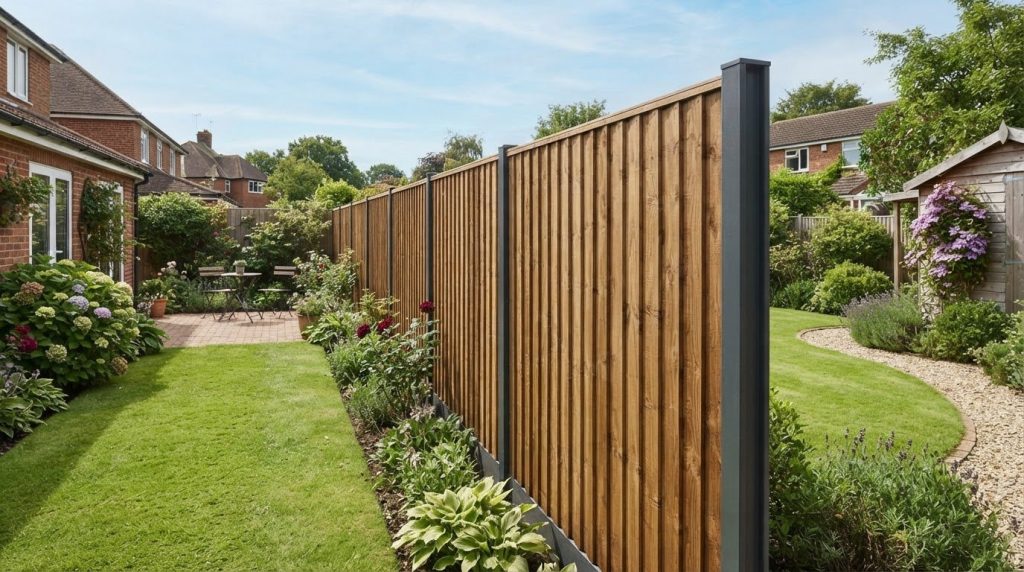
Hand-Made Double-Sided Closeboard Fence Panels
A shared garden boundary doesn’t have to leave one neighbour facing the fence’s less finished side. Fence panels that look good on both sides give both gardens a considered appearance. In the UK, there’s no universal rule that the finished side must automatically face the neighbour; ownership and responsibility can depend on title deeds and boundary agreements.
It’s understandable to want a boundary that feels fair as well as looking right from your own garden. Double-sided closeboard panels offer a practical way to achieve that, with a consistent appearance on either side.
Learn how double-sided panels are arranged, what to consider for a shared boundary, and how they compare with single-sided panels. This guide also covers options for updating an existing fence.
Key Takeaways
- Double-sided closeboard panels have boards on both faces, creating a finished look from either garden.
- Before changing a shared boundary, use title deeds and any boundary agreements to understand ownership and responsibility.
- Compare how the boards and supporting rails are arranged to judge whether a panel will look consistent from both sides.
- If you want to replace timber panels in existing concrete posts, EnduroFence’s maintenance-free steel panels are designed to fit them.
Hand-made double-sided closeboard fence panels
Hand-made closeboard panels use boards on both faces, creating a consistent finish across a shared boundary. Available heights include 90cm, 120cm, 150cm, 165cm and 180cm, so measure the space before choosing.
Double-sided panel designs
Look for panels with boards arranged on both faces, rather than a single boarded face with exposed rails. In double-sided feather edge designs, boards are fixed alternately on either side of the supporting rails, giving both gardens a similar view. Compare the board layout and overall height, then consider how the panel will sit alongside existing fencing, gates and garden features.
For example, a 150cm panel may suit a boundary where a taller 180cm option would feel out of proportion. The best design is the one that fits the boundary and provides the finish you want from both gardens.
Prices for double-sided panels
Price depends on a panel’s height, design and construction, so compare like with like rather than relying on the word “closeboard” alone. Taller panels use more material, and hand-made construction can also affect the quoted cost.
When comparing prices, check that each quote covers the same panel size and design. Separate the panel cost from any listed posts, fixings or delivery charges. This makes it easier to assess the total materials cost without assuming that similar product descriptions include the same items.
To install a double-sided panel, position it between suitable posts, align it to the required height and secure it with compatible fixings. Check that the panel is level before tightening them.
Choose posts that can support the panel’s dimensions and weight, and fixings suited to both the posts and the panel construction. Check that the fittings suit the design and don’t obstruct the boards or rails.
Fence panels for shared garden boundaries
On a boundary between two gardens, a double-sided panel gives each neighbour a finished face. Neither garden has to look at exposed rails or the less decorative side of a conventional panel. It’s a practical choice when both households care about the view from their outdoor space.
In the UK, there’s no universal rule that homeowners must automatically give their neighbour the finished side. Fence ownership and responsibility can depend on title deeds, boundary agreements and other legal documents. The belief that the right-hand fence belongs to you when facing your property from the front isn’t a universal rule either. Before replacing a boundary, review the documents relating to that property.
Yes, applicable fence-height rules still matter for a double-sided panel. The two-sided design affects the panel’s appearance, not its height category. Consider the fence’s position and proposed height when assessing the relevant requirements for your boundary.
For neighbours, the main advantage is visual fairness: both gardens face boards rather than one side showing exposed rails. This can make a shared boundary feel more considered, especially where patios or seating areas face the fence. A potential drawback is that both households may need to agree on the design and replacement arrangements. The two finished faces don’t determine who owns the fence or is responsible for it.
Traditionally, a standard fence may have its finished face towards the neighbouring property, leaving rails on the owner’s side. Arrangements vary, so don’t assume that convention establishes ownership. If a boundary fence needs replacing, first review the documents that describe it, then discuss the panel’s appearance with your neighbour. Agreeing on the design and position before work begins can prevent disagreements about the shared view.
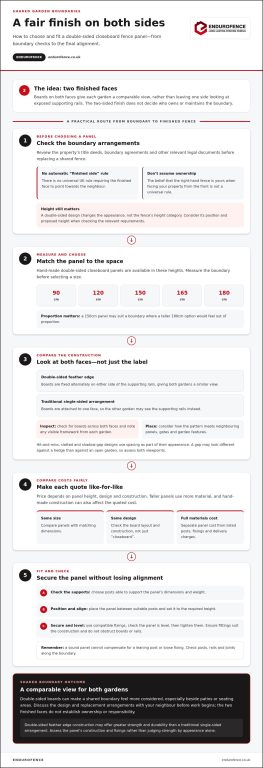
Which UK fence panels look the same on both sides?
Double-sided feather edge panels are designed to give both gardens a comparable view. Their boards alternate across the supporting rails, unlike traditional feather edge panels, where boards are attached to one face. That changes what each neighbour sees. If you want fence panels that look good on both sides, check the board arrangement rather than relying on the product label alone.
Traditional panels can look finished from one garden while showing supporting rails from the other. For example, a patio beside the boarded face may have a different outlook from a neighbouring seating area facing the rails. Compare both faces to see the difference before choosing a replacement.
Double-sided panels can be fitted either way round because both faces look alike. That makes orientation less of a concern during fitting, but alignment with adjoining panels, gates and posts still matters. At a corner, compare the pattern from both directions so the join looks deliberate.
Use these checks when comparing UK panel designs:
- Look for boards arranged across both faces, rather than all fixed to one side.
- Check whether the boards alternate across the supporting rails.
- View the panel from both gardens and note any visible framework.
- Compare how its pattern meets nearby fencing and gates.
Hit-and-miss, slatted and shadow-gap designs use spacing as part of their appearance, so assess how the pattern looks from each side. A visible gap, for example, may look different against a hedge than against an open garden. Fence panels that look good on both sides should suit both viewpoints, not just the side nearest your patio. Inspecting a sample or a clear view of each face can help you judge the finish before choosing.
Are double-sided fence panels as strong as standard ones?
Double-sided feather edge panels can offer greater strength and durability than a traditional single-sided arrangement. Boards fixed alternately across supporting rails create a different construction from boards attached to one face. Compare the panel’s construction and fixings rather than judging its strength by appearance alone.
Durability also depends on the condition of the fence as a whole. A sound panel can’t compensate for a leaning post or loose fixing. Before replacing a section, inspect the posts, rails and joints along the boundary. If a post moves when you press the panel, for example, include that support issue in the replacement plan.
Installation affects how well a panel stays in place. Set it level between suitable posts, then use fixings that suit the panel and its supports. Make sure each fixing is secure without forcing it through a board. Uneven positioning or loose connections can put strain on the panel, whatever its design.
Use these checks when comparing a double-sided panel with a standard one:
- Look at how the boards meet the supporting rails on each face.
- Check the rails and board joints for secure, consistent construction.
- Inspect existing posts for movement, damage or an uneven position.
- Make sure the panel and fixings are suitable for the boundary layout.
For a shared garden, the alternating-board layout can give both faces a finished appearance and offer greater strength than a traditional single-sided arrangement. The panel still needs sound posts and secure fitting. Assess the panel construction alongside the existing supports before choosing a replacement.
If you’re replacing timber panels in existing concrete posts, explore a retro fitting panel swap designed for that setup.
EnduroFence: Maintenance-Free Fence Panels
EnduroFence offers maintenance-free steel fence panels for homeowners updating garden boundaries without regular painting or treatment. Each panel has profiled steel outer sheets and a high-density insulated core, providing weather resistance and security. Designed to fit existing concrete posts, the panels are a relevant option when replacing timber panels while retaining those supports.
These panels are a practical alternative if reducing fence upkeep matters more than choosing a hand-made timber closeboard design. The Retro Fitting Panel Swap is suited to replacing panels in existing concrete posts, while Post Covers offer another way to finish the posts. The panels are straightforward to install: no additional tools or qualifications are needed.
Explore EnduroFence panels and find a design for your boundary on the EnduroFence website.
Plan a boundary that works for both gardens
A fence is part of your garden’s view every day, so consider both its appearance and upkeep. Before deciding, think about how the boundary should look from each side and how it needs to fit the garden’s existing layout. This gives you a clear basis for deciding whether fence panels that look good on both sides suit your plans.
Next, identify what you want the finished boundary to achieve. You might prioritise a coordinated look beside a patio, less routine treatment, or a panel that works with existing posts. If the fence is shared, include your neighbour in the conversation early. Discussing the design and intended position can help both households feel comfortable with the change.
When you’re ready to explore a practical option for your garden, contact EnduroFence about your boundary. A considered choice can make the space feel more complete for everyone who uses it.
Frequently Asked Questions
What are the best double-sided fence panel styles for privacy?
Closeboard panels are a practical choice when screening matters, as their closely arranged boards create a more enclosed boundary than open designs. Check the panel from both gardens and consider sightlines from nearby windows, patios and seating areas. For instance, a boundary beside a ground-floor sitting area may need fewer gaps than a fence dividing less-used parts of the garden.
How do hit-and-miss, slatted and shadow-gap fence panels compare from both sides?
Hit-and-miss designs place boards across both faces, creating a balanced pattern from either garden, though gaps may allow some views through. Slatted and shadow-gap styles also use spacing as part of their appearance. Compare the view through each panel from the boundary and from garden seating. More open spacing generally provides less visual screening than closely fitted boards.
What are the prices of double-sided fence panels in the UK?
UK prices vary with panel height, design and construction, so compare panels with matching specifications. Check whether the quoted price covers the panel alone or also includes items such as posts, fixings or delivery. Those details affect the total materials budget, even when panels appear similar.
What posts and fixings are needed for double-sided fence panels?
Choose posts that can support the panel’s dimensions and weight, with fixings compatible with both the posts and the panel construction. Check that the fixings don’t obstruct the boards or rails.
Which UK suppliers sell double-sided fence panels, and what sizes are available?
Available heights are 90cm, 120cm, 150cm, 165cm and 180cm.

Leave a Reply