


How to Stop Fence Panels Rattling: Permanent Solutions for a Silent Garden
You’re lying in bed, and every gust of wind sends a rhythmic thud and clack through your bedroom window. It’s the sound of a loose fence panel, and it’s enough to keep anyone awake. Learning how to stop fence panels rattling is essential for anyone tired of the constant clatter during a storm. It’s incredibly frustrating when you’ve spent time and money on your garden, only to have a windy night turn it into a source of anxiety. You’ve likely tried jamming wooden wedges or plastic shims into the gaps, only to find them lying on the grass a few weeks later after the timber has shrunk or shifted.
This guide will show you how to silence your garden for good by moving beyond these temporary fixes. You’ll discover why traditional timber panels are prone to this behaviour and how precision-engineered, maintenance-free solutions provide the permanent peace you’re looking for. We’ll explore the mechanics of fence noise, the limitations of standard hardware, and the benefits of retrofitting your existing concrete posts with stable, high-density materials that won’t warp or wobble.
Key Takeaways
- Understand how the 10mm gap between timber panels and concrete posts creates a “rattle zone” that worsens as wood shrinks over time.
- Discover why plastic wedges and shims are only temporary fixes and how to stop fence panels rattling for good by addressing material instability.
- Recognise the hidden structural risks of drilling into concrete posts and how constant vibration can wear down your fence’s foundations.
- Compare the long-term value of a “Retro Fitting Panel Swap” against the recurring effort and cost of annual maintenance.
- Learn how high-density steel panels absorb wind energy and vibration to provide a silent, secure boundary regardless of the weather.
Understanding Why Fence Panels Rattle in Concrete Posts
Fence rattle is the direct result of kinetic energy transfer between a vibrating panel and a rigid post. When the wind hits the broad surface of your fencing, it creates pressure that needs to be dispersed. If there is any space between the panel and its support, that energy manifests as a repetitive, mechanical banging. To effectively stop fence panels rattling, you need to address the physical gap that allows this movement to occur in the first place.
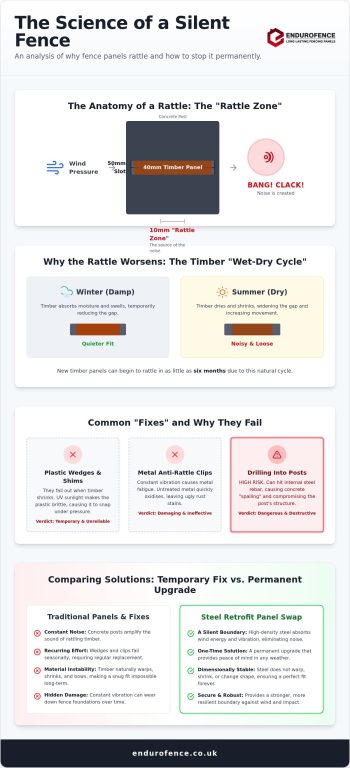
The core of the issue lies in what professionals call the “rattle zone”. Most standard UK concrete posts are manufactured with a 50mm wide slot to accommodate different types of fence construction and various panel thicknesses. However, a standard timber lap panel is typically only 40mm thick. This leaves a 10mm discrepancy that’s often ignored during installation. Whilst this gap makes it easy to slide a panel into place, it creates a permanent channel for vibration that only worsens as the materials age.
The Role of Timber Shrinkage
Timber is a hygroscopic material, meaning it constantly adjusts its moisture content to match the surrounding environment. This leads to the “Wet-Dry Cycle”, where panels swell during damp winters and contract during drier summers. You might notice your garden is silent in January but incredibly noisy by July. This is because the timber shrinks as it dries, widening the gap in the post slot and giving the panel more room to move.
It’s common for new timber panels to start rattling within just six months of installation. Whilst warping involves the wood twisting or bowing, shrinkage is a reduction in the wood’s overall volume. Even a few millimetres of loss can compromise the fit. Because timber is inconsistent by nature, these dimensions change every season, making it impossible for a rigid timber panel to maintain a snug fit in a concrete slot forever.
Why Concrete Posts Amplify the Sound
Concrete posts are favoured for their longevity, but they are particularly prone to noise issues compared to timber-on-timber fixings. Concrete is an incredibly dense and rigid material that doesn’t absorb energy; it reflects it. When a panel strikes the side of the post, the concrete acts as a resonator, turning a small tap into a deep, hollow “boom” that can be heard from inside the house.
The H-profile design of the post essentially creates a natural echo chamber. Because there’s no “give” in the concrete, all the wind energy hitting the fence is converted directly into vibration. In a timber-to-timber setup, the wood-to-wood contact provides a slight dampening effect, but the hard shoulders of a concrete post offer no such luxury. Every gust of wind becomes a percussive event that echoes through the garden.
Myth vs. Reality: Do Fence Wedges and Grips Actually Work?
Most homeowners reach for a bag of plastic wedges the moment they decide to stop fence panels rattling. It’s a cheap, accessible option found in any DIY shop. Yet, these small components usually represent a temporary “plaster” rather than a cure. They are designed for a static environment, but your garden is anything but static. Wind, rain, and temperature changes ensure that your fencing is in a constant state of subtle movement.
Wedges rely purely on friction to hold a panel in place. As established, timber is a living material that expands and contracts. When a panel dries out and shrinks during a warm spell, the friction holding the wedge vanishes. The result is a garden floor littered with plastic after every breezy night. Metal anti-rattle clips face similar hurdles. Over time, the constant vibration against the rigid post causes metal fatigue. If these clips aren’t specifically treated for long-term outdoor use, they quickly oxidise, leaving orange rust stains that ruin the aesthetic of your timber.
The Problem with Temporary Wedges
UV rays are the hidden enemy of plastic fixes. Standard poly-wedges often turn brittle after just a few months of exposure to direct sunlight. When the wind picks up, the pressure from the vibrating panel can snap these weakened parts in an instant. It leads to a frustrating routine of re-wedging your entire boundary every few months. This turns a supposedly simple fix into a permanent chore that fails just when you need it most during a storm.
The Danger of DIY Mechanical Fixings
Attempting to screw or bolt panels directly into concrete is a significant error. You should never drill into a concrete fence post, as you risk hitting the internal steel reinforcement bars. This can lead to “spalling”, where the concrete cracks and falls away, potentially compromising the post’s structural integrity. Some people turn to expanding foam to fill the gaps, but this creates a messy finish and permanently bonds the panel to the post. If you ever need to replace a damaged panel later, you’ll find it nearly impossible to remove without causing structural damage to the post itself.
Stuffing the gap with timber offcuts is another common “bodge” that causes more harm than good. These offcuts trap moisture against the main panel and the post, creating a damp micro-environment. This accelerates rot in the very panels you’re trying to protect. Rather than relying on fixes that eventually fail, consider a more professional Retro Fitting Panel Swap to solve the noise issue once and for all.
The Hidden Damage Caused by a Rattling Fence
A rattling fence is a failing fence that has lost its primary security and privacy value. Whilst the noise is the most immediate annoyance, the physical movement indicates that the structure is actively self-destructing. Every time a gust of wind causes a panel to strike a post, it delivers a mechanical shock that timber and concrete were never designed to withstand repeatedly. It’s a symptom of a boundary that can no longer perform its job effectively.
The “Sail Effect” is a major concern during UK storms. A secure, fixed panel allows wind to apply a steady, predictable pressure. In contrast, a loose panel catches the wind and accelerates across the “rattle zone” before slamming into the post. This creates an impact force far greater than simple wind pressure, significantly increasing the risk of a full blowout. It turns a standard garden boundary into a liability that could fail at the height of a gale.
Structural Wear and Tear
The constant vibration acts as a destructive force on the “shoulders” of your concrete posts. These are the thin vertical edges that form the H-profile slot. Concrete is famously strong under compression but relatively brittle when subjected to high-frequency impacts. Over time, this repetitive banging creates micro-cracks that allow moisture to penetrate the post. If this water freezes, it expands and causes the concrete to spall or flake away, eventually exposing the internal steel reinforcement to rust.
There is also the risk of panels jumping out of their slots entirely. In high winds, the combination of vertical lift and horizontal rattling can cause a lightweight timber panel to “walk” up the post until it clears the top. Beyond this, the constant flexing puts immense strain on the horizontal rails of the panel. These rails are often the first part of the timber to snap, leaving the slats to fall apart and requiring a full replacement rather than a simple fix.
Acoustic Stress and Neighbour Relations
In the context of semi-detached or terraced UK gardens, a noisy fence is more than a personal nuisance. It can quickly become a source of friction between neighbours. Persistent rattling during the night can easily be perceived as a breach of local noise etiquette, especially when homeowners are looking for ways to stop fence panels rattling to restore the peace. It’s difficult to relax when your boundary sounds like a construction site every time the weather turns.
The psychological toll shouldn’t be underestimated. Living with a noisy fence creates a state of “acoustic anxiety” where you find yourself waiting for the next bang every time the wind picks up. This prevents you from enjoying your garden as a place of rest. A silent, secure boundary is essential for maintaining both your property’s appeal and your own mental well-being during the winter months.
Practical Fixes: From Band-Aids to Permanent Solutions
When you’re looking to stop fence panels rattling, it helps to categorise potential fixes by their expected lifespan. Most solutions fall into three camps: temporary band-aids like wedges, mid-term hardware like clips, and permanent structural upgrades. Whilst a pack of 20 fence wedges might only cost around £12.99, professional installers rarely recommend them for long-term satisfaction. They understand that these small fixes require constant monitoring and frequent replacement, turning a one-off problem into an annual chore.
Cost is often the deciding factor, but a simple cost-benefit analysis reveals a different story. Spending £12.99 every year on wedges that inevitably fall out or perish in the sun adds up over a decade. When you factor in the time spent crawling along your boundary line to hammer them back in, a one-time panel upgrade becomes more attractive. It’s often faster to slide out a noisy timber panel and slide in a precision-fit replacement than it is to fiddle with dozens of individual wedges across a large garden.
The Mid-Term Fix: Stainless Steel Clips
Stainless steel clips represent a step up from basic plastic wedges. These spring-loaded devices are designed to sit within the post slot, maintaining constant tension against the panel even as the wood moves. They are effective for a few seasons, but they have distinct limitations. On heavily warped or very thin budget panels, the clips often struggle to find a flat surface to grip. If you aren’t ready for a full replacement, ensure you install at least three clips per side of each panel to provide even pressure and reduce the chance of the metal fatiguing under high winds.
The Permanent Solution: Material Stability
True material stability is the only way to end the rattle forever. Switching from organic timber to a non-organic material like steel removes the “Wet-Dry Cycle” entirely. Because steel doesn’t shrink or warp, the fit you have on day one is the same fit you’ll have ten years later. Precision manufacturing ensures these panels sit snugly within standard UK concrete post slots, leaving no room for the kinetic energy transfer that causes a racket.
Modern steel panels often feature high-density insulated cores. This design choice is vital for a silent garden because the core absorbs vibration rather than reflecting it. Even in extreme gales, these panels produce a dull “thud” rather than a sharp, metallic “bang”. If you’re tired of temporary fixes, a Retro Fitting Panel Swap provides an engineered solution that remains silent and secure regardless of the weather conditions.
The Silent Garden: Why Steel Retrofit Panels End the Rattle
EnduroFence steel panels represent the engineered response to the unpredictable UK climate. Unlike timber, which is subject to constant organic movement, these panels are built for long-term material stability. If you want to stop fence panels rattling, you need to replace the variable material with a constant one. Steel doesn’t react to humidity levels or seasonal shifts. It remains the same size throughout its entire lifespan, ensuring the fit never loosens and the noise never returns.
The secret to a silent garden lies in the high-density insulated core. While hollow timber panels or thin plastic alternatives reflect sound waves, this core is designed to absorb vibration. It effectively dampens the kinetic energy of the wind before it can turn into noise. This results in a quiet garden even during the most aggressive gales. You won’t have to worry about the rhythmic banging that usually accompanies a storm, as the panel stays firmly in place.
This solution is entirely maintenance-free. You can forget about the cycle of painting, staining, or treating your boundary every spring. There’s no need to buy bags of wedges or hunt for fallen shims on the lawn after a breezy night. These panels are designed for homeowners who value their time as much as their peace. They provide a high-quality finish that stays looking new without the ongoing labour associated with traditional materials.
Engineered for a Precision Fit
Standard UK concrete posts have specific slot widths that often leave timber panels with too much room to move. EnduroFence panels are manufactured to match these dimensions exactly. This precision eliminates the gap that causes noise in the first place. Because steel has zero-shrinkage properties, the snug fit you achieve on day one will be identical in twenty years. You can see the benefits of a Retro Fit Panel Swap and how it integrates with your existing posts without the need for specialist tools.
Acoustic Dampening and Security
The difference in acoustic performance is immediate and striking. A hollow timber panel creates a sharp, percussive bang when wind hits it. An insulated steel panel produces a low-frequency thud that doesn’t travel through the air or into your home. This snug fit also provides a significant security boost. A steel panel that fits perfectly is much harder for intruders to lift or rattle than a loose timber alternative. It’s a straightforward way to Upgrade to a silent, maintenance-free fence today and reclaim your garden’s peace.
Reclaim Your Garden Peace
A rattling fence is more than a nuisance; it’s a sign that your boundary is undergoing constant structural stress. The “Wet-Dry Cycle” of timber ensures that temporary fixes like wedges and clips will inevitably fail as the seasons change. To truly stop fence panels rattling, you need to address the root cause by choosing materials that don’t shrink, warp, or move within the post slot.
Upgrading to a precision-engineered solution ends the cycle of annual maintenance and sleepless nights. Our panels are designed to fit existing UK concrete posts perfectly, featuring an insulated core for superior acoustic dampening. This 100% maintenance-free steel construction means you’ll never have to worry about rot or noise again. It’s the most straightforward way to secure your home whilst restoring the quiet atmosphere of your outdoor space.
Browse our range of rattle-free steel fence panels to find a permanent answer for your garden boundary. You deserve a secure, silent perimeter that stands firm against the British weather for years to come.
Frequently Asked Questions
Do fence wedges actually stop rattling long-term?
Fence wedges do not provide a long-term solution because they rely entirely on friction. Timber is a hygroscopic material that expands and contracts with humidity changes. When wood shrinks during dry spells, the wedge loses its grip and eventually falls out. Additionally, plastic wedges often become brittle under UV exposure. This results in a recurring cycle of replacement rather than a permanent fix to stop fence panels rattling in your garden.
Is it safe to drill into concrete fence posts to secure panels?
Drilling into concrete fence posts is generally unsafe and not recommended. Most posts contain internal steel reinforcement bars that provide structural strength. If a drill bit strikes these bars, it can cause the concrete to crack or flake away, a process known as spalling. This allows moisture to reach the steel, leading to rust and potential post failure. It’s better to use non-invasive methods that sit within the existing post slots.
Why do my new fence panels rattle more than the old ones?
New fence panels often rattle more than older ones due to the initial drying process. Freshly manufactured timber typically has a higher moisture content than seasoned wood. Within the first six months of installation, the timber loses this moisture and shrinks in physical size. This creates a larger gap within the concrete post slot, allowing the panel to vibrate more freely. Older panels may have been held in place by accumulated debris or swelling.
Can I use expanding foam to stop my fence panels banging?
Using expanding foam is a poor choice for silencing a fence. Whilst it might provide an immediate fix, the foam quickly degrades when exposed to UV light and moisture. It also creates a permanent bond between the panel and the post. This makes it incredibly difficult to slide the panel out for future repairs or replacement without damaging the concrete. The resulting mess is also difficult to clean and often looks unprofessional from the street.
What is the best way to stop fence panels rattling in the wind?
The most effective way to stop fence panels rattling is to switch from timber to a dimensionally stable material like steel. Timber constantly changes size, but precision-engineered steel panels remain the same dimensions regardless of the weather. By choosing a panel with a high-density insulated core, you also benefit from acoustic dampening. This ensures that any wind energy is absorbed rather than reflected as a loud, metallic banging sound against the post.
Will steel fence panels fit into my existing concrete posts?
Precision-engineered steel panels are designed to slide perfectly into standard UK concrete posts. Most existing posts feature a 50mm H-profile slot, which is the industry standard. EnduroFence panels are manufactured to utilise this space effectively, providing a snug fit that eliminates the “rattle zone” found with thinner timber alternatives. You won’t need to modify your existing posts or use specialised tools to complete a straightforward retrofitting panel swap in your garden.
How much does it cost to replace rattling timber with steel panels?
The cost of replacing timber with steel depends on the size of your boundary and the specific finish you choose. Whilst the initial investment for steel panels is higher than for basic timber lap panels, it eliminates the recurring costs of treatments, paints, and temporary fixes. Because steel is maintenance-free and won’t rot or warp, it provides better long-term value. You can obtain a free, tailored quote directly through our website to plan your project accurately.
Do I need a professional to install anti-rattle solutions?
You don’t necessarily need a professional to install high-quality anti-rattle solutions. Products like the EnduroFence Retro Fitting Panel Swap are designed specifically for straightforward DIY installation. The panels are lightweight enough for two people to handle and require no specialised tools or previous fencing experience. Homeowners can quickly slide out old timber and slide in new steel panels, making it an accessible project for those looking to improve their garden independently.

Leave a Reply