

Heavy-Duty Garden Fence Panels: UK Buyer’s Guide 2026
Could a panel labelled “heavy duty” still be the wrong choice for your garden? The description alone won’t tell you how it’s built, whether it will fit your existing concrete posts or how it contributes to a secure boundary. Look beyond the label: security depends on the panel, its fit and the condition of the boundary as a whole.
This guide explains what to check when comparing heavy duty garden fence panels, from construction and dimensions to the details that make security claims meaningful. You’ll learn how to match a panel to your garden’s needs and assess whether a panel swap could update the boundary while retaining suitable concrete posts. We’ll also compare familiar timber panels with options made from profiled steel outer sheets and a high-density insulated core. Before choosing, measure the gaps between your posts and decide what you need the boundary to do. These checks help you compare options and avoid a poor fit.
Key Takeaways
- Look beyond the “heavy duty” label: construction, fit and the condition of the whole boundary all matter.
- Compare timber and steel by upkeep and practical suitability, rather than assuming a heavier panel is automatically better.
- Use a simple security check: identify your concern, inspect the boundary, assess panel fit, then compare options.
- Measure your existing concrete posts to see whether heavy duty garden fence panels could suit a retrofit.
- Compare profiled steel outer sheets and a high-density insulated core as one option for replacing panels while retaining suitable posts.
What makes heavy duty garden fence panels different?
“Heavy duty” can be vague if a product description doesn’t explain what the panel is made from or how it fits. The phrase alone doesn’t guarantee strength or security. To compare panels, look at their construction, whether they suit your boundary, how securely they fit between the posts and the condition of the fence around them.
For this guide, a heavy-duty panel is one whose materials and construction suit the job, whose dimensions and edges fit its supports, and whose role is assessed as part of the whole boundary. A sturdy panel can contribute to a more secure boundary, but it can’t guarantee security on its own.
Which parts of a fence panel affect its strength?
Start with construction details, not the product label or the panel’s weight. Check the face material, how the panel is assembled and what supports or reinforces it. Inspect the edges too: they need to be sound and compatible with the way the panel sits in its posts. A strong-looking surface won’t make a suitable boundary if the panel is damaged, poorly supported or loose in its frame.
Product descriptions use different terms for different designs. A solid panel and an open mesh panel, for example, are built differently and suit different boundary needs. The welded wire mesh fence construction overview illustrates how mesh is formed and used. It’s a useful reminder that “heavy duty” doesn’t describe just one construction. Compare like with like, and don’t treat an unspecified thickness, weight or security claim as proof of performance.
- Material: Identify what the outer face and any core or supporting elements are made from.
- Construction: Look for a clear description of how the components combine to form the panel.
- Edges and fit: Check how the panel is held in place and whether its dimensions suit your posts.
Why the existing boundary matters as much as the panel
A fence panel is one part of a larger structure. Posts support it, the ground supports the posts, and gaps between panels or beneath the fence affect how continuous the finished boundary is. Check for leaning or loose posts, visible damage, uneven ground and openings that could undermine what you want the fence to do. Replacing a panel won’t repair weak supports or close gaps elsewhere.
Imagine replacing one worn panel in a garden run. A sturdier replacement may fit between two sound posts, but a neighbouring post that leans can leave a gap or put pressure on the panel. If the ground dips beneath another section, that opening remains after the new panel is fitted. Assess the run as a whole, then judge whether the panel, its fit and the surrounding boundary work together. That makes “heavy duty” a practical consideration rather than a label to rely on.
How heavy duty fence panel construction shapes everyday use
A panel’s weight can affect how it feels to handle, but it doesn’t show whether it’s well made or right for your garden. More useful clues are the materials, how the panel is assembled, what supports its faces and how its edges are finished. Look for those details instead of relying on “heavy duty” as a stand-alone claim.
Compare the documented material, outer faces, internal structure and edge design. Then consider how that construction suits your boundary and the upkeep you’re prepared to do. This gives you a practical basis for weighing up options without treating one feature, such as weight, as a measure of quality.
Steel and timber panels: compare the construction, not just the label
Steel and timber are broad material categories, not guarantees of a particular standard. Timber panels are assembled from wooden components, and their construction can vary. Steel panels also differ in how their faces and supporting elements are formed. Neither material is automatically right for every garden. Appearance, the existing boundary and the care you’re comfortable with all affect suitability.
Upkeep is another practical distinction. Timber may need periodic attention to keep its finish in good condition, while some steel panel options are designed to be maintenance-free. Check the specific product description rather than assuming all products made from the same material behave alike. When comparing heavy duty garden fence panels, weigh the stated construction and care requirements together, not the headline label in isolation.
- Material: Check whether the panel is made from timber, steel or another material.
- Build: Look for an explanation of how the panel’s faces and supporting parts are put together.
- Care: Consider the upkeep described and whether it fits your preferences.
What an insulated panel description tells you
An insulated panel has a core between its outer faces. That tells you something about how it’s built, but it doesn’t by itself establish a particular level of sound reduction, thermal performance or security. Don’t assume benefits beyond those clearly supported by the product information. For this comparison, focus on the construction and whether the panel’s format suits your boundary.
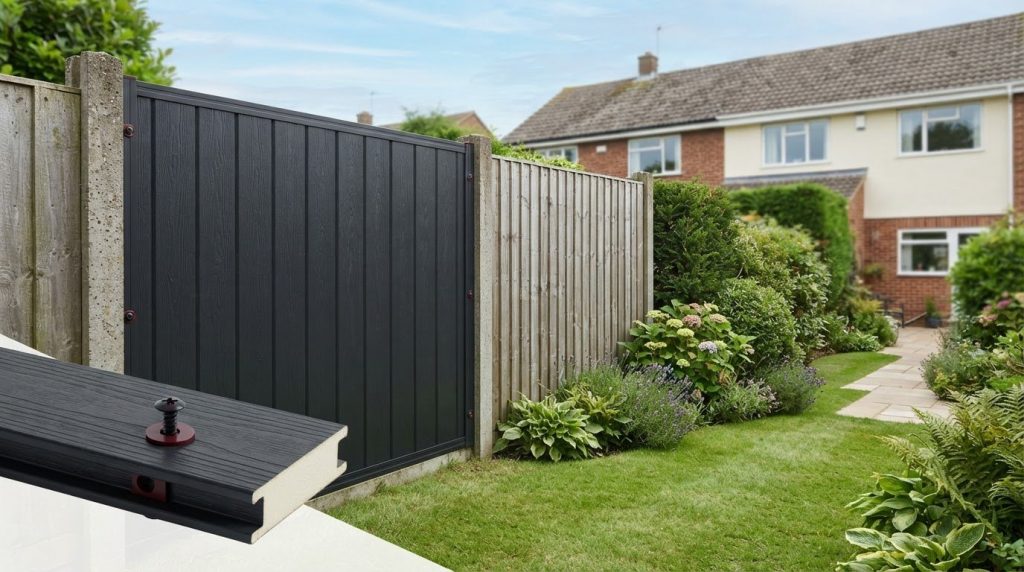
EnduroFence panels use profiled steel outer sheets with a high-density insulated core. This identifies both the facing material and the internal structure, giving you more useful information than a general “heavy duty” claim. EnduroFence panels are designed to fit existing concrete posts, making them relevant if you’re considering a panel swap and your posts are suitable.
Use the same questions for any panel you compare: what are its outer faces made from, what is inside, how are the edges formed, and what care does the product description specify? Then match those answers to your garden’s needs rather than assuming a heavier panel must be better. If steel construction and a retrofit are priorities, explore EnduroFence steel panels.
Heavy duty garden fence panels compared by homeowner priorities
The right panel depends on what you need the boundary to do and what is already in place. A garden where privacy matters may call for a different panel from one where appearance, upkeep or straightforward replacement is the priority. Compare materials against your needs rather than assuming one option is best for every property.
The table is a starting point. Designs vary, so use it to identify what to check in the details of each panel.
| Material | Upkeep | Fit considerations | Practical trade-off |
|---|---|---|---|
| Timber | May need periodic care to maintain its finish. | Check the panel dimensions and how its edges sit within the existing supports. | Offers a familiar, natural appearance, but its condition and care needs can change over time. |
| Steel | Some options are described as maintenance-free; check the specific product information. | Confirm the panel is designed for your post type and measure the available space accurately. | Can suit homeowners seeking a different finish or a panel replacement without changing suitable existing posts. |
Choose panels for the job your garden boundary needs to do
Start with your main priority. If privacy matters, consider how continuous the panel will be once fitted and whether gaps elsewhere in the boundary would undermine that aim. If appearance is central, compare the available colours and finishes with the garden and house. If you want a more substantial-looking boundary, look at the panel’s construction and how it will sit within the existing posts.
These are different requirements, and no material automatically meets them all. A panel can contribute to a sturdy boundary, but it can’t promise to deter every determined intruder or compensate for weak posts, gaps or other vulnerable points. Decide what matters most, then compare products against that specific need.
Compare replacement options when concrete posts are already in place
Existing concrete posts can shape your choice. A panel designed to fit them may let you update the boundary while keeping posts that are still suitable. Before comparing options, measure the opening between posts and the panel height you need. Also check that the posts are sound and aligned. Accurate measurements are useful only if the surrounding boundary is in suitable condition.
For example, if the posts are stable but the panels need replacing, compare a compatible steel option with timber. If posts lean or the gaps vary along the run, fitting may be less straightforward. Assess the boundary rather than choosing by material alone.
The best heavy duty garden fence panels are the ones that suit your priorities, fit your existing boundary and work with its condition. If a steel panel designed for existing concrete posts matches your plans, explore EnduroFence panel options.
How to assess security before choosing garden fence panels
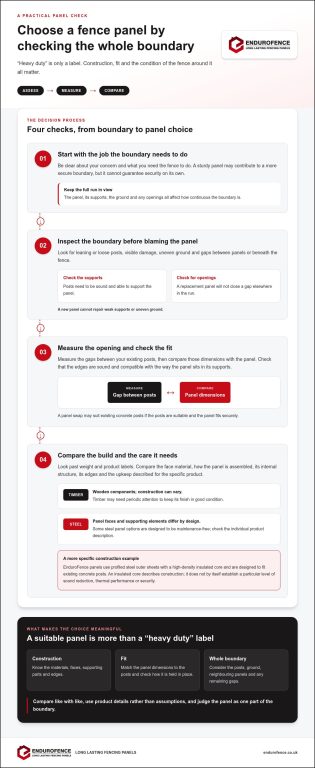
Start with the concern you want to address. It might be a visible gap, a boundary that feels exposed or a run of ageing panels. A heavy-duty panel may contribute to a sturdier boundary, but it can’t make the whole boundary secure by itself. Posts, adjoining sections, panel fit and the ground all play a part, so assess them together before choosing.
Use this sequence to keep the decision practical:
- Identify the concern. Decide whether your main priority is privacy, a more consistent boundary or addressing a particular weak point.
- Inspect the full boundary. Look for loose or leaning posts, damaged adjoining panels and visible gaps, including beneath the fence.
- Check the panel fit. Measure the space between supports and note whether the posts are aligned and in suitable condition.
- Compare options. Match each panel’s documented construction and dimensions to the boundary and the outcome you want.
Look for weak points across the complete boundary
Walk along the whole fence line instead of judging only the panel you plan to replace. A sound new panel can sit beside a damaged section or posts that no longer hold their position. Gaps at the base or between adjoining panels can also leave the finished boundary less continuous than expected. Note each weak point. This helps you decide whether replacing one panel addresses your concern or whether other sections need attention too.
For instance, replacing a panel at the back of the garden won’t address a gap by a side gate. The panel and the rest of the boundary have separate roles.
Match the panel choice to the concern you want to address
Privacy and appearance are practical aims, but they aren’t the same as preventing access. A panel that creates a more continuous screen may suit a garden where overlooking is the main concern. If you’re worried about access, consider the wider boundary and its weak points alongside the panel’s construction and fit. Don’t rely on a product label as proof of a particular security outcome.
Keep your expectations grounded. A fence is one part of a property’s boundary, and what it can achieve depends on its condition and surrounding features. Choose panels for the job you need them to do, and treat security claims cautiously unless they clearly describe what has been assessed. A more substantial panel can inform your decision, but it isn’t a guarantee.
EnduroFence steel panels are designed to fit existing concrete posts, offering an option for panel replacement where those posts are suitable. Compare their construction and fit with your checklist, then consider whether the rest of the boundary supports the result you want. Explore EnduroFence panel options as part of your assessment.
Choose EnduroFence heavy duty garden fence panels for a simpler upgrade
If your existing concrete posts are still suitable, replacing the panels can refresh the boundary without changing the whole structure. EnduroFence steel panels are designed to fit existing concrete posts, so a panel swap can be an alternative to replacing sound posts. As with any replacement, measure the gaps carefully and assess the condition and alignment of the posts before choosing.
The panels combine profiled steel outer sheets with a high-density insulated core. This describes their construction, not a promise of a particular security, sound or thermal result. Their maintenance-free design may also suit homeowners looking for a boundary option that doesn’t require painting or treatment.
A retrofit panel option for existing concrete posts
Keeping suitable posts in place can make an upgrade more straightforward, but compatibility and condition matter. Check the opening between posts, the required panel height and whether the supports are stable and aligned. A panel that matches the measurements still needs a sound boundary around it. Replacing panels won’t correct damaged posts or other weak sections.
EnduroFence panels are intended for straightforward homeowner replacement and don’t require specialised tools or qualifications. That makes the panel-swap process accessible to homeowners planning a boundary refresh. Take measurements before selecting panels, and use them alongside your assessment of the existing fence so the new panels suit the space and the job you want them to do.
Explore the panel options and plan your next step
Practical details aren’t the only consideration. EnduroFence panels come in a range of colours and finishes, giving you options to coordinate the boundary with your garden and home. Consider how the chosen finish will sit alongside adjoining fence sections, gates and other visible features. A consistent appearance can help a replacement feel like a considered update rather than an isolated repair.
Before deciding, bring your measurements and boundary checks together. Confirm that the posts you plan to retain are suitable, compare the panel dimensions with the available space, and choose a finish that works with your garden. This grounds your decision in both practical fit and appearance, rather than relying on the “heavy duty” label alone.
If an upgrade using existing concrete posts sounds right for your garden, explore EnduroFence panel options and request a free quote. It’s a practical next step towards choosing panels that fit your boundary and priorities.
Make your boundary upgrade a practical next step
Before choosing heavy duty garden fence panels, take your measurements and decide what you want the finished boundary to achieve. A clear plan helps you focus on fit and appearance instead of product descriptions that don’t reflect your garden’s needs.
If your concrete posts are suitable, EnduroFence steel panels are designed to fit them. Replacing the panels can update the boundary without changing the posts. The panels are intended for homeowner replacement without specialised tools or qualifications, so you can plan the project around your own skills and circumstances.
Explore EnduroFence panels and request your free quote to view the options and consider how they could suit your garden. Start with what you need from the boundary, then choose panels that fit your measurements and priorities.
Frequently Asked Questions
Can heavy duty fence panels be installed on a sloping garden?
Yes, panels can often be fitted along a slope, but the approach depends on the panel design and how the boundary is supported. A stepped layout keeps each panel level, with the height changing between posts; a raked layout follows the slope. Check how the panel is intended to sit and whether the ground changes gradually or sharply. A sudden level change may affect fit and leave gaps beneath or between sections.
Do solid garden fence panels reduce noise?
Don’t assume a solid or insulated panel will provide a particular level of noise reduction. A product description alone can’t establish how much sound will be reduced in your garden. Gaps, the fence’s position and the direction sound travels all affect what you hear. If noise is your main concern, look for specific, substantiated acoustic performance information for the exact panel rather than relying on terms such as “solid” or “insulated”.
Is planning permission needed to replace a garden fence in the UK?
It depends on the fence’s height, position and property restrictions. In England, fences are generally permitted up to 2 metres high in a back or side garden, or 1 metre next to a highway, including a footpath, without planning permission; these limits include toppers. Listed properties, conservation areas and Article 4 directions can have different rules. Planning guidance differs across the UK, so check the relevant local planning authority’s current guidance before changing a boundary.
Can I mix steel fence panels with existing timber panels?
Yes, you can use different materials along one boundary, but the join needs careful planning. Check that the panel heights and top edges align, and consider how the steel section will connect to the timber supports. A change in colour, texture or finish may be noticeable, so decide whether you want a deliberate contrast or a more consistent appearance. Check the dimensions and support requirements of each panel rather than assuming they share fittings.
Are steel garden fence panels recyclable?
Recycling depends on the panel’s materials and the facilities available locally. A panel made from more than one material may need different handling from a single-material steel item, so don’t assume the complete product can go into a metal recycling collection. Check the product’s material information and your local authority’s guidance for bulky items or construction materials before disposal. This helps you identify an appropriate route without guessing how the panel should be separated.
Does replacing fence panels mean replacing the concrete posts too?
No, not necessarily. If the posts remain stable, aligned and in suitable condition, you may be able to replace only the panels, provided the new panels are designed to fit them. EnduroFence steel panels are designed for existing concrete posts. Before ordering heavy duty garden fence panels, measure the openings and inspect the posts for movement or visible damage. Keeping sound posts can make a panel-only upgrade a practical option.

Leave a Reply