

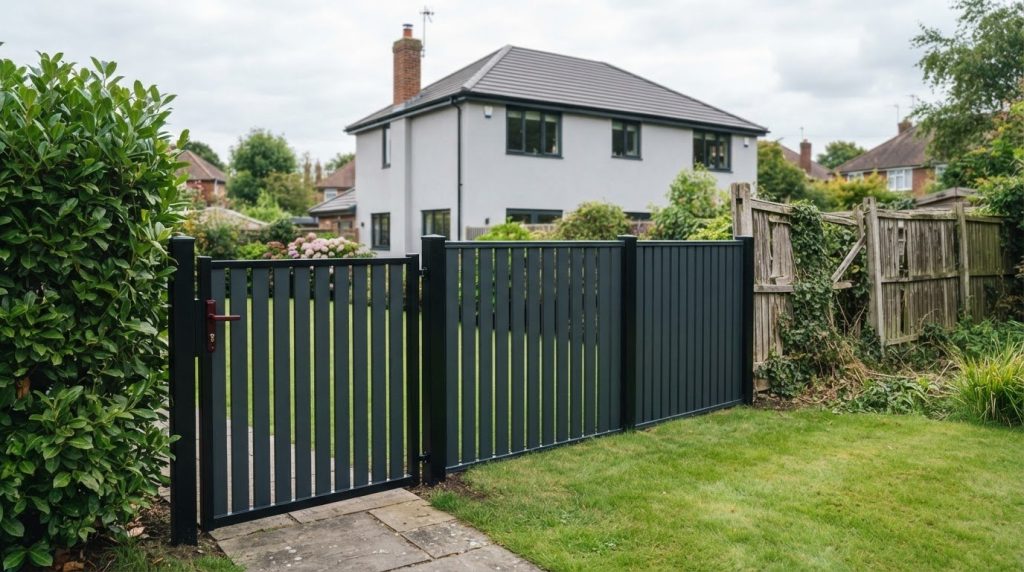
Best Fence for Security UK: How to Choose the Right Fence
The tallest or most solid option isn’t automatically the best fence for security UK homeowners can choose. A boundary may still have weak points if panels are damaged, gaps are easy to pass through or a side gate is left unsecured. The design matters, but so does the condition of the whole boundary.
It’s understandable to want a sturdy, private fence and to wonder whether domestic garden panels can offer the same protection as specialist security fencing. The right choice depends on your property and priorities. A garden boundary can improve privacy and make access less straightforward, but it isn’t a substitute for a purpose-designed security system.
This guide compares common fence types and explains which features can make a boundary more secure, from panel gaps and gates to maintenance. You’ll also see how domestic fencing differs from commercial options, and how maintenance-free steel panels can refresh a garden boundary while fitting existing concrete posts. By matching the design to your needs and addressing weak points, you can plan a practical improvement without expecting a fence alone to prevent crime.
Key Takeaways
- The best fence for security UK homes depends on whether you prioritise privacy, access control or a visible deterrent.
- Look beyond height: gaps, worn panels, damaged sections and poorly aligned gates can all weaken a garden boundary.
- Compare timber, steel, mesh and palisade fencing by visibility, privacy, upkeep and the setting they’re designed for.
- Inspect the full boundary to identify exposed edges, access routes and the condition of your existing posts before planning an upgrade.
- Maintenance-free steel panels can refresh a domestic boundary, but they aren’t a replacement for a specialist security system.
What makes the best fence for security in a UK garden?
The best fence for security UK homeowners choose depends on the problem they want to address. A garden boundary can define the property, make access less straightforward and reduce direct views into private areas. It can also make a boundary look cared for. A fence is one part of a wider plan, though, not a guaranteed barrier against crime.
It helps to distinguish between three aims. Privacy means limiting views into the garden. Access control is about making it harder to enter unnoticed or casually wander in, especially where a gate or side passage provides a route. Visible deterrence means presenting a clear, well-maintained boundary rather than one that looks neglected. A household with a secluded garden may value privacy, while another may focus on a vulnerable side entrance.
Definition: The best security-minded fence is proportionate to the property’s risks and weak points. It supports a considered boundary plan, but can’t guarantee that a crime won’t occur.
Start with the security concern you want to address
Separate concerns about overlooking from concerns about easy access or casual trespass. Walk the boundary and note which sections are exposed to a public route, close to a shared access way or screened by features that make activity harder to see. Consider the gate as part of the same boundary: a strong panel won’t resolve an easy route through an unsecured entrance. A fence should support, not replace, sensible home-security measures.
Think about the effect you want, too. A more private boundary may suit a garden overlooked by neighbours, while visibility from the house may matter more if you want to keep an eye on an entrance. There isn’t one design that fits every household.
Domestic garden fencing versus specialist security fencing
Domestic fencing is chosen for everyday residential needs, including defining a garden, providing privacy and improving the condition of a boundary. Specialist security systems may be designed for commercial premises or sites with defined, higher-risk requirements, where a particular level of access control is needed. These options aren’t directly interchangeable with ordinary garden panels.
For example, BS 1722-10:2019 covers anti-intruder chain-link or welded-mesh fences at least 2.4 metres high for situations requiring a higher level of security. That’s a specialist context, not a reason to assume a domestic panel has been tested or certified to the same standard. Perimeter security also describes how physical barriers form part of a broader approach, rather than working as a standalone answer.
For a home, start with the practical issue: privacy, an exposed approach or a boundary that needs replacing. Then consider the fence alongside gates, lighting and how garden tools or other items are stored. A suitable domestic upgrade can make the boundary more robust and orderly, but higher-risk sites may need a purpose-designed system.
Which fence features can make a garden boundary harder to breach?
Height is only one part of a fence’s design. A tall boundary may still be undermined by a loose panel, a gap beneath the fence or a gate that doesn’t close securely. Check the whole fence line, including its condition and the points where people can approach or pass through it.
Fence security depends on the continuity of the boundary, not on one feature in isolation. A sound run of panels can be weakened by a single damaged section or poorly aligned gate. During an inspection, look for movement, missing fixings, open joins and spaces where the fence meets a wall, shed or neighbouring boundary. A small defect doesn’t necessarily mean the whole fence needs replacing, but it does show where attention is needed.
Design involves trade-offs. Opaque panels offer privacy but block views through the boundary. Open designs allow visibility, while close-knit styles sit between the two. Choose according to your garden layout and priorities rather than assuming one arrangement is inherently more secure. Also consider whether nearby planting, stored items or structures provide access or concealment.
Why gates, gaps and junctions deserve attention
Inspect the gate latch, hinges and alignment as carefully as the panels. A gate that doesn’t sit properly in its frame may leave a gap or fail to close fully. Check panel ends and joins with neighbouring boundaries, too: a fence can look complete from the garden while leaving an easy route at the side or rear. Include these checks in routine garden maintenance, particularly after strong winds or if you notice a panel shifting.
Addressing the weak point is often more useful than simply adding height elsewhere. If the gate is the main access route, focus on how it closes and whether it remains in good condition. If a panel is damaged, check whether the panel or its supporting post is loose before planning a replacement.
When a security rating matters
Ratings such as LPS 1175 relate to tested security systems, not to a general impression that a fence is sturdy. A rating describes the particular product or system tested, so don’t assume it applies to every fence made from the same material. Domestic garden panels can provide a practical boundary, but shouldn’t be described as certified or rated security fencing without evidence for that specific product.
Practical constraints matter as well. Before changing a boundary’s height, consult UK planning regulations for fences, as planning requirements can depend on the fence’s position and circumstances.
If your domestic boundary needs replacing, maintenance-free steel panels are one option to consider. EnduroFence panels have profiled steel outer sheets and a high-density insulated core, and are designed to fit existing concrete posts. Explore maintenance-free steel fence panels as a practical garden upgrade, while treating gates, joins and the wider security setup as part of the same plan.
Timber, metal, mesh or palisade: compare security fence types
Each fence type balances screening, visibility and upkeep differently. The best fence for security UK homeowners choose depends on the boundary’s purpose and setting, not simply the material. Use this comparison to narrow the options, then consider how the chosen fence will work with the rest of the property.
| Fence type | Visibility and privacy | Upkeep and apparent robustness | Typical setting |
|---|---|---|---|
| Timber panels | Usually provide screening and privacy, with little visibility through the panel. | Condition affects how sound the boundary remains over time. Timber may need periodic care, and damaged or loose boards can affect its appearance and usefulness. | Common in domestic gardens where privacy and a familiar appearance matter. |
| Steel panels | Solid panels offer screening; visibility depends on the panel design. | Steel can provide a durable, low-maintenance option. EnduroFence panels have profiled steel outer sheets and a high-density insulated core, designed for durability and weather resistance. | Suitable as a domestic boundary upgrade, including where panels are designed to fit existing concrete posts. |
| Mesh | Allows sight through the boundary, so it offers less screening than an opaque panel. | Its open format makes the boundary visible. Apparent robustness varies with the mesh and supporting system. | Used in garden, commercial and security fencing settings, depending on the system. |
| Palisade | Typically leaves more of the boundary visible than solid panels, although screening depends on the design. | A metal format often associated with security and commercial fencing. The system’s specification matters more than its label alone. | Often found in commercial or other defined security applications rather than as a default choice for a garden. |
How domestic panel materials differ
Timber is a familiar garden choice, but its usefulness depends on its condition. Warped boards, decay or loose sections can leave a boundary looking and functioning poorly. Steel panels can suit homeowners seeking a durable, maintenance-free alternative. EnduroFence panels are intended for garden use and can replace timber panels while retaining suitable existing concrete posts. Neither material alone proves a particular level of security performance.
Mesh keeps sightlines open, which can help maintain visibility across a boundary, but it won’t provide the same privacy as an opaque panel. Solid panels screen the garden, though that may not suit every layout. Decide whether views in or out matter before comparing appearance and upkeep.
Where mesh, palisade and rated systems fit
Mesh and palisade appear in both security and commercial fencing ranges, but those categories aren’t automatically necessary for a home. A site with defined security requirements may call for a purpose-designed system tested against a named standard. For an ordinary garden, compare options in proportion to the setting and intended use.
Durability describes how a fence is designed to withstand everyday conditions; it isn’t evidence that the fence has resisted a defined attack in a test. Check claims against the specific product or system, rather than inferring a rating from its material or robust appearance.
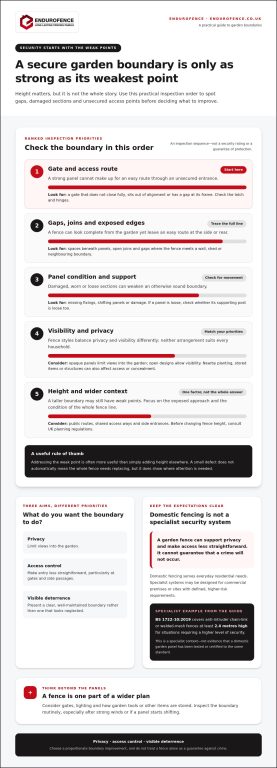
How to choose a secure fence for your property
A clear assessment helps you choose a fence that suits your home, rather than overhauling the whole boundary without a specific reason. Work through the steps in order: identify the concern, inspect what’s already there, compare suitable designs, then plan an upgrade around the sections that need attention.
- Identify your main concern. Decide whether you’re aiming for more privacy, better control of an access route, a clearer boundary or a combination of these. Note which areas feel exposed and how you use each part of the garden.
- Inspect the boundary. Walk its full length and record exposed edges, access routes, damaged or loose panels, gaps, gate condition and any movement in the posts. Note where the fence meets a wall, shed or neighbouring boundary, as these junctions affect the overall layout.
- Compare suitable options. Weigh privacy and visibility against appearance, upkeep and intended use. Consider whether a solid panel or a more open design better suits each section, and whether the material is practical for the boundary you have.
- Plan the upgrade. Decide whether the whole fence needs attention or whether the priority is a particular run, gate or damaged section. Factor in the condition of existing posts and any relevant planning or boundary considerations before settling on a design.
Assess the existing boundary before choosing
Check whether panels sit securely, posts appear stable, gates close properly and connections between sections are intact. Make a simple sketch of the garden and mark where privacy, visibility or controlled access matters most. If the existing concrete posts are suitable, replacement panels designed to fit them may let you update the boundary without changing the post layout. This helps clarify the scope of the job before you compare materials.
Record observations rather than relying on memory. For example, note which panel moves, where a gap appears and whether a gate is misaligned. This gives you a practical list of priorities and helps distinguish a local repair need from a wider boundary upgrade.
Match the fence type to your priorities
Choose with the garden’s use in mind. A more opaque design may suit a section where screening matters; an open style may be preferable where visibility is useful. Compare maintenance expectations as well as appearance: the option that looks best on day one may not suit the amount of upkeep you want over time. For a closer look at robust domestic options, use a guide to heavy-duty garden fence panels to inform your comparison.
Consider whether your planned height or position could affect planning requirements. Rules can vary with the circumstances, so consult current Planning Portal guidance on fences before finalising the design.
If your assessment points towards replacing worn panels while retaining suitable existing concrete posts, explore maintenance-free steel fence panels as a practical domestic upgrade. Their profiled steel outer sheets and insulated core are designed for durability and weather resistance, offering a convenient option to compare without treating a garden fence as a guaranteed security system.
Can EnduroFence steel panels suit a security-minded garden upgrade?
A worn or weathered garden boundary can be a practical reason to consider new panels, especially if the existing concrete posts remain suitable. EnduroFence steel panels are designed for UK gardens and offer a durable, maintenance-free alternative for homeowners looking to refresh their boundary. They can support a security-minded approach by helping maintain a sound, well-kept fence line, but they aren’t a certified security system and can’t guarantee crime prevention.
What EnduroFence panels offer for a domestic boundary
The panels have profiled steel outer sheets and a high-density insulated core, designed to provide durability and weather resistance. This combination suits homeowners who want a robust domestic panel without the ongoing maintenance associated with some traditional materials. A range of colours and finishes is available, so you can update the boundary to suit the garden as well as its practical purpose.
Panels are designed to fit existing concrete posts. If those posts are suitable, replacing the panels while retaining them can make an upgrade more straightforward than changing the whole boundary structure. Homeowners can carry out the replacement without specialised tools or qualifications. This offers a practical way to modernise a garden fence, particularly where timber panels have become worn but the posts remain usable.
Material and construction aren’t the same as a security rating. EnduroFence panels shouldn’t be described as anti-climb or tested against a defined attack. They’re a domestic boundary option, not a substitute for a specialist system intended for a higher-risk site. When comparing the best fence for security UK gardens can use, consider the property’s needs and the condition of the entire boundary, including gates and access points.
Decide whether a panel upgrade fits your next step
A panel replacement may suit you if your priority is a more durable, low-maintenance garden boundary and the existing posts are in suitable condition. It can also improve the appearance and continuity of a fence without treating it as a complete security solution. Before deciding, consider whether the panels will address the specific issue you identified, such as worn sections or a boundary that needs a more consistent finish.
Keep the wider layout in view. A new panel won’t resolve a gap at the side, a poorly closing gate or another easy access route. Include those features in your plan so the upgrade improves the whole boundary, rather than just one section.
To compare available colours and finishes or request a free quote, explore EnduroFence panels and request a free quote.
Make your next fence decision with confidence
Use your boundary inspection to set a clear brief before choosing a replacement: what needs improving, what should stay and which sections deserve priority? This gives you a practical way to judge whether a domestic panel upgrade fits your plans, rather than expecting one fence to solve every security concern. The best fence for security UK homeowners choose is one that suits their property and intended use.
If you’re considering a straightforward garden refresh, EnduroFence panels are designed to fit existing concrete posts, and homeowners can replace them without specialised tools or qualifications. Their high-density insulated core is designed to provide durability and weather resistance, making them an option to compare as you plan the next step.
Review the available colours and finishes, then decide whether they suit your garden and boundary priorities. Explore EnduroFence panels and request a free quote. A considered upgrade can help you move forward with a boundary that better suits your home.
Frequently Asked Questions
What is the best type of fence for home security?
There isn’t one best fence for security UK homes: the right choice depends on what the boundary needs to do. For a garden overlooked from a footpath, screening may matter more than visibility; for a side passage, the gate and access route may be the priority. Start by mapping how people could approach the property, then choose a fence that suits those routes and your day-to-day use.
Is a metal fence more secure than a wooden fence?
Not automatically. A metal fence may suit someone seeking a durable, low-maintenance boundary, while timber may appeal for its familiar garden appearance. Neither material alone establishes resistance to a particular threat. For example, a strong panel won’t address a gap at the bottom or a gate that doesn’t close. Compare the complete boundary, and look for test evidence specific to a product before relying on a security claim.
Can a fence stop burglars getting into a garden?
A fence may make access less straightforward, but it can’t guarantee that nobody will enter the garden. Consider the garden as part of your home’s wider security: keep side gates closed, avoid leaving ladders or tools accessible, and think about lighting around entrances. These measures address different risks and can complement a boundary improvement without relying on the fence alone.
How high should a security fence be in the UK?
No single height makes every garden secure. The right choice depends on the property, the boundary’s position and what you need it to do. Before changing the height, consult current official planning guidance, particularly if the fence is beside a highway or the property has special restrictions. Also consider whether a taller boundary would affect visibility from the house or create an awkward layout around gates and paths.
Are security-rated fences necessary for a home garden?
Not necessarily. A tested system may be appropriate where a site has a defined, higher-risk security requirement, but that doesn’t make it the default choice for a domestic garden. When comparing products, distinguish a documented rating for the exact system from general terms such as “strong” or “durable”. For everyday residential needs, consider what you want the boundary to achieve and whether a domestic fence meets that purpose.
Are steel fence panels suitable for existing concrete posts?
Yes, some steel panels are designed to fit existing concrete posts. EnduroFence panels are made for this type of replacement, and homeowners can fit them without specialised tools or qualifications. Before choosing panels, measure the openings and inspect the posts for movement or damage. Retaining suitable posts can make replacing worn infill a simpler project, but it doesn’t make the fence a tested security system.
What should I check before replacing garden fence panels?
Check the posts first: note whether they’re upright, stable and free from visible damage. Measure each panel opening rather than assuming every space is identical, and record any sections that have shifted or broken. Test how gates close and inspect the joins where the fence meets walls or sheds. These notes help you plan the materials and scope of the replacement. If you’re changing the boundary itself, check relevant official guidance.

Leave a Reply