

Home Improvement Franchise UK: Is It the Right Move for You?
What if the right franchise isn’t the one with the widest range, but the one that best matches how you want to work? A home improvement franchise UK listing can look appealing, yet the day-to-day responsibilities, customer focus and business demands matter just as much as the sector itself.
It’s reasonable to feel unsure where to start. Home improvement covers everything from renovations to specialist fencing, and a directory entry alone won’t show whether a concept suits your skills or appetite for ownership. Use this practical fit-check to compare opportunities, clarify what you want from business ownership and identify what to examine before making a commitment.
You’ll explore what a home improvement franchise involves, how to assess your experience and working style, and which business details deserve closer attention. EnduroFence provides one focused example: a franchise centred on maintenance-free steel fence panels designed to fit existing concrete posts, alongside post covers and retrofit panel swaps. Use the questions ahead to judge whether this specialist business, or another part of the sector, fits the future you have in mind.
Key Takeaways
- Compare product-led, repair-led and project-led franchises by the customer contact and work patterns each involves.
- A home improvement franchise UK opportunity may suit you without trade expertise. Focus on the capabilities you already bring and the requirements of the model.
- Use a practical self-assessment to weigh your business goals, preferred work, customer contact and available time.
- Set out initial and ongoing commitments separately, then compare them with your resources before deciding whether ownership is a realistic fit.
- Consider whether EnduroFence’s specialist fencing focus matches the kind of home improvement business you want to build.
What is a home improvement franchise in the UK, and what does ownership involve?
A franchise operates under an established brand and business model, with the relationship between the franchisee and franchisor set out in an agreement. The franchisee runs the business within those agreed arrangements, rather than building an entirely independent brand and approach. Responsibilities vary: one opportunity may centre on selling products, whilst another involves delivering services or managing projects.
That distinction matters when assessing a home improvement franchise UK opportunity. A directory description may name the sector without explaining what your working week would involve. Compare the actual activities, customer interactions and business responsibilities, rather than relying on the category label.
Which activities sit under home improvement franchising?
Home improvement covers work that changes, maintains or upgrades a home. Renovation and repair businesses may focus on improving rooms or fixing specific problems. Property maintenance can involve recurring upkeep, whilst specialist home-product businesses centre on supplying a particular item or system. Gardening overlaps with home services, but generally focuses on outdoor spaces and their upkeep rather than the home itself.
The work pattern depends on the offer. A service-led model may involve arranging and delivering work; a product-led one may focus more on presenting a defined product and explaining how it meets a customer’s needs. Project-led businesses can involve coordinating a larger piece of work. Fencing is one specialist home improvement category, not a description of the whole sector. EnduroFence’s franchise focuses on maintenance-free steel fence panels designed to fit existing concrete posts, alongside post covers and retrofit panel swaps. For wider industry context, see the Anglian Home Improvements Wikipedia page, which traces the history of a recognised UK home improvement company.
What does franchise ownership mean in practice?
A franchisee runs a business using an established brand and model under an agreement; an independent owner builds and operates a business under their own brand and approach. This is the basic distinction, but franchisees don’t all have the same role or level of independence. The agreement defines how the brand may be used and sets out the operating arrangements for that particular franchise.
Ownership still means taking responsibility for running a business. Depending on the model, that may include handling enquiries, organising sales or work, managing customer relationships and keeping track of business commitments. A franchise doesn’t remove the decisions or uncertainty involved in business ownership. Understand the role’s responsibilities and consider whether they suit your strengths and preferred working style.
This guide is a fit-check, not a forecast of performance. It can help you identify the type of work and ownership structure that suit you, but it can’t predict demand, income or results. Treat the category as a starting point, then assess the actual business model and agreement against your goals.
How do home improvement franchise business models differ?
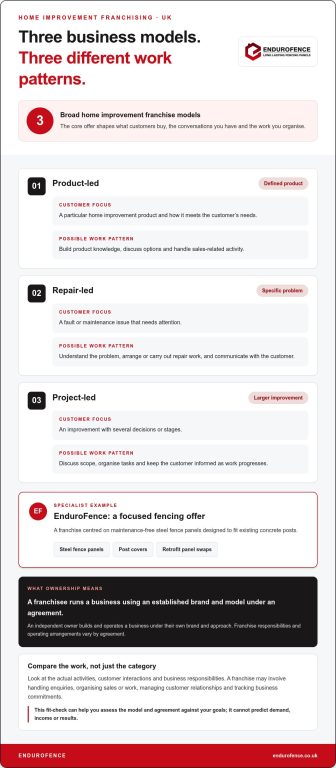
The label “home improvement” covers businesses with quite different offers. One may sell a defined product, another may focus on fixing faults, whilst a third may manage a larger project. Those differences affect customer conversations, the skills used and the rhythm of the work. Compare the core offer first, rather than assuming businesses in the same directory category operate alike.
A franchise’s core offer shapes its operating model: what customers buy influences the conversations, tasks and workflow the owner handles. The comparison below is a guide, not a promise that every franchise in a category follows the same pattern. Each business has its own arrangements and requirements. The British Franchise Association (bfa) official website offers further context on franchising standards and ethics in the UK.
| Broad model | Typical customer focus | Possible work pattern |
|---|---|---|
| Product-led | A defined home improvement product and how it meets a customer’s needs. | Building product knowledge, discussing options and handling sales-related activity. |
| Repair-led | A specific fault or maintenance issue that needs attention. | Understanding the problem, arranging or carrying out repair work, and communicating with the customer. |
| Project-led | A larger improvement with several decisions or stages. | Discussing scope, organising tasks and keeping the customer informed as work progresses. |
Product-led or service-led: which type of work appeals to you?
Product-led models centre on supplying or selling defined home improvement products. Service-led models focus on completing work or providing expertise, from repairs to specialist maintenance. Some businesses combine elements of both, so look beyond the category name to understand the owner’s role. Would you enjoy learning product details and helping customers compare options? Do you prefer practical problem-solving, or are you more comfortable coordinating a sequence of tasks?
EnduroFence’s specialist fencing offer centres on maintenance-free steel fence panels, post covers and retrofit panel swaps. The panels are designed to fit existing concrete posts and have profiled steel outer sheets with a high-density insulated core. This is a focused product category, rather than a general home improvement offer. To explore the EnduroFence fencing franchise opportunity, visit EnduroFence’s fencing franchise opportunity.
How does a specialist trade compare with a broad home improvement offer?
A specialist business addresses a narrower customer need, such as fencing. That focus makes the offer more defined, while the owner still needs to understand the actual business responsibilities. A broader home improvement offer may span several activities and a wider variety of customer enquiries and work. Neither structure is automatically the better fit. Consider whether you prefer depth in one category or variety across several, then compare the day-to-day role described for each opportunity.
Is a home improvement franchise right for your skills and working style?
Trade expertise can be valuable, but it isn’t automatically the only route into franchise ownership. A home improvement franchise UK opportunity may also call for communication, organisation, sales ability or confidence in making day-to-day business decisions. Which capabilities matter most depends on the work and the franchise’s requirements. Don’t rule yourself out simply because you haven’t worked in a trade, but don’t assume every skill can be learned after joining either.
Start with the role, not the label. Would you enjoy speaking with customers about practical property needs? Are you comfortable following up enquiries, planning work and taking responsibility when a decision needs to be made? Your honest answers can reveal whether the working style suits you better than a general description or headline about the opportunity.
Which personal strengths could transfer to this type of business?
Skills developed in other jobs can be relevant. Clear communication helps you understand what a customer needs; reliability supports consistent follow-through. Organisation helps you manage enquiries, commitments and records, whilst practical problem-solving helps you approach unexpected issues calmly. Consider whether you enjoy helping people find solutions to tangible needs around their home, rather than focusing only on a product or service.
- Communication: Can you listen carefully, explain options clearly and manage customer expectations?
- Organisation: Can you keep track of commitments and prioritise tasks without losing sight of customers?
- Practical problem-solving: Do you enjoy working through real-world challenges, even when the answer isn’t immediately obvious?
- Responsibility: Are you prepared to make business decisions and learn from their results?
These are useful capabilities to reflect on, not universal entry requirements. Some technical or business skills may be developed, depending on the specific franchise’s requirements and arrangements. Separate what you already do well from what you’d need to learn, then compare that gap with the opportunity’s stated expectations.
What trade-offs should you weigh before choosing a franchise?
A franchise may provide an established brand and business framework, giving an owner a defined starting point. In return, the franchisee agrees to operate within arrangements set out by the franchisor. This can mean less freedom to shape the brand or business approach than an independent owner would have. The specific rights and obligations depend on the franchise agreement, so read the terms carefully.
Starting independently offers more scope to make your own choices, but you’re responsible for creating the business identity and approach yourself. Neither route removes the need to manage responsibilities. Consider which balance fits you: would a defined framework help you focus, or would restrictions feel frustrating? Also think about how you respond to uncertainty, customer contact and accountability for decisions.
Before deciding, write down what you want from ownership, what work you prefer and which parts of the role you’re willing to learn. Compare that list with the responsibilities and agreement for each opportunity. A good personal fit isn’t a promise of business performance; it gives you a clearer basis for judging whether the demands suit you.
How can you assess whether a franchise fits your goals and resources?
A structured self-check helps you move beyond an appealing listing and test whether a home improvement franchise UK opportunity fits your circumstances. Start with your priorities, then compare them with the documented role and commitments. Separate what’s stated in writing from what you’re assuming. An estimate or general claim isn’t the same as an agreed term.
Build a personal readiness checklist
Be candid about the work you want to do and the compromises you can accept. Use these questions to guide your assessment, and note where you need clearer information before deciding.
- Goals: What do you want business ownership to give you? Consider the type of work, level of responsibility and longer-term direction you’re seeking, rather than relying on a promise of results.
- Preferred work: Would you rather focus on product knowledge, customer conversations, practical problem-solving or organising activities? Compare your preference with the role’s stated day-to-day responsibilities.
- Customer contact: How comfortable are you handling enquiries, discussing home improvement needs and maintaining customer relationships? Think about the amount and type of contact involved.
- Time and uncertainty: How much time can you realistically commit alongside household and personal responsibilities? Consider whether you can accommodate changing demands without assuming every week will follow the same pattern.
Then identify what you’re willing to trade. A defined way of working may suit you, but could limit some choices; greater independence may appeal, but brings more decisions of your own. There’s no universally right answer. Aim for a clear picture of your priorities, constraints and non-negotiables.
Review the business commitments before progressing
Personal fit is only part of the decision. Set out what the opportunity asks of you, including financial commitments and when they arise, agreement terms, and the responsibilities involved in operating the business. Include ongoing commitments and the time needed to meet them. Don’t fill gaps with figures or assumptions: record what is documented, what is estimated and what remains unclear.
- Financial commitments: List initial and ongoing items separately, using the amounts and conditions set out in the opportunity’s documents.
- Agreement terms: Understand the duration, renewal arrangements, brand-use permissions and any restrictions or obligations that apply.
- Operating responsibilities: Write down the tasks you would handle, the decisions you would make and any stated procedures you would follow.
Compare these requirements with your available resources and revisit your checklist. If the figures only work under optimistic assumptions, or the responsibilities conflict with your available time, pause and reassess. This process can make your decision more informed, but it can’t guarantee business success.
If specialist fencing is the kind of home improvement business you’re considering, explore the EnduroFence franchise opportunity against your checklist.
Could an EnduroFence franchise fit your interest in home improvement?
EnduroFence offers a franchise under its brand, focused on specialist fencing. Fencing is a distinct part of home improvement, centred on garden boundaries rather than a broad mix of renovation or repair work. The focused category may appeal if you’re interested in a defined product range and the practical needs it addresses, but it won’t suit every working style.
The product range includes maintenance-free steel fence panels, post covers and retrofit panel swaps. The panels are designed to fit existing concrete posts and consist of profiled steel outer sheets with a high-density insulated core. They are weather-resistant and secure, without the need for painting or treatment. This gives the offer a clear product focus: steel panels that work with existing posts, alongside products for post finishing and panel replacement. These details describe the products, not the franchisee’s precise day-to-day responsibilities.
What makes fencing a distinct home improvement specialism?
Garden boundaries are a tangible property feature, and fencing gives a business a defined category to focus on. EnduroFence’s steel panels, post covers and retrofit panel swaps relate to different aspects of that category. The panels fit existing concrete posts, whilst covers and panel swaps address other fencing requirements. The range may interest you if you’re comfortable learning about specialist products and discussing a specific type of home improvement with customers.
Rather than treating specialism as a shortcut to a particular result, consider how well it matches your interests and preferred work. Do you like becoming knowledgeable about a focused offer? Are you comfortable with customer conversations about fencing and property needs? These questions help you assess personal fit without assuming anything about demand or future performance.
What is a sensible next step if the opportunity interests you?
Return to your fit-check before progressing. Does the opportunity align with your goals? Does the work appeal to you? Can your available resources accommodate the financial and time commitments? Are you comfortable with the responsibilities and agreed arrangements involved in operating a franchise? Keep confirmed details separate from assumptions, and base your decision on the documented terms and role rather than broad expectations.
A considered review won’t guarantee a business outcome, but it can help you decide whether this specialist category deserves further attention. If fencing fits your interests and the documented commitments fit your circumstances, explore EnduroFence and its fencing franchise opportunity.
Take the next step with a clear fit-check
Your next move doesn’t need to be a commitment. Use it to test whether the opportunity’s responsibilities and terms align with the business you want to run. For a home improvement franchise UK option, weigh the appeal of the specialist subject against the practical demands of ownership, and keep documented details separate from assumptions.
EnduroFence offers a franchise under its own brand, centred on steel panels designed to fit existing concrete posts. The panels have profiled steel outer sheets and a high-density insulated core, and require no painting or treatment. Use these specifics to consider whether a focused fencing business matches your interests, then weigh the opportunity against your goals, preferred work and resources.
A measured decision is a stronger next step than relying on broad promises. Explore EnduroFence and its fencing franchise opportunity, then assess whether the details fit the business you want to build.
Frequently Asked Questions
Is a home improvement franchise suitable for someone without trade experience?
Possibly, because requirements vary by franchise and role. A business involving hands-on trade work may call for practical experience, whilst another may place more emphasis on customer service, sales or business management. For example, an owner might discuss a product with customers without personally carrying out trade work. Before deciding, review the actual tasks, any stated qualifications and how the business expects work to be delivered.
Can I run a home improvement franchise part-time?
It depends on the business model, customer expectations and responsibilities you’ll need to manage. Don’t assume a franchise can be run part-time based on a directory listing or broad category label. Consider how you’d handle enquiries, organise work and meet customer commitments alongside other responsibilities. Compare the opportunity’s stated hours and availability expectations with your existing schedule, rather than relying on an informal assumption.
How much money do you need to start a home improvement franchise in the UK?
The amount varies by opportunity, so a sector-wide estimate can’t establish the cost of a specific home improvement franchise UK. Use the documented terms to identify initial commitments and ongoing charges, then build a cash-flow plan that includes working capital and operating expenses. Consider when each payment falls due and how long your available funds need to cover business costs. Don’t treat assumptions as confirmed figures.
Do home improvement franchise owners need sales or business experience?
Not universally. Relevant experience depends on the role and the franchise’s stated requirements. Customer communication, organisation and commercial awareness can be useful, for example when responding to an enquiry or keeping track of business costs, but they aren’t automatic entry conditions for every opportunity. Compare the actual responsibilities with your experience, and distinguish stated learning or support arrangements from what you’re assuming will be provided.
What is the difference between a franchise and starting an independent home improvement business?
A franchise operates under an agreed brand and business arrangement, whilst an independent owner creates their own brand and operating approach. The franchise agreement sets out the specific rights, obligations and costs, so the balance of control differs between opportunities. Compare those written terms with how much freedom you want over branding, decisions and daily operations. Don’t assume all franchises offer the same structure or level of independence.
Is a specialist fencing franchise different from a general home improvement franchise?
Yes. A specialist fencing concept focuses on a narrower product category, whilst a general home improvement business may cover several activities. That focus may suit someone interested in fencing products and garden boundaries, though the owner’s actual responsibilities depend on the model. EnduroFence’s range includes maintenance-free fence panels, post covers and retrofit panel swaps. Use the product focus to assess your interest, not to infer specific franchise terms.

Leave a Reply