

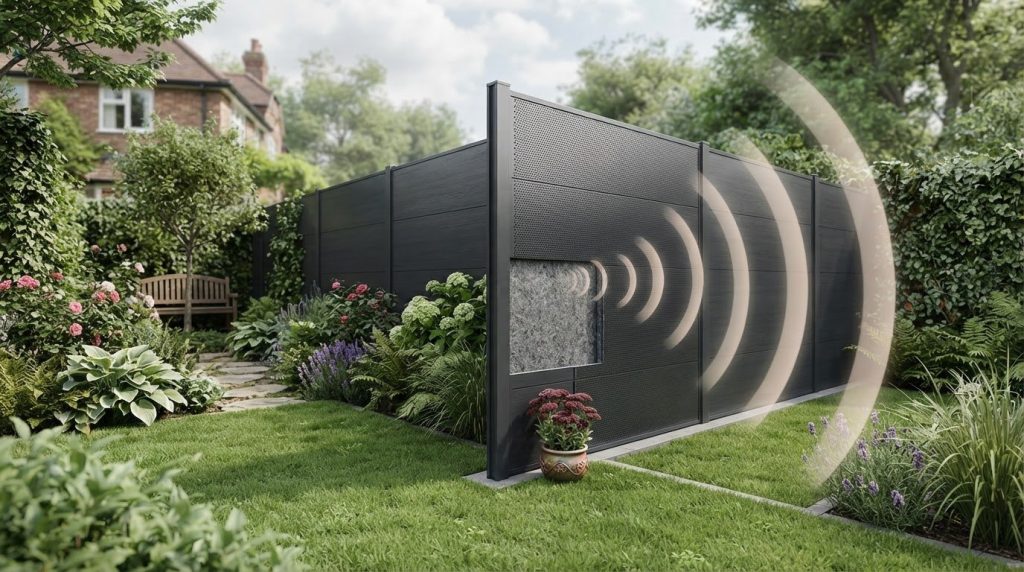
How to Soundproof a Garden Fence by Combining Reflection and Absorption
Planning permission is usually not needed for acoustic garden fencing in the UK. According to the UK Government, permission is required for a fence over 2 m high, or over 1 m high beside a road or footpath. The practical answer to how to soundproof a garden fence is to create a dense, continuous barrier that blocks the noise path and leaves no gaps.
It’s understandable to expect a taller fence or thicker panels to solve the problem, but sound can still pass through weak joints and open edges. A practical approach considers both reflection, which redirects some sound, and absorption within the barrier. This guide explains how to soundproof a garden fence, what acoustic fencing can achieve, and how to prevent sound gaps in a UK garden. The barrier’s position, continuity and construction matter as much as its material.
Key Takeaways
- Acoustic fencing can reduce noise, but its effectiveness depends on a continuous barrier with sealed edges and joints.
- Prevent sound escaping through gaps by choosing boards that fit closely and keeping the barrier in contact with the ground.
- Choose a dense barrier suited to its position, then combine sound reflection with absorption for a more considered approach.
- For an existing concrete-post fence, explore panel options designed to fit the posts without painting or treatment.
Does acoustic garden fencing work?
Acoustic fencing can reduce sound reaching a garden, but its performance depends on the barrier’s mass, position and continuity. It won’t make outdoor noise disappear.
How Acoustic Fencing Reduces Sound
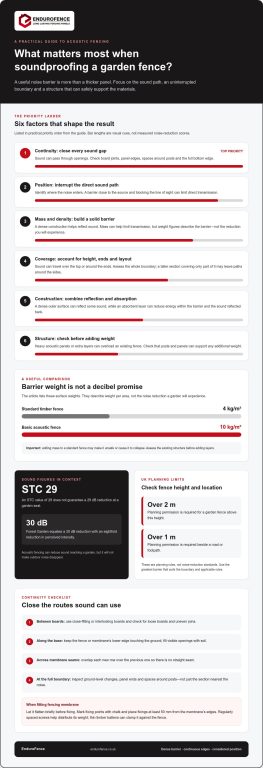
Acoustic fencing reduces transmission by reflecting some sound, absorbing some and converting absorbed energy into small amounts of heat. A solid, uninterrupted surface matters because sound can pass through openings instead of interacting with the barrier. An STC value of 29 doesn’t guarantee a 29 dB reduction at a garden seat. Forest Garden equates a 30 dB reduction with an eightfold reduction in perceived intensity.
Acoustic Fencing Compared With Other Barriers
Standard timber panels, acoustic barriers and garden walls differ in density, construction and how well they close the sound path. A standard timber fence is listed at 4 kg/m², compared with 10 kg/m² for a basic acoustic fence. These figures describe weight, not the reduction you’ll experience. A wall can provide a continuous barrier, while fencing may suit an existing boundary; gaps and height still affect both.
Noise From Traffic and Neighbours
Acoustic fencing can interrupt the direct path from traffic or neighbouring gardens to your seating area. Positioning a barrier close to the noise source and blocking the line of sight helps limit direct sound transmission. Sound can still travel over the top or around the ends, so assess the whole boundary rather than adding one short panel. The noise source and barrier layout both affect the result.
Acoustic Fencing Materials and Construction
Dense construction helps reflect sound, while absorbent layers can reduce the sound energy reflected back. Joints, panel edges and the bottom of the fence need attention, as openings let sound through. According to the UK Government, planning permission is required for a garden fence over 1 m high when it is next to a road or footpath. Fences over 2 m also require permission. This is a planning rule, not a noise-reduction standard. Costs depend on the barrier’s length, materials, supports and any alterations needed to the existing boundary.
Interlocking boards and preventing sound gaps
Interlocking boards can create a closer-fitting fence, but joints and edges still need attention. Even a narrow opening gives sound a path through the boundary.
Mass and Sealing Gaps
Mass helps limit sound transmission, while closed joints prevent sound passing through openings. Together, these qualities make a barrier more effective than covering gaps with insulation. Interlocking boards fit together at the edges, reducing direct openings between panels. Check for loose boards, uneven joins and spaces around posts. Heavy acoustic panels can add load to an existing fence, potentially making it unsafe or causing it to collapse. Make sure the fence structure can support any additional weight.
Sealing Gaps Beneath and Between Panels
For a continuous barrier, close the joints between panels and keep the bottom edge in contact with the ground. Fit fencing membrane without gaps, with its lower edge touching the ground. Overlap each new row over the previous one so sound cannot pass through a straight seam. Mark fixing points with chalk, then place fixings at least 50 mm from the membrane’s edges. Regularly spaced screws help distribute its weight; thin timber battens can clamp it against the fence.
At the base, fill visible openings with soil to maintain solid contact and prevent a clear route beneath the fence. Check the full boundary, including changes in ground level and the ends of each panel. During installation, unroll the membrane and let it flatten briefly before fixing it. For an existing concrete-post boundary, explore fence panel options designed to fit those posts.
Choosing a suitable noise barrier
Choose a dense, continuous barrier that blocks the line of sight to the noise source. Make it as high as practical and extend it around the garden perimeter, since sound can travel over or around a short fence. Deciding how to soundproof a garden fence starts with identifying that sound path.
For height, use the greatest barrier that suits the boundary and planning rules; thickness depends on the material and construction, not a universal measurement. According to the UK Government, a garden fence over 2 m high needs planning permission, as does a fence over 1 m high beside a road or footpath.
First, identify where the noise enters. For traffic beyond one boundary, a barrier close to the source can interrupt the direct sound path. For noise from neighbouring gardens, assess the shared boundary and any gaps at the ends. A taller section covering only part of the boundary may leave sound paths around its sides, so consider the layout as well as the height.
Material choice affects noise reduction and structural demands. Hedges and trees don’t block noise effectively because gaps between foliage let sound pass. Adding enough mass to a standard timber fence may make it unsafe or cause it to collapse. A double-skinned retrofit with insulation and a cavity can also create moisture or mould problems if the cavity cannot breathe.
Assess the existing fence before adding layers. Check whether its posts and panels can support extra weight, and consider whether a new, dense barrier is more suitable than loading an older structure. The fence should be continuous along its full length, with joins and gaps at ground level addressed rather than relying on height alone.
A practical plan for how to soundproof a garden fence takes account of the noise direction, available space, fence condition and required height. For traffic noise, consider the road-facing boundary and any applicable planning permission requirements. These factors help you match the barrier to the sound path without assuming that a thicker panel alone will solve the problem.
Combining sound reflection and absorption
A combined barrier uses a dense outer surface to reflect some sound and an absorbent layer to reduce energy within its structure. The aim is to limit transmission without simply redirecting noise towards another part of the garden. To soundproof a garden fence effectively, match both functions to the boundary and noise source.
Consider which side faces the incoming sound. A dense surface facing traffic can reflect some sound, while an absorbent layer on the garden side can reduce sound bouncing back into the space. The same arrangement may help with neighbouring noise, provided the barrier interrupts the direct sound path and covers the relevant boundary.
Absorption occurs when sound enters a porous or insulated material and movement within the layer dissipates some energy. Reflection occurs at a denser surface, where sound waves bounce away instead of passing through. Combining these materials in one construction can be more balanced than using a reflective sheet alone, which may redirect noise elsewhere.
Construction determines whether the materials work together. A double-skinned fence may combine dense and absorbent materials, though its construction should be considered carefully. Trapped moisture can create maintenance problems. A membrane fitted to an existing fence is another option, provided the panels support its added weight and the covering remains continuous.
If you’re considering how to soundproof a garden fence, assess the noise-facing side, garden-facing side, panel joins, ends and ground contact. A reflective face cannot compensate for an open seam, and absorption cannot block sound travelling over a low fence. Match the height and structure to the noise source, available space and how you use the garden.
For a practical finishing detail around fence posts, explore post covers as part of planning the boundary structure.
EnduroFence: Maintenance-Free Fence Panels
EnduroFence’s Maintenance-Free Fence Panels are designed for homeowners replacing timber panels in existing concrete posts. Each panel has profiled steel outer sheets on both sides and a high-density insulated core. The panels are powder-coated, weather-resistant and designed for security, with no painting or treating needed.
They’re a practical option if you want to update a boundary without replacing its concrete posts. A close fit and attention to gaps remain important for limiting sound transmission, since no fence panel alone can block sound travelling over or around the boundary. The panels are designed for straightforward replacement, and no training or qualification is needed.
For details about the panels and whether they suit your existing boundary, visit EnduroFence online.
Plan your next step with confidence
Before changing your boundary, notice where noise affects how you use the garden. Is it most disruptive near a seating area, along a shared edge or across the whole space? That distinction can help you prioritise the boundary and decide what matters most: a calmer corner, a consistent appearance or a practical update to an existing fence.
Planning how to soundproof a garden fence is also an opportunity to consider how the boundary will work over time. Think about upkeep, the condition of existing posts and how any changes will fit the garden. A clear idea of these priorities makes it easier to choose a solution that suits both the space and your plans for it.
If you’re considering a panel change for an existing boundary, contact EnduroFence for advice on the available options. A considered next step can help you shape a garden that feels more comfortable to use.
Frequently Asked Questions
Do acoustic garden fences require planning permission?
Not always. According to the UK Government, planning permission is required for a garden fence over 2 m high, or over 1 m high next to a road or footpath. For example, a boundary beside a pavement falls under the lower threshold. Before changing an existing fence, consider its position and proposed height, as acoustic performance does not remove planning requirements.
Are slatted-looking panels automatically acoustic?
No. A slatted appearance alone doesn’t make a panel acoustic. Open spaces between slats let sound pass directly through, so assess the construction behind the finish. A decorative face over a continuous, dense backing differs from exposed slats. Judge the panel by whether it forms a solid barrier, not by its visual style or surface finish.
Can Composite Fencing Be Part of a Noise-Reduction Design?
Yes, composite fencing can be part of a noise-reduction design if the finished barrier is solid and continuous. The material label alone doesn’t establish acoustic performance: board profile, joints, height and openings affect the sound path. If a composite boundary has decorative gaps, consider how they can be closed before relying on it to limit noise transmission.
Can I add acoustic fencing between existing posts?
Yes, acoustic panels can be fitted between existing posts if the structure can support their weight. Measure the clear span and check the post slots before choosing replacement panels. EnduroFence Maintenance-Free Fence Panels are designed to fit existing concrete posts, and the Retro Fitting Panel Swap is an option for replacing timber panels within that structure.
Does STC 29 mean 29dB less traffic noise?
No. An STC value of 29 doesn’t mean a garden seat will experience 29 dB less traffic noise. The rating describes sound transmission through a construction; outdoor results also reflect the sound path, barrier position, gaps and sound travelling over the top. Treat the rating as a product measure, not a guaranteed reduction at a particular listening point.
How many decibels does a fence reduce?
There isn’t one fixed decibel reduction for every fence. The measured change depends on the barrier’s construction and position, the noise source, openings and where sound is measured. For example, a solid barrier between a road and a seating area creates a different sound path from a short fence beside the seat. A product rating alone cannot predict the reduction outdoors.

Leave a Reply