

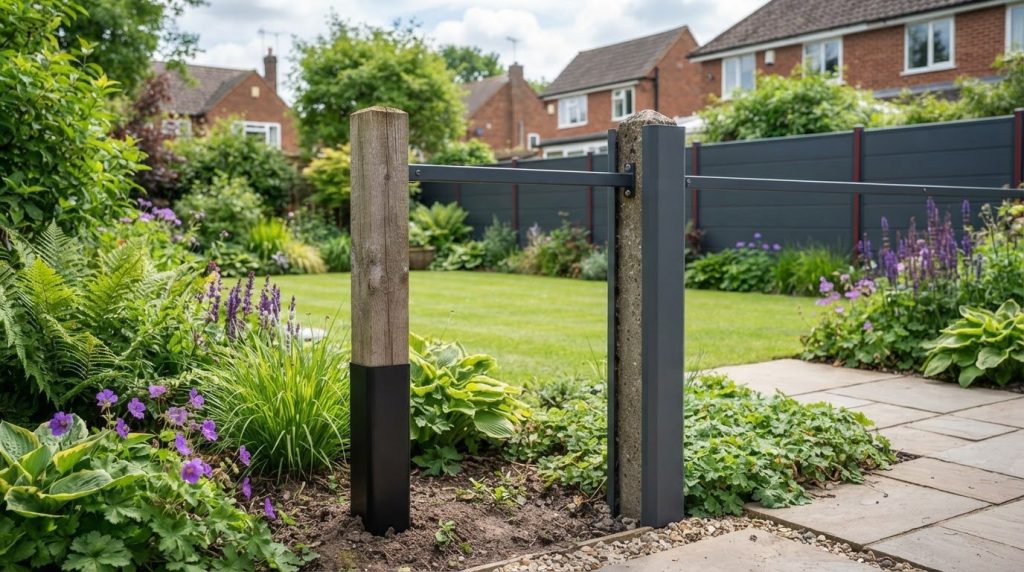
Fence Post Sleeves: How to Choose the Right Type for Your Garden
A fence post sleeve can solve one problem while doing nothing for another. A sleeve designed to protect timber at ground level has a different purpose from a cover that refreshes the appearance of an existing concrete post. They aren’t interchangeable.
If you’ve seen the term used for both products, start by identifying what you need the product to do. Then check your post’s material and measurements against the product details before buying.
This guide explains how ground-line sleeves are intended to protect timber, how decorative post covers differ, and what to measure when comparing options. If you have concrete posts, a cover can refresh their appearance; maintenance-free steel panels offer a way to coordinate a wider fencing update. By the end, you’ll know which type is relevant to your garden and what to check before choosing.
Key Takeaways
- Choose a fence post sleeve by its purpose: ground-line protection for timber and a cover for refreshing an existing concrete post are different solutions.
- Check what the specific product is designed to do and what evidence its maker provides before relying on performance claims.
- Identify the post material, measure it and compare the product’s fitting instructions and specifications with your goal.
- A sleeve or cover won’t replace a post that needs replacing. Base your decision on the post’s condition and material.
- EnduroFence post covers can refresh existing concrete posts, while maintenance-free steel panels offer a way to coordinate a wider garden fencing update.
What does a fence post sleeve do, and which type are you looking for?
A sleeve fits around a fence post, but its purpose depends on the product. Some are designed to protect a timber post where it meets the ground. Others cover the visible surface of an existing concrete post to refresh its appearance. The shared name can make them sound interchangeable, but they do different jobs.
Identify the post material and the problem first: a sleeve intended for buried timber won’t do the same job as a cover for an existing concrete post. This distinction helps you assess product claims against your needs instead of relying on the word “sleeve” alone. For a basic overview of types of fence posts, start by considering what your existing fence is built around.
Timber post sleeves and ground-line rot protection
Some products fit around timber at ground level to create a barrier between the wood and conditions associated with decay. They target ground-line rot, where the post enters the soil, rather than providing a decorative finish along the full visible length. Designs and fitting methods vary, so follow the product’s instructions. Any stated lifespan or guarantee applies to that specific product, not to every fence post sleeve.
For example, Postsaver states that its sleeves protect timber posts from ground rot for 20 years. That is a claim about Postsaver’s product, not a general promise for all sleeves or a reason to overlook correct fitting. A barrier sleeve targets a particular vulnerable area; it won’t automatically repair badly decayed timber or make an unsuitable post sound again.
Covers for existing concrete fence posts
A post cover has a different purpose. It goes over an existing concrete post to refresh its visible appearance; it isn’t a ground-line barrier for buried timber. EnduroFence post covers update concrete posts that remain in place. They can also form part of a wider garden refresh alongside maintenance-free steel panels designed for existing concrete posts.
Consider the result you want. If you’re concerned about rot where a timber post enters the ground, look for products specifically designed for that location and purpose. If your concrete posts are staying and the issue is their appearance, a post cover is the relevant category. Neither product should be expected to solve the other problem: a concrete post cover isn’t timber rot protection, and a ground-line sleeve isn’t a decorative cover for a concrete post.
Before comparing products, check what each is made to do, which part of the post it covers and how it fits. Similar product descriptions can refer to different functions. Start with the post you have and the job you need done; those details will narrow down the right option.
How fence post sleeves work: materials, barriers and realistic expectations
A ground-line sleeve is designed to create a barrier around the part of a timber post most exposed to conditions associated with decay. The principle is preventive: protect a vulnerable section, rather than treat rot after it has taken hold. Materials, construction and fitting methods differ, so the word “sleeve” alone doesn’t explain how a particular product works.
A rot barrier is intended to protect timber at ground level; a cover fitted over a concrete post refreshes its visible appearance. Keep that distinction in mind when comparing descriptions. Claims about protection, performance or longevity should relate to the specific product and the evidence its maker provides, not be assumed to apply to every sleeve on the market.
What a ground-line barrier can and cannot do
Use a timber barrier as a preventive measure and fit it according to the product instructions, so it covers the intended part of the post. Check details about its construction, fitting and any testing or guarantee. A stated service life or test result applies to that named product and its conditions of use, not to all sleeves.
Prevention has limits. If a post is already soft, badly decayed or unstable, a sleeve won’t restore its strength or make it structurally sound. Assess the post’s condition before deciding that a protective barrier is the answer. A damaged post may need attention beyond adding a sleeve.
What a post cover changes on an existing fence
A post cover changes the appearance of the part of the fence you see. It can refresh an existing concrete post, but don’t assume it provides timber rot protection or adds structural strength. Nor should you infer weatherproofing or insulation from the word “cover”; rely on claims made for the particular product.
For a wider garden update, EnduroFence post covers can be paired with maintenance-free steel panels designed for existing concrete posts. A range of colours and finishes gives you options for coordinating the overall look while leaving the posts in place. The covers and panels have separate roles, so decide which visible elements you want to update and compare their product details accordingly.
In short, match the product to the job: preventive ground-line protection for suitable timber, or a visual refresh for an existing concrete post. If you’re considering the latter, explore EnduroFence post covers and related fencing options, then compare the relevant product information with your requirements.
Timber sleeve or concrete post cover? Compare the options by purpose
Start with the post you have, then decide what you want to change. A timber ground-line sleeve is intended to reduce exposure to decay around the point where a timber post enters the ground. A concrete post cover updates its visible appearance. Replacing a damaged post is a separate decision, not another type of sleeve.
| Option | Post material | Purpose and fitting location | Intended outcome |
|---|---|---|---|
| Ground-line rot sleeve | Timber | Fitted around the section of post at or near ground level, following the maker’s instructions. | A barrier intended to help protect the timber in a decay-prone area. |
| Post cover | Existing concrete | Fitted over the visible post, according to the product’s specified fit. | A refreshed appearance while retaining the existing post. |
| Post replacement | Depends on the fence design | The damaged or unstable post is removed and replaced, rather than covered. | Addressing a post that can no longer provide reliable support. |
Choose by post material and the problem to solve
If the post is timber and you’re concerned about decay where it meets the ground, look for a sleeve designed for that specific protective purpose. If the post is concrete and you want to improve its appearance, a post cover is the relevant option. A cover isn’t a rot barrier simply because it surrounds a post, and a timber sleeve won’t give concrete posts a coordinated finish.
Condition matters too. If a post is loose, badly damaged or no longer supports the fence securely, adding a sleeve or cover won’t correct the underlying problem. Consider replacement if the post is unsound. A covering may hide damage without resolving it, so assess the post before choosing a cosmetic or preventive product.
Compare fit, finish and product evidence
Check the product’s stated dimensions and fitting instructions against the actual post. Don’t assume a broad size label guarantees a fit. Timber posts can vary, and covers need to match the posts they are designed for. The next section explains what to measure and how to compare those details.
For a concrete-post refresh, consider how the cover’s appearance will work with the panels and the rest of the garden. EnduroFence offers post covers and maintenance-free steel panels in a range of colours and finishes, so you can plan a coordinated update while keeping existing concrete posts in place.
For rot sleeves, distinguish specific evidence from general wording. Look for claims tied to the named product, including what the maker says has been tested, the conditions covered and any guarantee terms. Don’t treat one product’s performance statement as proof that every fence post sleeve works in the same way. Match the product to the post material, its condition and the result you want.
How to check a fence post sleeve will suit your posts
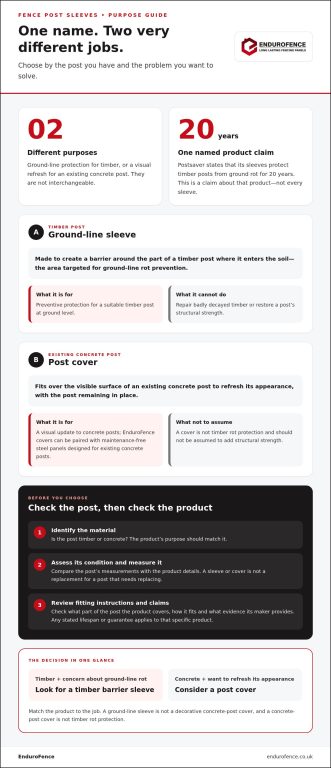
A careful fit check can prevent you buying a sleeve that won’t suit the post or address the problem you have. Work through these steps in order, using the product’s stated measurements and fitting instructions as your reference.
- Identify the post material. Check whether it’s timber or concrete. This narrows down the relevant product type because a ground-line timber sleeve and a cover for an existing concrete post have different purposes.
- Measure the post. Record its width and depth, or its diameter if it’s round. Follow the product instructions for where to measure and whether to check more than one point.
- Define the goal. Decide whether you want preventive protection around timber at ground level or a visual update to a concrete post. If the post is damaged or unstable, a sleeve or cover won’t resolve that underlying issue.
- Compare the specifications. Check the stated size, compatible post type, fitting method and intended use against your measurements and goal. Don’t rely on the product label alone.
Measure the post before comparing sleeve dimensions
Measure the actual post, rather than relying on a size name in a product listing. Timber sold under a nominal size may not measure exactly that size, so record its real dimensions. For concrete, note the shape and measure where the cover is intended to fit. A post may not be perfectly even along its length.
Measurement points and acceptable tolerances vary by product. The instructions may specify where to measure, how much clearance is needed or how dimensions are defined. Follow the relevant product guidance instead of assuming one method applies to every fence post sleeve. Compare dimensions only once you know what the figures refer to.
Check the intended use and fitting requirements
Read the product details for the material it’s designed for, the area it covers and the fitting requirements. For a ground-line timber sleeve, check how the instructions say to position it around the post. For a concrete post cover, compare the stated fit with your measurements and consider whether its appearance suits your planned fence update.
Look for requirements that may affect fit, such as the post’s shape or condition, and whether there needs to be a clear path to fit the product in place. This isn’t a full installation guide; it’s a way to spot a mismatch before choosing. Read claims about performance, testing or guarantees in the context of the specific product.
If your measurements point towards a cover for an existing concrete post, Explore EnduroFence post covers as part of a considered garden fencing update.
Refresh existing concrete posts with EnduroFence post covers
If your concrete fence posts are staying in place, you can refresh the fence’s appearance without treating them as timber posts that need ground-line rot protection. EnduroFence post covers refresh existing concrete posts. They serve a visual purpose, so consider the posts’ condition and the finish you want across the garden before choosing this option.
When a cover suits an existing concrete-post fence
A cover may suit a fence with concrete posts that are staying in place and whose appearance you want to improve. It isn’t a timber rot sleeve or a repair for cracked, unstable or otherwise damaged concrete. First consider whether the existing posts are suitable to remain, then think about how a refreshed finish would look alongside the panels and other garden features.
Post covers are one part of the decision. Compare the relevant product details for fit and suitability, and consider the overall effect rather than judging a post in isolation. A consistent finish can help the fence feel more considered, while a contrast can make the posts stand out. Choose based on the look you want, not on an assumption that a cover will solve a structural problem.
Plan a coordinated fence update
If you’re refreshing more than the posts, EnduroFence maintenance-free steel panels are designed to fit existing concrete posts. Pairing the panels with post covers can bring the visible parts of the fence together while leaving the posts in place. The panels have profiled steel outer sheets and a high-density insulated core, with a range of colours and finishes to choose from.
Before settling on a finish, look at the garden’s fixed details, such as paving, planting and the colour of nearby structures. Decide whether you want the fence to blend in or create a clear visual boundary. This makes it easier to compare colours and finishes as part of the whole update instead of selecting each element separately. Check the product information for its fit and specifications; don’t assume dimensions or fitting details from one cover apply to another.
The practical distinction remains the same: a timber fence post sleeve is associated with ground-line protection, while a cover refreshes the appearance of an existing concrete post. Neither should be expected to make an unsound post structurally sound. EnduroFence also offers a free quote through its website if you’re planning a wider fencing update.
Explore EnduroFence post covers and fencing options
Plan a fence update that suits your garden
Before choosing your next step, decide how you want the boundary to look and what you plan to keep in place. This turns a fence post sleeve search into a clearer decision about your garden, rather than a purchase based on the product name alone.
If you’re keeping existing concrete posts, EnduroFence offers post covers alongside maintenance-free steel fence panels designed to fit those posts. Choose from a range of colours and finishes to plan a consistent look across the fence. Consider your garden’s style and the features you want to retain, then compare options that fit that plan.
With the right product for your posts and your garden, a fence update can be more straightforward. Explore EnduroFence post covers and fencing options to plan your update.
Frequently Asked Questions
What is a fence post sleeve, and what does it do?
A fence post sleeve is a covering fitted around a post, and its function depends on the product. Some types are designed to protect timber around ground level, while a post cover can refresh the appearance of an existing concrete post. Check that the product is intended for your post material and goal. The term alone doesn’t tell you whether it offers protection, a decorative finish or both.
Do fence post sleeves prevent timber posts from rotting?
Some sleeves are designed to help protect timber from conditions associated with decay where the post meets the ground. They’re a preventive measure, not a guarantee that timber can never rot. Check the product’s stated purpose, fitting instructions and supporting evidence. A claim about a particular sleeve’s tested performance or guarantee applies to that product and its terms, not to all timber post sleeves.
Can you put a sleeve over an existing concrete fence post?
Yes, if you choose a post cover designed to fit that concrete post. First check that the post is in suitable condition to remain, then compare its measurements with the cover’s stated fitting details. A cover can refresh the visible post, but it isn’t the same as a timber rot barrier. EnduroFence also offers maintenance-free steel panels designed for existing concrete posts.
How do I measure a fence post for a sleeve?
Identify the post material, then use a tape measure to record the dimensions required by the product instructions. For a square or rectangular post, measure across the faces; for a round post, measure its diameter. If the post varies in width or shape along its length, note that and follow the product guidance on where to measure. Compare actual measurements, not just a nominal size in a listing.
Are timber post rot sleeves and concrete post covers the same thing?
No. A timber rot sleeve is intended to protect a particular section of a timber post, commonly around ground level. A concrete post cover refreshes the appearance of an existing concrete post. Their materials, fit and purpose differ, so one isn’t a substitute for the other. Check what your fence posts are made from, then choose a product designed for that material and intended use.
Can a fence post sleeve repair a post that is already rotten?
No. A sleeve may be designed to help prevent decay, but it can’t restore strength to timber that has already rotted. If a post feels soft, moves significantly or no longer supports the fence securely, don’t treat a cover as a repair. Assess whether the post can still do its structural job before choosing a preventive product or planning a replacement.
Do I need to replace my fence posts to update the look of my garden fence?
Not necessarily. If existing concrete posts are sound and you want to refresh the fence’s appearance, post covers can offer an alternative to replacing them. EnduroFence steel panels are designed for existing concrete posts, and a range of colours and finishes helps you plan a coordinated look. Check the product fit and the condition of your posts before deciding which parts of the fence to update.

Leave a Reply