

Best Fence for High Winds UK: How to Choose the Right Fence
The best fence for high winds UK gardens need isn’t always the most solid-looking one. A close-board panel can catch the wind like a sail, whilst a design that allows some airflow may reduce pressure on the fence. But no panel can make up for weak supports or unsuitable fixings.
If your fence rattles, loosens or blows out in strong gusts, it’s understandable to wonder whether you need a different style, stronger posts or both. The right choice depends on how exposed the boundary is and whether the existing structure can support a replacement.
This guide compares fence designs and materials, explains what to check around your garden, and sets out practical steps to take before ordering. You’ll also learn why weather resistance isn’t the same as verified wind performance, and what to confirm if you’re considering replacement panels designed for existing concrete posts. That way, you can compare suitable options without replacing sound parts or relying on guesswork.
Key Takeaways
- The best fence for high winds UK gardens depends on local exposure, panel design and the condition of the supports, not appearance alone.
- Compare solid and airflow-friendly designs against your privacy, upkeep and appearance needs before choosing replacement panels.
- Assess panels, posts and fixings as one system. A heavier fence isn’t automatically better suited to strong winds.
- Before ordering, check your existing post condition, panel measurements, compatibility and the manufacturer’s fitting guidance.
- Steel panels designed for existing concrete posts may be an option to assess. Confirm any wind-performance evidence rather than assuming weather resistance proves it.
Best fence for high winds UK: start with your garden’s exposure
The best fence for high winds UK gardens depends on how exposed the boundary is, the panel design, the condition of its supports and how the fence is fitted. A panel that performs well in a sheltered garden may face greater strain beside open ground or on a boundary that takes the full force of prevailing winds. There isn’t one design that suits every site, and no fence should be assumed windproof.
What makes one garden more exposed than another?
Look beyond the garden itself. Nearby buildings, hedges and established trees may provide shelter from the wind, whilst open fields or a gap between buildings can leave a boundary more exposed. The boundary’s direction and the garden’s layout matter too: wind may be channelled along a passage or strike one fence run more directly than another.
Exposure can vary within the same property. Note which boundary faces open ground, where shelter changes and where gusts seem strongest. If panels have already loosened, rattled or failed, record their positions and what happened. This can help you identify whether damage is concentrated on one exposed section or points to a wider problem with the fence structure.
How does wind affect fence panels and supports?
A fence presents a surface to moving air. A barrier can reduce wind speed on the sheltered side, but the force acting on the fence still needs to be carried through its panels, fixings and supports. A solid panel may catch more wind than a design with gaps, but the complete system and the conditions at the boundary matter too.
Wind exposure is the degree to which a fence boundary is open to, and affected by, local winds. It’s a practical factor in choosing a fence, not just a description of the wider area.
Check where the damage starts. Cracked or displaced panel edges may point to a panel or fixing issue. Posts that lean, move at ground level or pull away from their supports suggest the problem may extend beyond the panel. Rails, loose connections and soft or disturbed ground can also contribute. Don’t treat a replacement panel as the whole answer until you’ve checked what holds it in place.
Use this first assessment to compare designs against the needs of your boundary. Note the most exposed section, the direction of past damage and the condition of each post and fixing. You can then weigh privacy and airflow against what the existing structure can safely accommodate.
Compare fence types for windy gardens before choosing panels
Once you’ve assessed the boundary, compare what each design offers in practice. Privacy, airflow, upkeep and fit all matter, but none alone proves how a fence will perform in strong winds. The Planning Portal’s fence guidance can help you check planning considerations. Wind performance still depends on the specific panel and its supports.
| Fence type | Privacy and airflow | Upkeep and appearance | Compatibility to check |
|---|---|---|---|
| Timber panels | Varies by panel style; more solid options screen views but allow less air through. | Natural appearance; timber may need treatment to maintain it. | Check panel dimensions, condition and how it fits the existing posts and rails. |
| Closeboard | Usually offers strong screening, with little airflow through a closely built panel. | A traditional, solid appearance; upkeep depends on the timber and finish. | Assess the full construction, including boards, rails, posts and fixings. |
| Slatted or spaced designs | Gaps can let some air through, but usually reduce privacy compared with a solid panel. | Creates a more open, contemporary look; maintenance depends on the material. | Check how the slats are fixed and whether the design suits the boundary and supports. |
| Steel panels | Privacy depends on the panel design; don’t assume a steel panel allows airflow. | Profiled steel can offer a clean finish. EnduroFence panels are weather-resistant and need no painting or treatment. | Confirm measurements and fitting guidance. EnduroFence panels are designed for existing concrete posts, subject to suitability and fit. |
Do solid or spaced fence panels suit exposed gardens?
A solid panel may suit a boundary where screening is important, whilst a spaced design trades some privacy for gaps that allow some airflow. Those gaps don’t guarantee resistance to wind damage, and there’s no single spacing that will suit every garden. Exposure, panel construction and the strength and condition of posts and fixings all affect suitability. Compare the whole setup, not just the panel’s appearance.
How do timber and steel panels differ in upkeep?
Timber may need periodic treatment, depending on its finish and exposure. EnduroFence’s profiled steel panels have a high-density insulated core and need no painting or treatment. That’s a difference in upkeep, not proof of a particular wind rating: weather resistance and wind-load performance are separate considerations. For more detail on material upkeep and durability, see the planned guide, “Why Steel Garden Fence Panels Outlast Timber”.
If you’re considering steel as a replacement, explore maintenance-free steel fence panels. Before deciding, check the product’s dimensions, fixing requirements and any available wind-performance evidence.
Is a heavier or solid fence automatically better in high winds?
No. A heavier panel or solid appearance doesn’t, by itself, show how a fence will perform in strong winds. A solid surface may catch more wind, whilst a more open design may allow some air through, but the result depends on the panel construction and how it’s supported. The RHS advice on windbreaks explains why filtering wind with a semi-permeable barrier can be preferable to creating a completely solid screen.
Assess the whole fence system: panel, posts, rails or channels, fixings and installation. A robust panel attached to loose or unsuitable supports may still move or fail. Likewise, a strong-looking post doesn’t confirm that a panel and its fixings suit the conditions at your boundary. Material weight and weather resistance are useful considerations, but neither proves wind-load performance.
What evidence should a wind-resistance claim include?
Ask the manufacturer for documentation behind any stated wind rating. Check the test method, the configuration tested and what the result applies to. Does it cover the exact panel, post type and fixing arrangement you intend to use, or a different setup? Also ask whether the evidence relates to a complete fence system or just one component. Don’t infer performance from a product photograph or a general claim that it’s durable.
For EnduroFence panels, check whether product-specific wind-load test data or a rating is available before making a performance comparison. The panels are described as weather-resistant, but that alone doesn’t establish how they perform under wind loading.
Why do posts and fixings matter as much as panels?
Panel material alone cannot establish how a fence system will perform in wind; the supports, fixings and installation matter too. Loose fixings can let a panel rattle or shift, whilst cracked, leaning or moving posts may indicate that the support itself needs attention. Ground condition can also affect how firmly posts are held.
If you’re considering a panel-only replacement, inspect existing concrete posts first. Look for visible cracks, movement, damage to the panel channels and signs that the posts are leaning. Confirm that the replacement panel’s measurements and fixing requirements suit those posts, then follow the manufacturer’s fitting guidance. EnduroFence panels are designed to fit existing concrete posts, but check the precise compatibility and condition of your posts before relying on them.
Choose the best fence for high winds UK conditions by asking for evidence that matches the proposed panel and support arrangement. Don’t select the heaviest or most solid option based on appearance alone.
Use this checklist to choose a fence for a windy UK garden
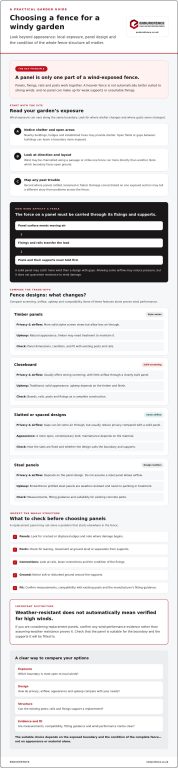
Use these steps to turn your exposure assessment into a practical buying decision. The best fence for high winds UK conditions isn’t chosen by material alone. Check the site, supports and panel details together.
- Assess exposure. Note which boundary faces open ground, where shelter changes and where wind has previously loosened or damaged panels.
- Inspect the supports. Check posts for cracks, leaning or movement, and look for loose or damaged fixings. A new panel won’t resolve a problem with an unstable post.
- Compare designs. Weigh privacy and appearance against airflow, upkeep and the needs of the exposed boundary. Gaps may allow some air through, but they don’t guarantee wind performance.
- Verify evidence. Ask for documentation supporting any wind-performance claim. Check which panel, posts and fixings were assessed, and whether the evidence applies to the proposed arrangement.
- Confirm fit. Measure the opening and check the panel dimensions and fitting requirements against the manufacturer’s current guidance before ordering.
What should you inspect before ordering replacement panels?
Measure the panel opening carefully, then confirm the existing posts are stable and suitable for the replacement. Check the manufacturer’s latest specifications for dimensions, fixings and fitting guidance rather than relying on an old panel’s measurements. Note any cracked posts, loose connections or damaged channels. These issues may need attention separately, as replacing the panel alone won’t correct them.
When should you seek a qualified assessment?
Get qualified advice if posts are visibly leaning, cracked or unstable, or if the boundary has unusual exposure or conditions you’re unsure how to assess. Don’t assume a panel swap is suitable until the supports and site have been checked. For more guidance on selecting panels for exposed sites, look out for the planned guide, “How to Choose Weatherproof Fence Panels for UK Winds”.
If your existing concrete posts appear suitable, EnduroFence panels are designed to fit them, subject to checking measurements and compatibility. You can request a quote for replacement fence panels and confirm the fitting details before deciding. A quote is a starting point, not a substitute for checking post condition or verifying wind-performance evidence.
Could EnduroFence steel panels suit your high-wind fence replacement?
If you’re replacing panels but hope to keep sound concrete posts, EnduroFence steel panels may be an option to assess. They’re designed to fit existing concrete posts, which could suit a panel-swap project where the supports are in suitable condition. Compatibility still needs checking against your fence and the current product information.
What is confirmed about EnduroFence panels?
The panels have profiled steel outer sheets around a high-density insulated core. They’re weather-resistant and require no painting or treatment, so they offer a low-maintenance alternative to panels that need periodic surface care. A range of colours and finishes is available, letting you consider appearance alongside the practical requirements of the boundary.
These details describe the construction and upkeep, not performance in high winds. Weather resistance doesn’t establish a wind rating, and the panel material alone can’t show how a complete fence will perform. The panel, its fixings, the existing posts and the way it’s fitted all need to suit the particular site.
What should you confirm before choosing EnduroFence?
Before deciding, check the condition of the concrete posts and measure the panel opening. Compare those measurements with the current panel dimensions, compatibility information and fitting requirements. Ask whether wind-load test data is available for the relevant panel and fixing arrangement, and what configuration any evidence covers. Don’t assume a result for a different fence setup applies to yours.
This helps you assess whether a panel-only replacement is appropriate, rather than ordering on the basis of material or appearance alone. If the posts are cracked, leaning or unstable, address that uncertainty before treating replacement panels as the solution. If the boundary is unusually exposed, consider whether you need a qualified assessment of the site and supports.
The best fence for high winds UK gardens can’t be selected from a product description alone. Match the panel to the exposure, confirm it fits the existing structure, and look for evidence relevant to the configuration you plan to use. EnduroFence offers a free quote through its website. If the panels appear suitable, request a free quote and confirm the measurements, compatibility and available wind-performance information before proceeding.
Choose your next fence with confidence
The best fence for high winds UK gardens depends on the boundary’s exposure, the panel design and the condition of its posts and fixings. A heavier or solid panel isn’t automatically the safer choice, and gaps don’t guarantee wind resistance. Compare the complete fence system, then check that any performance evidence applies to the panel and support arrangement you’re considering.
If you’re looking at a panel replacement, EnduroFence steel panels are designed to fit existing concrete posts, subject to confirming that the posts are suitable and the measurements match. Their profiled steel outer sheets surround an insulated core, and they need no painting or treatment. These features describe construction and upkeep, not a verified wind rating, so ask what product-specific evidence is available.
Have your panel measurements and post details to hand, then check panel suitability and request a free quote. A considered choice can help you move forward without replacing sound supports or relying on guesswork. You’re now better equipped to assess your options and choose a fence that suits your garden.
Frequently Asked Questions
What is the best type of fence for high winds in the UK?
There isn’t one fence type that’s best for every windy garden. The best fence for high winds UK conditions depends on local exposure, panel design, post condition, fixings and how the fence is fitted. Spaced designs may allow some airflow, whilst solid panels can offer more privacy. Compare the complete system and ask for wind-performance evidence that applies to the specific panel and support arrangement.
Are solid fence panels more likely to blow down in strong winds?
Solid panels can catch more wind than designs with gaps, but that doesn’t mean every solid fence will fail. Suitability also depends on the panel construction, posts, fixings, ground conditions and installation. A solid appearance or heavier material doesn’t prove wind performance. Check where damage has occurred and whether the supports are stable before deciding that panel style alone caused the problem.
Can steel fence panels be used in an exposed garden?
Steel panels may be an option for an exposed garden, but the material alone doesn’t confirm suitability. Check whether the manufacturer provides wind-load evidence for the exact panel and fixing arrangement, and make sure the posts can support it. EnduroFence panels have profiled steel outer sheets around a high-density insulated core and are designed for existing concrete posts. Their weather resistance isn’t proof of a wind rating.
How can I make my fence panels more secure in high winds?
Start by checking the whole fence, not just the panel. Look for loose fixings, damaged rails, cracked or leaning posts and movement where posts meet the ground. Confirm that panels and fixings are suitable for the existing supports, then follow the manufacturer’s fitting guidance. If posts are unstable or you’re unsure what’s causing movement, seek qualified advice before replacing or securing panels.
Do fence panels for high winds need gaps between them?
No single gap size is suitable for every fence, and gaps don’t guarantee that panels will resist wind damage. Spaced or slatted designs can let some air pass through, but usually provide less screening than solid panels. Consider the boundary’s exposure, the privacy you need, panel construction and the supports. Ask the manufacturer for evidence relating to the complete arrangement rather than relying on spacing alone.
Can I replace fence panels and keep my existing concrete posts?
Yes, if the concrete posts are in suitable condition and the replacement panels are compatible with them. Check for cracks, leaning, movement and damage to the panel channels before ordering. Measure the opening and compare it with the manufacturer’s current panel dimensions and fitting requirements. EnduroFence panels are designed to fit existing concrete posts, but compatibility and post suitability should be confirmed for your fence.
What should I check before buying wind-resistant fence panels?
Assess how exposed the boundary is, inspect the posts and fixings, then compare panel designs for privacy, airflow and upkeep. Check the panel measurements and fitting guidance against your existing supports. Ask what wind-load evidence is available and whether it covers the exact panel and support configuration you plan to use. If posts are damaged or the site presents unusual conditions, get qualified advice before ordering.

Leave a Reply