

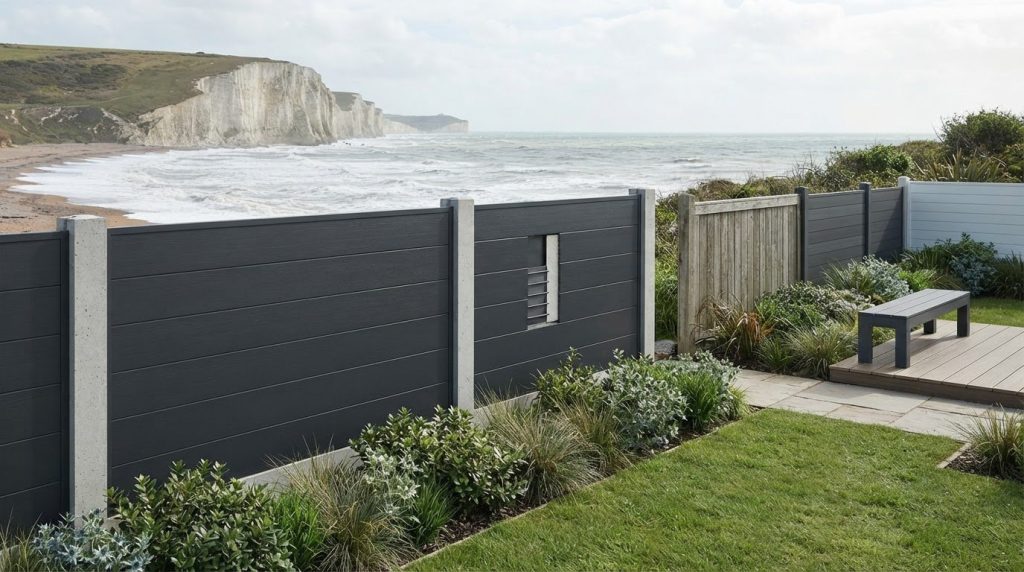
Best Fencing for Coastal Areas in the UK: 2026 Guide
The toughest-looking fence isn’t automatically the best choice beside the sea. Salt spray and damp can affect materials in different ways, while strong winds put extra pressure on solid panels and their posts. If you’re comparing the best fencing for coastal areas UK gardens can use, start by assessing the boundary’s exposure, the fence’s construction and how much upkeep you’re prepared to do.
It’s understandable to wonder whether metal fencing can cope with coastal conditions, or whether timber will mean years of treatment and repairs. Don’t rule out a material based on its name alone. Compare its resistance to corrosion or decay, how the fence is supported, and the care the specific product needs.
This guide compares timber, aluminium, steel, PVC and composite fencing, with practical points to consider before choosing. You’ll also learn why wind exposure matters, how existing posts affect your options, and when replacing panels while keeping sound concrete posts could be a straightforward way to update your garden. EnduroFence panels are designed to fit existing concrete posts and don’t require painting or treatment, giving you another option to compare.
Key Takeaways
- Find the best fencing for coastal areas UK gardens need by assessing how exposed the boundary is, rather than choosing on material alone.
- Compare timber, composite, PVC, aluminium and steel for upkeep, design flexibility and how each suits your garden conditions.
- Consider fence design, posts and installation together when assessing wind exposure.
- Before choosing replacement panels, inspect your posts and check panel dimensions and compatibility with their arrangement.
- Compare steel panels with profiled outer sheets and an insulated core if you want a fence that doesn’t require painting or treatment.
Best fencing for coastal areas in the UK starts with understanding exposure
Wind, damp and salt carried in coastal air can all affect a garden fence. But a coastal address alone doesn’t tell you how much pressure your fence faces. A sheltered garden behind buildings or hedges may experience different conditions from a boundary across open ground, even if both are close to the sea.
The best fencing for coastal areas UK gardens need depends on exposure, fence position, construction and upkeep, not just the material name. Start by identifying what the fence has to withstand, then compare products against those conditions.
Which coastal conditions put the most pressure on fencing?
Wind pushes against a fence, particularly where there’s little to break its path. The force on each section varies with its height, design, condition and position. A solid run facing an open approach may be more exposed than a section sheltered by the house, a hedge or neighbouring buildings.
Moisture matters too. Repeated wetting can contribute to timber decay if the wood isn’t suitably protected and maintained. Salt carried in sea air can settle on surfaces and contribute to deterioration, particularly where protective coatings are damaged. The effects vary from one garden to another: distance from the shore is only one factor, alongside shelter, prevailing weather and the fence’s condition.
Coastal settings also differ in how wind and water shape the surrounding land. The overview of coastal erosion in the UK provides wider context on these forces, but it isn’t a guide to fence performance. For your garden, focus on conditions at the boundary itself.
How can you assess your garden’s exposure?
Walk the boundary and observe it in different weather, rather than judging the garden from its most sheltered spot. Note where buildings, hedges or walls provide protection and where open ground gives wind a clear approach. Look for sections that regularly feel windier or stay wet for longer after rain.
- Map the boundary: note which sides are most exposed and whether the fence stands in the open or behind shelter.
- Compare sections: record where wind seems strongest and where rain or spray appears to reach most often.
- Check the surroundings: identify changes in shelter along the fence that could create different conditions from one end to the other.
This simple site check gives you a more useful basis for comparing materials and designs than relying on a broad “coastal” label. It also helps you see whether the whole boundary faces similar conditions or one section needs particular attention. Your observations are a practical starting point, not a substitute for site-specific technical advice if wind loading, structural condition or installation requirements need assessing.
How salt, moisture and wind affect coastal fence materials
Coastal exposure isn’t one condition. It’s the combined effect of wind, moisture and salt in the air, with the balance changing from one boundary to another. A fence might face strong gusts but sit behind shelter from sea air, whilst another may be more exposed to damp or salt carried on the wind. That context matters when you compare materials.
A material’s general properties are only part of the decision. Suitability depends on the product’s construction, the site’s exposure and how the fence is installed. Judge the best fencing for coastal areas UK homeowners choose as a complete fence system, not by its material label alone.
What does salt air mean for metal fencing?
Salt exposure can contribute to corrosion in susceptible metals. The risk depends on the metal and the protection applied to it, so look at the product’s stated finish and construction rather than assuming all metal panels behave alike. A protective coating is an important point to compare, but it doesn’t make every product identical or remove the need to consider local exposure.
Wear or damage to a finish may affect how well it protects the material beneath. When comparing products, look at the finish on the surfaces, edges and joins. Avoid treating “metal” as a single performance category: different metals and finishes have different properties, and a general description can’t establish how a product will perform in a particular garden.
Why do wind and moisture matter beyond the fence material?
Wind pressure acts on the fence as a structure. Panels transfer force to posts and fixings, so their condition, spacing and installation all contribute to how the fence performs. A solid panel presents a different surface to the wind from a design with gaps. That doesn’t determine the right choice by itself, but it shows why the panel and its support need to be considered together.
Moisture is another factor when comparing materials. Timber can be vulnerable to decay if it stays damp and isn’t adequately protected. Manufactured materials have different properties, but their suitability still depends on their construction and intended use. Don’t assume that a product described as weather-resistant is automatically right for every exposed position.
The UK government coastal erosion strategy sets out a wider approach to managing flood and coastal erosion risks in England. It isn’t a guide to garden fence performance, but it provides context for the forces that can shape coastal environments. For fence selection, focus on conditions and support at your own boundary.
If low upkeep is a priority, compare the construction and care requirements of maintenance-free steel fence panels with other options. EnduroFence panels use profiled steel outer sheets and a high-density insulated core, fit existing concrete posts and don’t require painting or treatment. They’re weather-resistant, but aren’t described as salt-proof or specifically coastal-rated. Compare their stated features without assuming a universal coastal advantage.
Coastal fencing compared: timber, composite, PVC, aluminium and steel
Each material brings different trade-offs in upkeep, appearance and construction. The table below is a starting point, not a performance guarantee: products within the same category can differ in treatment, finish and design. Compare the specific panel as well as the broad material type.
| Material | Coastal considerations | Maintenance and design |
|---|---|---|
| Timber | Check how the wood is treated and whether it is suitable for its position. Moisture and exposure make protection and condition important considerations. | May need ongoing treatment and care. Offers a familiar natural appearance and a range of panel styles. |
| Composite | Products vary in construction and finish, so assess the particular panel rather than assuming all composite performs alike. | Often chosen by people seeking less routine upkeep than timber. Available in different finishes, including wood-effect designs. |
| PVC | Product quality and construction matter. UV inhibitors are a relevant feature to compare where sunlight exposure could affect colour or brittleness. | Doesn’t need painting like timber, and is available in different colours and styles. Check that the look suits your garden. |
| Aluminium | Powder-coated aluminium is commonly considered for coastal settings because it does not rust like steel. Finish and product construction still matter. | Usually has a clean, modern appearance. Design choices depend on the panel or system selected. |
| Steel | Steel products aren’t all alike. Protection and finish are important considerations, as exposed or damaged areas can be more vulnerable to corrosion. | Can suit contemporary gardens and comes in different finishes. Compare the panel construction and care requirements. |
How do common fencing materials differ near the coast?
Timber’s natural look can be appealing, but its upkeep may include treatment or repair as it weathers. Composite and PVC are different manufactured options, not interchangeable labels: construction, finish and care guidance vary by product. Aluminium and steel also need to be judged individually. Protective finishes and panel designs differ, so the material name alone won’t tell you how a particular fence will perform.
Which trade-offs deserve more attention than a simple best-material label?
Balance the appearance you want against the upkeep you’re willing to do. Consider panel construction and finish, the condition of the supporting posts and how exposed the garden is. A design that suits a sheltered boundary may not suit a more open position, and the complete fence system matters as much as the panel material.
The best fencing for coastal areas UK gardens can use is the option whose construction, maintenance needs and design suit the site’s exposure. EnduroFence panels are a lower-maintenance steel option, with profiled steel outer sheets and a high-density insulated core. They fit existing concrete posts and don’t require painting or treatment. They’re weather-resistant, but aren’t described as salt-proof or specifically coastal-rated. Compare them on their stated features rather than assuming they have a universal coastal advantage.
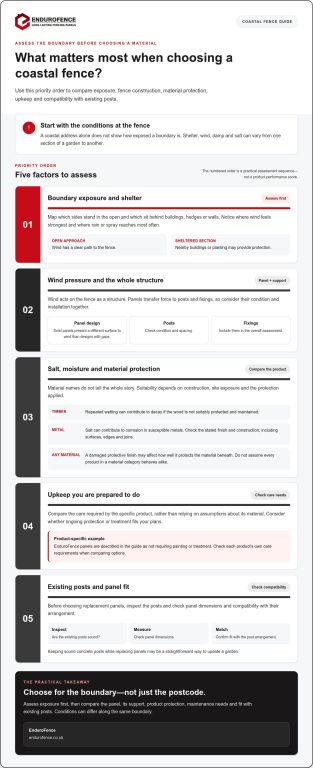
How to choose coastal fence panels for your garden and existing posts
Replacing panels can be a practical way to refresh a boundary without replacing sound concrete posts. First, assess the conditions at the fence and the state of the existing structure. Then compare panel fit, upkeep and appearance. This sequence helps you shortlist the best fencing for coastal areas UK gardens can use without relying on a material label alone.
- Assess exposure. Note which sections face open ground or receive the most wind, damp and salt air. Conditions may vary along one boundary, so note any more exposed stretches.
- Inspect the posts. Look for visible damage, movement or deterioration. Reusing posts is practical only if they’re sound and suitable for the replacement panels.
- Compare upkeep. Decide how much routine care you’re comfortable with, including any painting or treatment the material may need.
- Choose a finish. Consider colour and appearance alongside exposure and maintenance, so the replacement suits both the garden and its conditions.
What should you check before replacing panels in concrete posts?
Measure the panel opening carefully, including its width and height, and note how the existing posts are arranged. Record the post type and spacing too. Panel sizes and fitting methods differ, so don’t assume a replacement will fit simply because it’s the same broad material or style as the old one.
Next, check that the posts are steady and in sound condition. If they’re damaged or unstable, address that before treating panel replacement as a complete fix. EnduroFence panels are designed to fit existing concrete posts, making them an option when the posts are suitable for reuse. The panels are designed for straightforward homeowner installation without specialised tools or qualifications. A separate guide to the retrofitting panel swap process can provide more detail, whilst guidance on choosing weatherproof panels for UK winds can help you compare panels for exposed gardens.
How should you balance upkeep, appearance and exposure?
Start with the boundary sections that take the most weather. A garden may have one particularly exposed side and other runs protected by the house or neighbouring structures. Compare the care requirements for each material against the look you want, then consider whether the panel construction and finish suit those conditions. Colour matters too: a range of finishes can help you coordinate replacement panels with the rest of the garden.
For a wider material comparison, a steel-versus-timber guide can help you weigh different upkeep needs and appearances. If you’re considering steel panels for concrete posts, explore EnduroFence panel options. Their profiled steel outer sheets and high-density insulated core are designed to fit existing concrete posts. The panels are weather-resistant and don’t require painting or treatment. They’re one option to compare, not a claim that every steel panel suits every coastal site.
Are EnduroFence steel panels a practical option for coastal gardens?
EnduroFence steel panels suit homeowners looking for a lower-maintenance replacement who already have sound concrete posts. Their construction and fit are practical points to compare alongside your garden’s exposure, the condition of the existing fence and the level of upkeep you want to avoid. Assess the panel against the needs of your boundary rather than treating it as a universal answer for every coastal garden.
What makes EnduroFence panels relevant to a coastal fence replacement?
The panels have profiled steel outer sheets and a high-density insulated core, and are designed to fit existing concrete posts. If your posts are in good condition and the panel dimensions suit their arrangement, you can update the fence without replacing those posts. This makes the fit relevant when the existing supports remain usable and you’re considering a panel-only swap.
The panels are weather-resistant and don’t require painting or treatment, which suits people looking to reduce recurring upkeep. They’re steel, however, and aren’t described as salt-proof or specifically coastal-rated. Those stated features aren’t a guarantee against corrosion in a coastal environment. Consider your exposure and whether the panels suit the particular boundary before deciding.
Appearance is part of the choice too. A range of colours and finishes gives you options for coordinating the replacement with the garden or house, without making upkeep the only factor in your decision.
What is the straightforward next step?
Make the practical checks before choosing a finish or planning a panel swap:
- Inspect the posts: look for signs of damage or movement and decide whether they’re suitable to reuse.
- Measure the opening: note the panel height and width, post type and spacing so you can compare compatibility.
- Consider exposure: think about how open the boundary is and whether the panel is appropriate for that position.
- Compare upkeep and appearance: weigh the no-painting, no-treatment benefit against the colour and finish you prefer.
Installation is designed for homeowners and doesn’t require specialised tools or qualifications. That can make a panel replacement a manageable project if you’re comfortable carrying out the work. First, make sure the existing posts are sound and the panel arrangement is suitable.
In brief: EnduroFence panels are worth considering if you want steel panels that need no painting or treatment and are designed to fit existing concrete posts. For a coastal garden, assess the site and product fit rather than assuming any material is right for every level of exposure.
To compare the panel details, colours and finishes, explore EnduroFence panels.
Turn your fence shortlist into a practical next step
Before choosing, write down what matters most for your garden: keeping sound posts, reducing routine upkeep, or finding a finish that suits the space. Then compare panels against those priorities and the conditions at the boundary. A clear shortlist makes it easier to find what fits your needs, rather than chasing a single answer to “best fencing for coastal areas UK”.
If you’re considering a panel replacement, EnduroFence panels are designed to fit existing concrete posts. Their profiled steel outer sheets and high-density insulated core give you a distinct construction to compare, and the panels don’t require painting or treatment. Check that your posts are suitable and the panels fit your garden before deciding.
Explore EnduroFence steel fence panels and compare them with your plans. With your priorities clear, you can take the next step with confidence.
Frequently Asked Questions
Is steel fencing suitable for coastal areas?
Steel fencing can be suitable, but judge the specific panel, its protective finish and your garden’s exposure rather than relying on the material name. Salt air can affect susceptible metals, so don’t assume any steel fence is corrosion-proof. To choose the best fencing for coastal areas UK gardens need, compare product information with conditions at your boundary. EnduroFence panels are weather-resistant, but aren’t described as salt-proof or specifically coastal-rated.
Can salt air make a fence rust?
Salt exposure can contribute to corrosion in susceptible metals, but it doesn’t mean every metal fence will rust. The outcome depends on the metal, its finish, the condition of that finish and how exposed the fence is. Protective finishes vary between products, so don’t assume they all provide the same level of protection. Treat general material guidance as a starting point, then assess the particular panel’s construction and product information.
Does a coastal fence need to let wind through?
Not necessarily. A more open panel may be worth considering in a wind-exposed garden, but whether it suits your boundary depends on the site and the fence structure as a whole. Consider shelter, the panel’s dimensions and how it is supported. Posts and fixings matter too. No design can be assumed to prevent damage in every situation, so assess the complete arrangement rather than choosing solely by whether a panel is solid or open.
How do I measure fence panels for existing concrete posts?
Measure the clear opening between the posts, then compare it with the old panel’s width and height. Note the post arrangement and check whether the panel sits in slots or uses another fitting method. Measurements and the posts’ condition both affect compatibility. Don’t order on width alone. For a fuller walkthrough of replacing panels while retaining suitable posts, follow the planned retrofitting guide.
Can I replace fence panels without replacing the concrete posts?
Yes, panel-only replacement can be possible if the concrete posts are sound and the new panels fit their openings. Check for visible damage or movement, then measure the opening and note the post arrangement before choosing a replacement. Not every post will be suitable for reuse. EnduroFence panels are designed to fit existing concrete posts, making them an option when the posts are in suitable condition.
How do I maintain a fence near the sea?
Follow the care guidance for the specific fence material and product. As part of routine upkeep, inspect panels, posts and visible fixings for movement, damage or changes in condition, particularly after rough weather. Timber may need different painting or treatment from manufactured panels. EnduroFence panels don’t require painting or treatment, but visual checks are still worthwhile. Don’t assume every coastal fence needs the same maintenance routine.

Leave a Reply