

Best Low-Maintenance Franchise UK: How to Choose in 2026
What if the cheapest franchise is not the easiest to run? If you’re searching for the best low maintenance franchise UK, the entry cost is only part of the picture. A business that looks affordable on paper may still involve demanding daily tasks, regular travel or hands-on customer service.
It’s reasonable to want a manageable workload, but “low maintenance” shouldn’t mean passive income or little effort. A better test is what the business asks of you week after week: how much time tasks take, what needs doing in person and what operating support is described.
This guide gives you a practical way to compare franchise models by their day-to-day demands, costs and operating requirements. It also considers whether a product-led fencing franchise could suit your goals. EnduroFence offers a franchise model based around maintenance-free steel panels designed to fit existing concrete posts. The panels need no painting or treatment, but that customer benefit doesn’t determine the franchisee’s workload. Assess the business model as carefully as the product.
Key Takeaways
- Judge the best low maintenance franchise UK by its recurring workload and owner involvement, not just its advertised entry cost.
- Map customer work, sales, administration and product handling, then consider how often each task comes up.
- Use the same comparison criteria across different franchise models to see which fits your time and working style.
- Before committing, define your limits, examine the routine work and read the agreement alongside all disclosed financial commitments.
- Consider whether a product-led model such as EnduroFence suits your goals, while assessing the franchise work separately from the product’s customer benefits.
What makes the best low-maintenance franchise in the UK?
A promising franchise should fit your available time and preferred way of working, not just look attractive in a directory. The best low maintenance franchise UK is not automatically the one with the smallest start-up commitment. It’s the model whose regular tasks, customer demands and operating commitments you can manage over the long term.
Treat “low maintenance” as a practical description of recurring work, not a promise of passive ownership or guaranteed ease. A business may have straightforward routine processes yet still require regular sales activity, customer contact and decision-making. To understand what franchising involves, start with the basic arrangement: an owner runs a business using an established brand and its model. The day-to-day responsibilities depend on the particular opportunity.
Low maintenance does not mean hands-off ownership
Every franchise involves responsibility. Even if a product or process reduces routine upkeep, the owner may still need to organise work, respond to customers, promote the business and keep administration in order. Those duties are different from physical maintenance, such as servicing equipment, replenishing stock or completing repeat operational tasks.
Imagine two businesses with a similar number of weekly tasks. One may involve short, predictable jobs that can be scheduled in advance; the other may depend on frequent customer conversations and quick responses. The task count is similar, but the working day feels different. Consider whether you prefer planned work or ongoing interaction, and how much responsibility you’re comfortable carrying yourself.
Franchise ownership also involves active decisions. You may need to manage priorities, follow the operating model and address issues as they arise. A lower-maintenance structure can make some recurring work more manageable, but it doesn’t mean the business runs itself or guarantee a particular lifestyle.
Why entry cost alone cannot identify a suitable franchise
An upfront investment tells you about the initial financial commitment, not the hours or level of oversight involved once trading begins. A relatively modest commitment could still come with frequent customer appointments, regular stock handling or substantial administration. A higher initial investment doesn’t, by itself, show how demanding the routine workload will be.
Separate the two questions: What must I commit at the outset? and What will I need to do repeatedly? Then review the opportunity’s disclosed operating commitments, including the owner’s expected involvement and recurring tasks. Don’t assume that a simple-looking product or online format automatically means less work. Sales, customer service and business records can still take time.
Suitability depends on the individual, the business model and its disclosed commitments. Before comparing opportunities, set a realistic limit for your working hours and decide which tasks suit your skills. This gives you a clearer basis for weighing ongoing effort alongside affordability, rather than treating entry cost as a shortcut to finding a manageable franchise.
What ongoing work should you expect from a low-maintenance franchise?
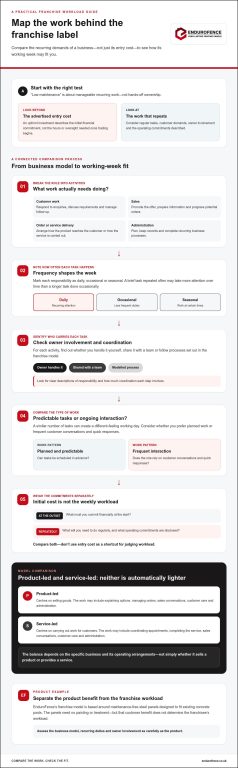
Start your comparison with the working week, not the label attached to a franchise. Break the role into activities: finding customers, handling enquiries, making sales, fulfilling orders or delivering services, and keeping business records. Then note how often each task occurs and whether you’ll handle it yourself, share it with a team or follow processes set out in the franchise model.
Recurring tasks that shape the owner’s working week
Customer communication and sales follow-up are related, but they are not the same task. A business may require time to respond to prospective customers, discuss their needs, progress a sale, arrange an order and deal with questions afterwards. Add planning and administration, such as scheduling work, maintaining records and completing routine business processes.
Compare responsibilities by frequency and owner involvement. A brief task repeated every day may take more attention over time than a longer task completed occasionally. Look for a clear description of who handles each step and how much coordination it involves.
- Customer work: responding to enquiries, discussing requirements and managing follow-up.
- Sales: promoting the offer, preparing information and progressing potential orders.
- Order or service delivery: arranging how the product reaches the customer or how the service is carried out.
- Administration: planning, record-keeping and other recurring business processes.
Use these categories to sketch a typical week. Mark which duties are daily, occasional or seasonal, and note which ones require your direct attention. This helps reveal whether the workload is predictable and suits your preferred way of working.
How a product-led franchise differs from a service-led model
A product-led model centres on selling goods, while a service-led model centres on carrying out work for customers. Both can include sales conversations, customer care and administration. A product offer may involve explaining options and managing orders; a service business may involve coordinating appointments or completing work. Neither structure is automatically lighter. The balance depends on the specific business and its operating arrangements.
Fencing is one example of a product category. EnduroFence offers steel fence panels designed to fit existing concrete posts, as well as post covers and retrofit panel swaps. The panels have profiled steel outer sheets and a high-density insulated core, and don’t need painting or treatment. These features address product durability and routine upkeep for the customer, but they don’t establish how much work a franchise owner does. Assess sales, order handling and other owner responsibilities separately.
The franchise agreement and operating model set out commitments that shape a particular role. Read them alongside any description of routine duties, and distinguish the product’s benefits from the franchisee’s responsibilities. For broader industry information, the Quality Franchise Association UK is one reference point for understanding franchising.
If a product-led fencing opportunity is relevant to your plans, explore the EnduroFence franchise model as one option to compare against your workload priorities.
How to compare low-maintenance franchise opportunities fairly
Franchise listings describe businesses in different ways, which can make direct comparison difficult. Use the same questions for each opportunity and record what the available information actually says. This turns “low maintenance” into practical points you can assess, rather than relying on a label or an attractive description.
A useful comparison measures recurring work as well as investment. Keep financial commitments in view, but assess workload separately. If a term or responsibility is unclear, mark it as unanswered. Missing information is not evidence that a task is rare, simple or handled by someone else.
A practical franchise comparison checklist
Set up one column for each opportunity and compare the same categories across them. For each duty, note its expected frequency, who is responsible and what information supports your assessment. If you can’t establish a detail from the material available, leave it open for your due diligence rather than filling the gap with an assumption.
- Time commitment: What working pattern is described, and how much owner time is expected?
- Recurring tasks: Which activities repeat, and how often are they likely to come up?
- Customer contact: How much time may involve enquiries, sales conversations and follow-up?
- Owner involvement: Which duties sit with the franchisee, and which are assigned elsewhere?
- Product or service delivery: What does fulfilling an order or providing the service involve?
- Administration: What planning, records and routine business processes are part of the role?
- Disclosed franchise obligations: What operating terms, ongoing commitments and support arrangements are set out?
Compare frequency and responsibility together. A task that happens occasionally may still require substantial owner attention, while frequent tasks may be straightforward if processes and responsibilities are clearly described. Record the evidence beside each answer so you can distinguish stated commitments from your own interpretation.
Assess fit with your skills, interests and available time
Compare the work with your circumstances. Consider whether your experience suits the sales, customer-facing or organisational demands, and whether those activities appeal to you. Be realistic about the hours you can make available alongside existing responsibilities. A role may look manageable in general but still be a poor fit if its busiest periods or routine tasks conflict with your schedule.
Use your comparison to identify trade-offs, not to declare a universal winner. Someone who enjoys customer conversations may prefer a different pattern of work from an owner who favours planning and administration. The best low maintenance franchise UK for you is the one whose documented responsibilities and working rhythm fit your skills, preferences and time. Review the agreement and disclosed obligations as part of that assessment, and keep unresolved points visible until you understand their effect on the role.
How to assess a franchise opportunity before committing
Before making a decision, test the opportunity against your working limits and the commitments set out in its documents. Assess the routine work before judging a franchise by its headline promise. A clear process helps separate what the business says it offers from what you would be responsible for doing.
Work through these steps in order:
- Define your personal limits. Set out how much time you can commit, which days or hours you can work and what responsibilities you need to fit around. Include the amount of customer contact and administration you’re willing to take on.
- Inspect the recurring work. List routine owner duties, how often they arise and whether they depend on your direct involvement. Separate one-off set-up activity from ongoing sales, customer care, order handling and business administration.
- Review the agreement and commitments. Read the franchise agreement carefully and make sure you understand its stated obligations. Consider all disclosed financial commitments alongside the operating terms, rather than treating the initial outlay as the full picture.
- Compare the role with your circumstances. Weigh the expected activities against your skills, preferred working style and available time. Note where the opportunity fits, where it may stretch your limits and which details still need clarification.
Look for realistic operating examples where the opportunity provides them. A description of a typical working period, customer journey or order process can make broad claims more concrete. Use examples to understand the sequence of tasks, but don’t assume one scenario captures every busy period or responsibility.
Questions to resolve about workload and operating terms
Before you commit, make sure you can describe the owner’s regular duties in plain language. Which tasks involve direct customer responsibility? How much time is expected, and which activities recur rather than happen only during set-up? Check that your understanding matches the franchise agreement and the opportunity’s disclosed operating terms. If an answer is unclear, record it as unresolved instead of assuming the task is minor or handled by someone else.
Check whether the opportunity fits your circumstances
Consider the nature of the role as well as its time demands. If the model relies on finding customers and progressing sales, decide whether that work suits your experience and interests. If customer conversations are central to the week, be realistic about whether that level of interaction appeals to you. Account for existing personal responsibilities too, so your decision reflects the routine workload, not just the idea of owning a business.
Use the same process for each opportunity you’re considering, then compare the documented duties with your own limits. A business described as low maintenance still needs to suit the person running it. To assess a product-led option against these criteria, explore the EnduroFence franchise opportunity.
Could the EnduroFence franchise suit someone seeking a lower-maintenance business?
EnduroFence offers a franchise model centred on maintenance-free steel fencing products. It’s a product-led example to assess using the workload framework in this guide, not a promise that the franchise requires little time or effort. The customer benefit and the franchisee’s day-to-day responsibilities are separate questions.
For customers, the need is straightforward: conventional timber fencing can involve painting or treatment as part of its upkeep. EnduroFence steel panels don’t need painting or treatment, offering an alternative for people who want to avoid those recurring maintenance tasks.
The customer need behind EnduroFence’s fencing offer
The steel panels are designed to fit existing concrete posts. This gives the product a clear purpose for customers looking to replace fence panels while making use of posts already in place. EnduroFence also offers post covers and retrofit panel swaps as part of its fencing range.
The panels have profiled steel outer sheets and a high-density insulated core. They are designed to be weather-resistant and provide a durable fencing option. Installation is straightforward and requires no specialised tools or qualifications, allowing homeowners to replace timber fencing without professional installation. These product details help explain the customer problem the offer addresses, but they don’t tell you how a franchisee’s working week is organised.
Decide whether this franchise model matches your goals
Consider the opportunity against your priorities. Do you want to build a business around selling a physical product? How much customer interaction, sales activity and administration would suit you? Which tasks would you be willing to handle regularly, and how much time can you realistically commit?
Then apply the same comparison points you would use for any franchise: expected time commitment, recurring responsibilities, owner involvement, product handling and the obligations set out in the franchise agreement. Separate what you know about the fencing products from what you need to understand about the business model. A maintenance-free product may address an ongoing customer upkeep concern, but it doesn’t establish a low-maintenance franchise workload.
The best low maintenance franchise UK for one person may not fit another. Your decision should turn on whether the disclosed operating commitments suit your skills, preferred working style and available time, not solely on the product’s selling point. If a practical, product-led fencing opportunity sounds relevant, explore the EnduroFence franchise opportunity and assess it against the criteria that matter to you.
Make your next step a considered one
Before choosing a franchise, turn your comparison into a simple decision record: note what you understand, what remains unclear and which responsibilities matter most to you. This gives you a grounded basis for exploring the best low maintenance franchise UK for your circumstances, without letting a persuasive headline make the decision for you.
EnduroFence offers a franchise model under its brand, centred on maintenance-free steel fence panels designed to fit existing concrete posts. Treat that product focus as a starting point for assessing the opportunity, not as a measure of the franchisee’s workload. Consider whether a product-led business aligns with the work you want to do and the commitments you’re prepared to take on.
Use your workload checklist to decide whether the model fits your goals, then explore the EnduroFence franchise opportunity.
Frequently Asked Questions
Is a low-maintenance franchise the same as a passive business?
No. A low-maintenance franchise still needs an owner to make decisions, oversee operations and take responsibility for the business. “Low maintenance” describes the nature or manageability of recurring work, not an absence of work. A business may have few physical upkeep tasks but still need regular sales activity or customer follow-up. Treat claims about passive income cautiously and focus on the duties you would personally carry out.
What should I compare when choosing a low-maintenance franchise in the UK?
Compare the actual role, not just how the opportunity is described. Note the expected working pattern, sales and customer responsibilities, order or service processes, administration, owner involvement and terms in the franchise agreement. The best low maintenance franchise UK for you should also fit your skills and existing commitments. For a practical test, imagine handling a typical customer enquiry from first contact through to follow-up, and identify every step you would own.
How much can a franchise owner earn in the UK?
There’s no single reliable figure that applies to every UK franchise owner. Earnings depend on the business model, sales, operating costs and the owner’s circumstances, so projected revenue shouldn’t be mistaken for personal income. Review the assumptions behind any financial information and distinguish turnover from profit and drawings. Consider how long the business may take to establish and whether you can meet your personal financial needs during that period.
What is the cheapest franchise to start in the UK?
There isn’t one permanent answer, as opportunities and their required commitments differ. A low entry cost doesn’t necessarily mean a low overall financial requirement. Compare the disclosed franchise fee and set-up expenses with ongoing charges, equipment or stock requirements, and working capital needed to operate. Make sure you understand what each figure covers and excludes before deciding whether an opportunity is affordable for you.
Can a franchise be run part-time?
Some franchise models may suit part-time operation, but this depends on their operating terms and customer expectations. A role with scheduled appointments might be easier to fit around another commitment than one requiring frequent responses during working hours. Don’t rely on the word “flexible” alone. Map the hours when tasks must be completed, consider cover for busy periods and check that your intended working pattern is compatible with the agreement.
Do I need experience to become a franchisee?
Not necessarily, but requirements vary between franchise opportunities. Relevant experience can help with tasks such as selling, managing customers or organising work, while transferable skills may also be useful. Look closely at the role’s stated entry requirements and the preparation provided as part of that opportunity. Be realistic about any skills you’ll need to develop, and consider whether you’re comfortable learning them while taking responsibility for a business.
Is a product-based franchise easier to manage than a service-based one?
Not automatically. A product-based business may involve stock, orders and explaining product choices, while a service-based model may centre on scheduling and delivering customer work. Either can require substantial sales, administration and customer care. The balance depends on the specific operation. Consider a busy period: would you be more comfortable coordinating several enquiries and orders, or organising service appointments and delivery? That practical preference can reveal more than the category label.

Leave a Reply