


Buying a franchise UK guide
A well-known franchise name isn’t automatically the right fit for your budget, skills or location. A useful guide to buying a franchise in the UK starts with comparing the investment, industry and territory, then examining the agreement and the franchisor’s training and ongoing support. The UK has no franchise-specific laws; franchises are governed by the same laws as other businesses.
It’s sensible to build a clear picture before committing to a business model. Free franchise guides and resources can help you understand the options, but the key questions are how each opportunity works in practice and whether it suits your circumstances.
This guide explains what to compare when researching opportunities, how to assess a franchisor’s support and what franchise schemes involve. It also offers practical ways to use free resources to build your understanding, create a shortlist and make a more informed decision.
Key Takeaways
- Compare the full investment and ongoing commitments with your available funds and business goals, rather than judging an opportunity by its entry cost alone.
- Assess how franchisor training prepares you for day-to-day operations and what practical support continues after launch.
- Read the franchise agreement closely to understand the rights, responsibilities and financial arrangements that shape the relationship.
- Narrow your search by industry and location, then consider how each model fits your experience, working preferences and local market.
- Use free guides and resources to build a shortlist and identify the questions that matter before making a decision.
Assessing franchisor training and ongoing support
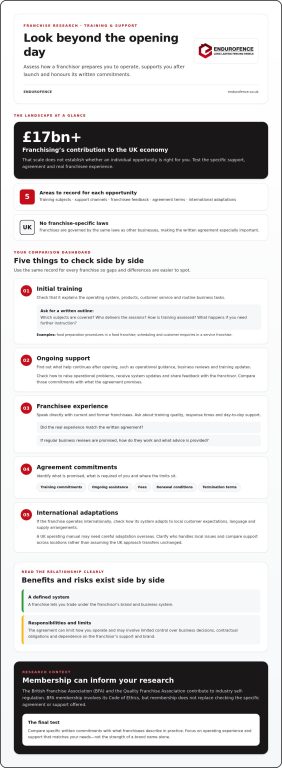
Training and support show how a franchise system prepares you to operate, not just to open. Compare the practical help on offer with the responsibilities and limits set out in the franchise agreement.
Franchisor training provision
Initial training introduces you to the franchisor’s operating system, products, customer service and routine business tasks. It matters because you need to understand the model before taking responsibility for daily decisions. Ask for a written outline of the subjects covered, who delivers the sessions, how training is assessed and what happens if you need further instruction. For example, a food franchise may teach preparation procedures, while a service franchise may focus on scheduling and customer enquiries.
Ongoing and international location support
Ongoing support is the help available after opening, such as operational guidance, business reviews and training updates. If the franchise operates internationally, assess how the system adapts to local customer expectations, language and supply arrangements. A UK operating manual may need careful adaptation for an overseas market. Clarify how franchisees receive updates and who handles local issues, then compare those commitments with the agreement.
When researching a UK franchisor, review its operating history, business model and membership information, then speak directly with current and former franchisees. Ask about training quality, response times, day-to-day support and whether their experience matched the written agreement.
The main risks include limited control over business decisions, contractual obligations and dependence on the franchisor’s support and brand. UK judicial decisions indicate that franchisors are expected to disclose relevant facts clearly before entry and owe franchisees a duty of good faith.
Franchising contributes over £17 billion to the UK economy, but that scale doesn’t establish whether an individual opportunity is suitable. The British Franchise Association (BFA) and the Quality Franchise Association contribute to industry self-regulation. BFA membership involves its Code of Ethics; membership can inform your research, but it doesn’t replace understanding the specific agreement or support offered.
The UK has no franchise-specific laws; franchises are governed by the same laws as other businesses. That makes the written agreement especially important. Identify the training commitments, ongoing assistance, fees, renewal conditions and termination terms. Compare each promise with the practical support franchisees describe. If the agreement promises regular business reviews, for example, ask franchisees how those reviews work and what advice they receive.
Support can also affect how well a franchise responds to changing conditions. Look for clear processes for raising operational problems, receiving system updates and sharing feedback with the franchisor. For an international operation, compare support across locations rather than assuming a UK-based approach transfers unchanged. A larger brand may have more established processes, but the key test is whether its actual support matches your needs and the agreement.
Use the same comparison record for each opportunity: training subjects, support channels, franchisee feedback, agreement terms and any international adaptations. This makes differences easier to spot and helps you identify gaps before committing. Focus on specific commitments and real operating experience, not the strength of a brand name alone.
What do Franchise Schemes do?
A franchise scheme lets a franchisee trade under a franchisor’s brand and business system through a franchise agreement. Review the agreement alongside the financial requirements and any scheme-specific rules before deciding whether the arrangement suits your plans.
The UK has no franchise-specific laws; franchises are governed by the same laws as other businesses. The Trading Schemes Act may apply to multi-tiered franchises in the United Kingdom, so understand whether the proposed structure has multiple levels before signing.
The agreement sets out the relationship between franchisor and franchisee. Review its terms for opening obligations, fees, territory, operating standards, renewal, termination and restrictions on leaving. Compare each financial commitment with your projected cash flow, including ongoing payments and spending required by the system. A franchise offers a defined business model, but the agreement also limits how you can operate it.
Plan your finances around the full business model, not just the initial outlay. Map expected income against regular commitments, working capital and any required investment in equipment or premises. Some UK ATOL applicants may have to meet financial criteria depending on the size of their licence. For a Franchise ATOL, franchise holders provide guarantees to the Civil Aviation Authority (CAA), instead of Franchise ATOL holders providing bonds to the CAA.
Student finance rules apply to certain higher education franchise arrangements in England. From the 2028-29 academic year, franchise providers delivering higher education courses must register with the Office for Students (OfS) if they have 300 or more franchised students and want new students to be eligible for student finance, unless an exemption applies. This threshold concerns franchised student numbers, not a general franchise business.
The timetable matters for providers and franchisees in higher education. The deadline for franchise providers to submit OfS registration applications was 1 July 2026. The Department for Education was due to confirm in September 2027 which providers’ courses are designated for student finance for new students in academic year 2028-29. The Department for Education publishes a list each year of franchised providers with courses designated for student finance.
For September 2027 and 2028 only, franchise providers can appeal if they can evidence that their student numbers were below 300 in the year before the designation decision. An unregistered provider in England that exceeds 300 franchised students after implementation loses student finance eligibility for new students for one year, even if it registers later. Further education colleges in England are exempt when delivering a designated course on behalf of an OfS-registered provider.
Tax, VAT and business structure affect how you record income, manage liabilities and meet reporting duties. Consider whether operating as a sole trader or through a limited company fits the franchise agreement and your financial circumstances. Build tax and VAT records into your opening plan, and account for franchise payments and business expenses separately.
Searching franchise opportunities by industry, investment and location
Start by filtering opportunities against three practical tests: the work, the total investment and the location. Then compare the options that remain with your experience, available funds and goals for running a business. This approach helps you assess a franchise as an operating model, rather than choosing on brand recognition alone.
The industry shapes your day-to-day work. A food franchise may involve serving customers and managing stock, while a business service model may centre on client relationships and scheduling. Consider whether you want a customer-facing role, a mobile operation or premises-based work. List the tasks you’re willing to handle, then rule out opportunities whose routine responsibilities conflict with your preferences or existing commitments.
Compare investment by building a complete picture of each opportunity. Separate the initial franchise fee from other opening requirements, such as premises, equipment, stock, training and working capital. Then record ongoing payments and any spending needed to follow the operating system. Use the same categories for every option, so a lower entry cost doesn’t distract from larger continuing commitments. Your available funds matter, as does the time the business may need to generate reliable income.
Location affects who can reach your business and how it operates. For a premises-based franchise, consider customer access, local demand and nearby competition. For a mobile service, map travel time and the territory described in the agreement. For example, compare a town-centre location with a residential area and consider how each suits the franchise’s customers. A territory may be exclusive or shared, so understand its boundaries before treating a map as proof of protection.
The British Franchise Association (BFA), established in 1977, provides a useful point of reference when researching the UK industry. Its membership and Code of Ethics can help you understand how franchisors approach recognised standards, but they don’t replace comparing individual opportunities. In 2026, the BFA Member Milestones campaign recognises member brands marking milestones. Treat a milestone as one research clue, then examine the specific business model and its fit for you.
A buying a franchise UK guide is most useful when it turns broad claims into consistent comparisons. Give each opportunity the same headings, then record what you learn under each one:
- Industry: record the everyday tasks and the skills they call for.
- Investment: separate opening requirements from ongoing commitments.
- Location: identify the customer base, territory and travel involved.
- Mission: judge whether the model matches the business you want to run.
Finally, compare the largest brand with less prominent alternatives using the same criteria. A familiar name may attract attention, but it doesn’t show whether the work, investment and local opportunity suit your priorities. Keep the buying a franchise UK guide as a working checklist and record evidence rather than impressions. This gives you a reasoned basis for deciding which opportunities deserve closer consideration.
Benefits of franchising compared with starting alone
A franchise gives you permission to trade using another business’s brand and operating system. Starting independently means creating those foundations yourself. For example, an independent café owner develops a menu, supplier relationships and service routines, while a franchisee follows the franchisor’s established model. The first route offers a framework; the second gives you more freedom to shape the business.
A franchise framework can make the early stages more structured. It may provide an established format for presenting services, handling customer enquiries and organising daily tasks. An independent business must develop each process through its own decisions and experience. Compare what the franchisor actually provides with what you would need to build yourself, rather than assuming every franchise includes the same resources.
Brand recognition is another potential advantage. Customers may already know a franchise brand, which can help them understand what the business offers. An independent operator starts by establishing its own name and reputation locally. Neither route guarantees demand: a recognisable brand still needs a suitable location, good service and customers who want the offer.
Franchising can also connect you with a wider network of operators. Other franchisees may share practical experience about local trading, customer expectations or routine challenges. An independent owner has no built-in franchise network, though they can develop business relationships independently. Consider the value you place on shared systems and peer contact alongside the responsibilities of following the franchisor’s model.
Control is a key difference. A franchise agreement may set rules for branding, products, suppliers and business operations. Those requirements can help keep the customer experience consistent across locations, but they restrict independent choices. Starting alone lets you adjust your offer, pricing approach and working methods directly. For example, changing a service may be easier without a franchise system’s approval process.
Both models involve financial responsibilities, but they differ in form. A franchisee must account for the agreement’s fees and operating obligations, as well as ordinary business costs. An independent owner avoids franchise payments but funds the creation of the brand, systems and customer proposition. Compare both budgets over time, including ongoing commitments, rather than treating the franchise fee as the only difference.
The UK franchise industry contributes over £17 billion to the economy, but that overall figure cannot predict the outcome for one business. Use it as context, not a forecast. A franchise may suit someone seeking a defined model and willing to work within its rules. Starting alone may suit an entrepreneur who values control and accepts responsibility for building the operation from its foundations.
Make the comparison practical: write down the support and systems the franchise offers, the restrictions it imposes and the work you would need to create independently. Then weigh those points against your skills, preferred level of control and business aims. The better choice is the model whose commitments and daily demands fit your plans, not simply the one with the most familiar brand.
Free franchise guides and resources
Free resources can help you understand franchise terminology, compare business models and prepare focused questions. Use them to build a shortlist, not to decide from a promotional summary. For example, compare a franchisor’s guide with its agreement and notes from conversations with franchisees.
The British Franchise Association (BFA) and Quality Franchise Association (QFA) are useful starting points for learning about UK franchising. The BFA was established in 1977 and operates a Code of Ethics for members. Read membership information as context, then assess each opportunity on its own terms. A membership badge is not a substitute for examining costs, responsibilities and support.
Use free guides to create a consistent comparison sheet. Record the franchise model, opening requirements, ongoing commitments, territory, training and support, and add a column for unanswered questions. This turns broad claims into comparable points, such as whether the system provides operational guidance or requires specific purchasing arrangements. Keep the same headings for every brand.
Industry events can add useful perspective to online reading. The National Franchise Exhibition was scheduled for 2 and 3 October 2026, whilst the BFA lists events including World Franchise Day on 10 June and its Annual Conference on 12 November. Event dates help you plan research, but use any conversation to gather specific details about the model rather than relying on a presentation alone.
For franchise opportunities in higher education, use the Department for Education’s annual list of franchised providers whose courses are designated for student finance. This resource answers a specific question about course designation; it does not assess whether a franchise is commercially suitable. Separate regulatory or sector-specific information from your assessment of investment, agreement terms and day-to-day operations.
Turn each guide into practical research by noting its source and date, then checking whether the information applies to the opportunity you’re considering. A general guide may explain what a franchise agreement does, while the actual agreement contains the terms for that particular business. Record claims that need a direct answer, such as territory boundaries or the support available after opening.
A simple research file can bring resources together:
- Guide notes: capture definitions and questions to follow up.
- Comparison sheet: use matching categories for each opportunity.
- Agreement review: mark financial duties, restrictions and renewal terms.
- Franchisee discussions: record examples of how the system works in practice.
Free guides are most useful when they lead to sharper comparisons, not a quick yes or no. If you’re exploring a franchise in fencing, explore the franchise opportunity as one option to research alongside your shortlist.
EnduroFence: Maintenance-Free Fence Panels
EnduroFence supplies maintenance-free steel fence panels for UK gardens, designed to fit existing concrete posts. Their profiled steel outer sheets and high-density insulated core provide durability, weather resistance and security, with no painting or treating needed.
If you’re considering a fencing franchise, EnduroFence offers a practical example of a business focused on a specific garden improvement. The Retro Fitting Panel Swap lets homeowners replace timber panels using existing posts, with straightforward installation. No specialised tools or qualifications are needed. Post Covers are also available to complement the fencing system.
Explore EnduroFence’s franchise opportunity to learn more about this business model. For details about its fence panels and franchise, visit EnduroFence online.
Choose a next step that fits your plans
Your next move doesn’t need to be a commitment. Turn your research into a practical conversation: identify what you want from a business, then explore opportunities that match those priorities. A guide to buying a franchise in the UK can help organise your thinking, but your goals should shape the decision.
If fencing interests you, EnduroFence offers a franchise alongside its Maintenance-Free Fence Panels, Post Covers and Retro Fitting Panel Swap. These offerings provide a concrete example of a specialist business serving a defined customer need. Consider whether that focus suits the kind of work and business relationship you want.
Use the questions you’ve developed to understand the opportunity and its operating model. Take the next step at your own pace, focusing on the details most relevant to your plans.
Contact EnduroFence to discuss your project, and take a considered step towards your next opportunity.
Frequently Asked Questions
Buying a Franchise in the UK?
Buying a franchise means running a business under a franchisor’s brand and system, under a franchise agreement. You operate the business, while the franchisor sets out the model and any obligations in that agreement. Before committing, compare the work involved, the financial commitments and the level of control you’ll retain. For example, consider whether following set operating procedures fits your preferred way of working.
What tests do I have to meet?
There’s no single franchise-entry test for every UK opportunity. Each franchisor sets its own selection criteria, which may cover relevant experience, financial capacity, management skills and willingness to follow the operating model. Prepare a clear account of your business background and available resources. Then compare the franchisor’s stated requirements with your circumstances, including the time you can devote to running the operation.
Where to Start?
Start with your priorities: the type of work you want, the funds you can commit and the responsibilities you can take on. Use them to set boundaries before browsing opportunities. For instance, decide whether you prefer customer-facing work or managing a team. A focused search makes it easier to compare franchise models and spot opportunities that don’t match your working preferences.
What are the steps to buy a franchise in the UK?
Begin by defining your budget, preferred sector and working needs. Shortlist opportunities, learn how each business operates and speak with franchisees about their experience. Review the proposed agreement and financial projections carefully, then arrange appropriate professional advice before signing. Treat each stage as a decision point: proceed only when you understand the business model, your obligations and how the arrangement fits your plans.
How much does it cost to buy a franchise in the UK, including fees and working capital?
There’s no single UK franchise purchase cost; the total depends on the business model and its opening requirements. Build a cost plan covering the initial fee, premises or equipment, stock, training, working capital and ongoing payments. Then test whether your available funds can also cover operating expenses during a slower start. Compare the same cost categories across opportunities rather than relying on the headline entry fee.
What are the best UK franchise opportunities by investment level and sector?
The best opportunity is the one that fits your resources and preferred work, not a universal ranking. Compare sectors by daily duties, customer demand and required skills. Then group options by investment, using each franchisor’s full cost breakdown. A lower initial commitment can still involve substantial ongoing costs, so compare the complete financial picture before prioritising a sector.
How can I assess whether a UK franchise is profitable and financially viable?
Assess viability by building a cash-flow forecast from expected sales and realistic operating costs. Include rent, wages, stock, franchise payments, tax and seasonal changes where they apply. Calculate the sales level needed to cover costs, then test the forecast under different trading conditions. Compare your assumptions with actual figures shared by franchisees, and separate one-off opening expenses from regular operating costs.
What should I check in a UK franchise agreement before signing?
Check the agreement’s term, territory, renewal conditions, fees, operating obligations and exit provisions. Look closely at restrictions on suppliers, branding, products and selling the business. Confirm how the agreement handles disputes and what happens if either party ends the arrangement. Note each commitment and compare it with the franchisor’s explanations. Independent legal advice can help clarify how the clauses affect your circumstances.

Leave a Reply