

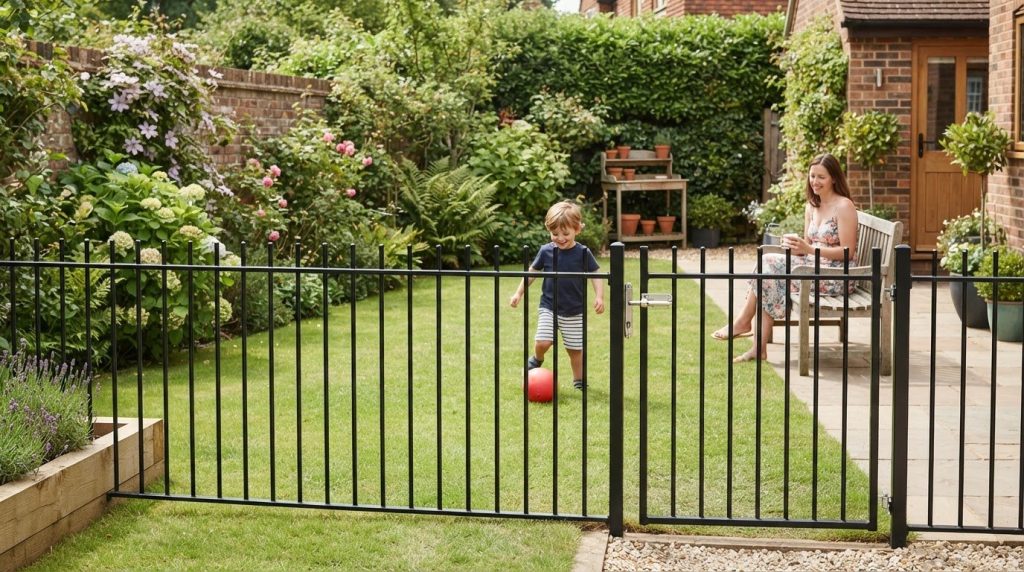
Child safe garden fencing ideas for safer play spaces
A child-safe garden fence should have close-spaced vertical pickets, flat or rounded tops and no easy footholds for climbing. Keep gaps between pales under 100 mm to reduce the risk of a child becoming trapped, and choose a gate that closes securely. Practical child safe garden fencing ideas start with these details, not just the fence’s overall height.
A clear boundary can make a play space easier to manage, but toddlers may notice gaps, climbable rails and open gates that adults overlook. When considering child safe garden fencing ideas, think about how the fence and gate work together and how the materials perform outdoors.
This guide explains what to look for, why close-spaced metal pickets and flat-topped rails can suit children’s areas, and how to think about toddlers’ needs around the garden. You’ll also find practical points on fence height, gate security and keeping the boundary in good condition, so you can make a considered choice for your play space.
Key Takeaways
- Compare fence styles by the needs of your garden, including how much privacy, visibility and upkeep you want.
- Choose rounded or flat-topped pickets and avoid horizontal rails that could give children footholds.
- Think beyond the boundary: gate positioning and separate barriers can help organise safer play areas for toddlers.
- Plan fence height around its purpose and location; rear and side garden fences can be up to 2 metres high without planning permission, according to Planning Portal.
1. What is Child Safe Garden Fencing?
Child-safe fencing creates a clear boundary while avoiding sharp edges, climbable features and openings that could trap a child. A solid panel offers privacy, while a see-through design can help adults watch the play area from the kitchen or patio. Smooth-finished wood suits traditional gardens but needs upkeep. For a durable, low-upkeep option, consider materials designed to withstand outdoor conditions.
In the UK, front garden fences are restricted to 1 metre in height. Rear and side garden fences can be up to 2 metres high without planning permission; like-for-like replacements at the same height usually don’t need permission, whilst changes to style, height or position may require it. These rules make the boundary’s location and the proposed change important before installation.
There is no single cost per metre for child-safe fencing. The total depends on the material and panel design, boundary length, access, ground conditions and whether you need a gate. To improve an existing fence, close gaps, secure loose panels, cover sharp edges and move objects that could serve as footholds.
Ground may slope or shift, so plan the fence layout to keep it stable and avoid openings beneath panels. Stepped panels or a raked layout can follow uneven ground; the best approach depends on the slope and fence design. With timber, check for splinters, rot and loose fixings, and maintain the surface as needed. Inspect the full boundary, including posts and joins.
A see-through fence can support supervision, but adults still need a clear view of the play area. Around a pond or pool, use a separate secure barrier and gate. Beside a road or steep drop, prioritise a continuous boundary without gaps. Match additional barriers to the hazard and check them for movement, damage or openings a child could reach.
2. Close-spaced metal pickets and flat-topped rails
For young children, consider vertical metal pickets with narrow, even spacing and flat or rounded tops. Avoid pointed pales and horizontal rails, which can provide footholds or handholds for climbing. A simple structure without spikes or projecting details is easier to assess for hazards. Close-spaced pickets are one practical child safe garden fencing idea when you want a visible boundary.
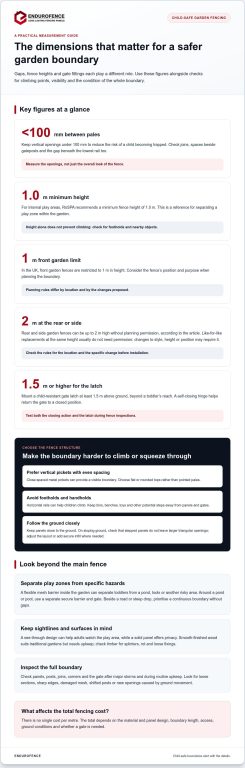
Check the gaps between pales, not just the overall appearance. Keep vertical openings under 100 mm to reduce the risk of a child becoming trapped. Also look for spaces at panel joins, beside gateposts and beneath the lowest rail. On sloping ground, a stepped fence can leave larger triangular openings; adjust the layout or add a secure infill that closes them.
A welded construction can help maintain a consistent metal fence structure, while a finished surface helps avoid rough or sharp areas. Before children use the play area, inspect joints and accessible parts for damage, sharp edges or loose sections. Carefully check rails and posts by hand, and address any rough or projecting areas promptly.
Flat tops avoid the sharp points of spear-topped designs, but they do not make a fence unclimbable. Keep bins, benches and toys away from panels so children cannot use them as steps. Supervise play and check the view from the places adults usually sit or work. A see-through picket fence can help maintain sightlines across the garden.
Prevent children squeezing underneath by fitting panels close to the ground and following the garden’s contours. Check for gaps after heavy rain or ground movement, especially where soil slopes away from a post. Recheck fixings, joins and gates as part of routine garden upkeep. If a solid boundary better suits your setting, maintenance-free fence panels offer an alternative to open pickets.
3. Outdoor fencing for children and toddlers
Plan the garden in separate zones rather than relying on one boundary to address every hazard. A main fence can define the play space, while a flexible mesh barrier inside it can separate toddlers from a pond, tools or another risky area. Position the additional barrier securely where adults can supervise both spaces. It should complement, not replace, the garden’s main fence.
Choose vertical boards or pales instead of horizontal slats. Horizontal rails can give a child footholds, especially beside a playhouse or raised border. For timber, smooth and sealed surfaces reduce the chance of splinters; check board edges and fixings during routine upkeep. Modern pressure-treated timber is safe for children to touch and approved for gardens and play areas. These material choices help make outdoor play more manageable.
Give the gate its own safety routine. A self-closing hinge helps return it to a closed position, while a child-resistant latch mounted at least 1.5 m above ground keeps the fastening beyond a toddler’s reach. Test the closing action and latch whenever you inspect the fence. Keep toys, chairs and garden equipment away from the gate so children can’t use them to climb.
Inspect fences regularly and after major storms. Look for loose boards, shifted posts, damaged mesh and new openings caused by changes in the ground. Pay particular attention to corners and the join between the gate and its post, where movement can affect closing. Secure displaced sections and address sharp or broken parts before children return to the play area. Regular checks can help identify hazards early.
4. What height should a garden fence be to keep children safe?
Fence height depends on its purpose, position and nearby features. A taller fence can define the main garden boundary, but height alone does not prevent climbing. Consider footholds, gaps, gate security and whether adults can supervise the play area. A child could climb a low wall, raised planter or storage box beside the fence, so assess the whole boundary, not just the panel.
For internal play areas, RoSPA recommends a minimum fence height of 1.0 m. This offers a practical reference for separating a play zone within the garden. For the main boundary, 1.8-metre panels are a common choice. The suitable height still depends on the garden layout and the need to maintain visibility across the space.
In the UK, rear and side garden fences can be up to 2 metres high without planning permission, according to Planning Portal. Front garden fences are restricted to 1 metre in height. Before changing an existing boundary, consider its location and whether the work changes its height, style or position. Like-for-like replacements at the same height usually don’t need planning permission, whilst changes may require it.
Measure from ground level along the fence line, especially on a slope. A panel that looks tall from one side may leave a climbable step or opening on the other. Check how stepped sections meet, and move bins or benches that could help a child reach the top. Combine suitable height with close-spaced vertical pales, smooth edges and a gate that closes securely.
For a safer boundary, match the height to the area and remove nearby climbing aids. If you’re planning a panel change, explore options for your garden boundary as part of your next steps.
EnduroFence: Maintenance-Free Fence Panels
EnduroFence offers Maintenance-Free Fence Panels for replacing worn garden panels while keeping existing concrete posts. Made with profiled steel outer sheets on both sides and a high-density insulated core, the panels provide a durable, weather-resistant boundary. They are powder-coated, with no painting or treating needed. A solid panel can suit a garden where privacy matters; consider sightlines from the house when planning a children’s play space.
EnduroFence’s Retro Fitting Panel Swap lets homeowners replace panels within existing posts, and EnduroSmart Post Covers can finish exposed posts. The panels are designed for straightforward fitting, and no training or qualification is needed. This offers a practical way to update a fence while keeping the existing concrete posts.
If you’re weighing up a panel replacement for your garden, visit EnduroFence to explore the options.
Plan a safer space that grows with your family
As children grow, the way they use the garden can change. Review the boundary when play areas move or the layout changes, and consider whether the fence still suits your family’s needs. The most useful child safe garden fencing ideas are those that work with your home, routine and available space.
If your existing concrete posts are staying in place, EnduroFence’s Maintenance-Free Fence Panels and Retro Fitting Panel Swap provide a panel replacement option. EnduroSmart Post Covers can finish exposed posts. These options suit homeowners looking to update a boundary without replacing the whole fence structure.
Choose the next step that fits your garden and the condition of its existing boundary. Contact EnduroFence about your fencing to explore the available options. A considered change can help make your garden more practical for family life.
Frequently Asked Questions
What is Child Safe Garden Fencing?
Child-safe garden fencing is designed to reduce common hazards while supporting adult supervision. Think about how children use each part of the garden: a clear perimeter may suit the whole space, while a separate barrier can keep a play area apart from garden equipment. Check the fence from a child’s viewpoint, looking for footholds, accessible sharp edges and gaps through which toys could be pushed.
What are the best child-safe garden fencing materials: timber, metal, vinyl or composite?
The right material depends on your priorities. Timber has a natural appearance but needs a smooth finish and upkeep to limit splinters and decay. Metal can suit close-spaced pickets with rounded or flat tops. Solid vinyl provides a smooth surface without gaps between panels, while composite can offer a wood-like look with less upkeep than natural wood. Compare each option with your garden’s style and maintenance needs.
What gates, latches and locks are safest for a child-friendly garden?
A self-closing gate with a child-resistant latch can help limit accidental access. Position it so it does not open directly towards a pond, driveway or tool storage. After fitting, open and release it from different positions to check that it closes and latches each time. Check whether a toddler can reach the latch, and move nearby objects that could help a child climb to it.
How should garden fencing be installed securely and checked for hazards?
Set posts at least 2 feet (600 millimetres) into the ground to support a stable fence. Check that fence pales are spaced safely and that panels sit securely in their slots. After installation, look along the full boundary for loose fixings, sharp edges, unstable posts and gaps beneath panels. Recheck the joins and gate after ground movement or severe weather.

Leave a Reply