

Dog proof garden fencing for uneven gardens
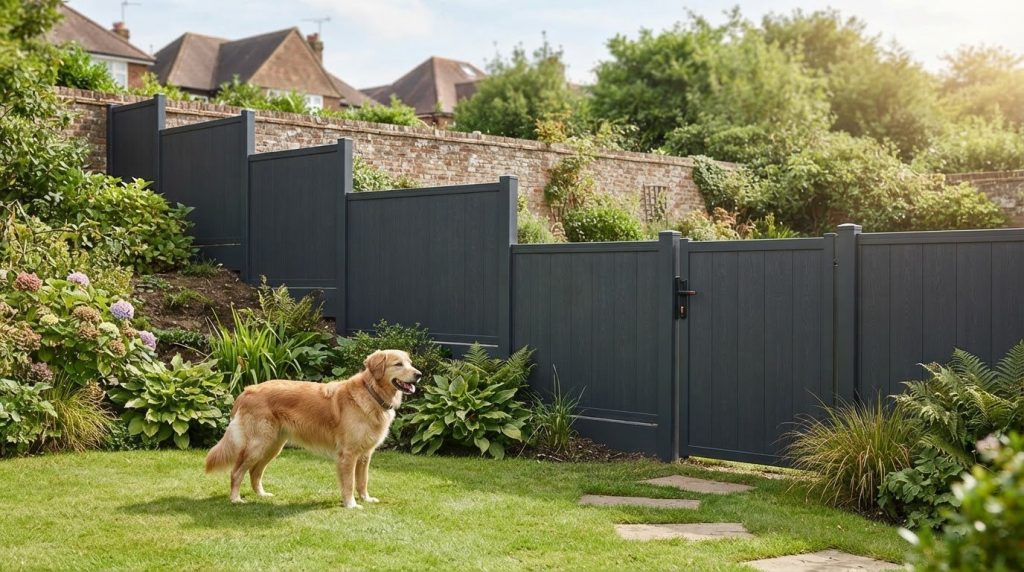
A fence is only as secure as its lowest gap. On uneven ground, dog proof garden fencing needs to follow the boundary closely and leave no easy route underneath. A fence about 24 inches high may be enough for most dogs to respect the boundary, whilst a particularly active, athletic or giant-breed dog may need 30-36 inches; some dogs can jump much higher. The best dog proof garden fencing also accounts for your dog’s behaviour, not just the fence height.
Fence height matters, but sloping ground, dips and gaps can be just as important when you’re trying to keep your dog in. Effective dog proof garden fencing should suit your dog’s behaviour and the shape of your garden, with no openings where the ground falls away. Planning for these details helps you choose a boundary that works in practice.
This guide explains how to plan a secure boundary across uneven terrain, compare suitable fencing materials and reduce the effects of rust, weather and UV exposure. You’ll also learn what to consider around gates and fence bases, so you can choose a practical solution for your garden.
Key Takeaways
- Map the boundary’s slopes and dips before choosing a fence, so you can spot gaps where a dog might squeeze underneath.
- When assessing galvanised steel, note that BS EN 1461:2009 is identified as a standard by the British Standards Institution (BSI).
- Compare fencing materials and finishes for outdoor exposure, and consider how much upkeep they need to resist rust, weather and UV exposure.
- Choose a fence that suits your dog’s behaviour as well as your garden; open sections and weak points can undermine an otherwise sturdy boundary.
- For an existing concrete-post boundary, EnduroFence Maintenance-Free Fence Panels offer a steel panel option designed to fit into those posts.
Uneven terrain and boundary definition
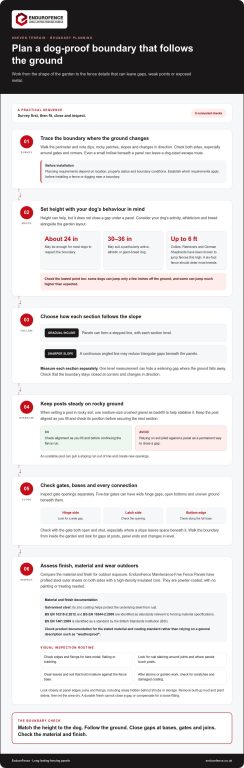
Start by tracing the garden boundary where the ground actually changes, rather than imagining a level fence line. Walk the perimeter and note dips, rocky patches, slopes and changes in direction. Even a small hollow beneath a panel can leave a dog-sized escape route. Check both sides of the boundary, especially near gates and corners. This survey shows where panels need to follow the slope and where gaps need particular attention.
For UK garden fences, planning requirements can depend on location, property status and boundary conditions, so there isn’t one answer for every garden. Establish which requirements apply before installing a fence or digging near a boundary.
Match the fence height to the dog as well as the terrain. A fence about 24 inches high may be enough for most dogs to respect the boundary, whilst 30-36 inches may suit a particularly active, athletic or giant-breed dog. Collies, Retrievers and German Shepherds have been known to jump fences up to six feet high. A six-foot fence should deter most dog breeds, but height alone won’t close a gap under a panel. Some dogs can jump only a few inches off the ground, so inspect the lowest point carefully.
Decide how the fence will follow the slope. On a gradual incline, panels can form a stepped line, with each section level. On a sharper slope, a continuous angled line may reduce triangular gaps beneath the panels. Measure each section separately: one level measurement can hide a widening gap where the ground falls away. Check that the boundary stays closed at corners and changes in direction.
Rocky soil needs a different approach from soft, even ground. When setting a post, use medium-size crushed gravel as backfill to help stabilise it. Keep the post aligned as you fill and check its position before securing the next section. An unstable post can pull a sloping run out of line and create new openings. Don’t rely on soil piled against a panel as a permanent way to close a gap.
Inspect gate openings separately. Five-bar gates can have wide hinge gaps, open bottoms and uneven ground beneath them. Check the hinge side, latch side and full bottom edge with the gate both open and shut. A single gap at this transition can undermine an otherwise secure boundary, especially where a slope leaves space beneath the gate.
The British Standards Institution (BSI) identifies BS EN 1461:2009 as a standard. Use that identifier when assessing relevant finish documentation, then inspect the actual boundary for fit and coverage. Walk the line from inside the garden, looking for gaps at posts, panel ends and changes in level. A dog-proof boundary depends on those details as much as the fence height.
Outdoor rust resistance
When comparing metal fencing, check how the material and finish suit outdoor exposure. EnduroFence Maintenance-Free Fence Panels have profiled steel outer sheets on both sides with a high-density insulated core. They are powder-coated, with no painting or treating needed. Check panel edges and the points where panels meet posts as part of your boundary assessment.
Galvanised steel is a common choice for outdoor wire fencing because its zinc coating helps protect the underlying steel from rust. The research identifies BS EN 10218-2:2012 and BS EN 10244-2:2009 as standards relevant to fencing material specifications. BS EN 1461:2009 is also identified as a standard by the British Standards Institution (BSI). Check product documentation for the stated material and coating standard, rather than relying on a general description such as “weatherproof”.
Look closely at the whole panel, not just its broad, visible face. Examine the edges, joins and fixings, where coating damage or trapped moisture may be less obvious. For example, a cut wire end can rust sooner if its protective layer has been compromised. A fence exposed to persistent damp, shaded by dense planting or positioned beside wet soil needs regular visual checks.
- Inspect panel edges and fixings for bare metal, flaking or bubbling.
- Look for rust staining around joints and at points touching posts.
- Clear leaves and soil that hold moisture against the fence base.
- After installation, examine any cut or drilled areas and address damaged coating appropriately.
Maintenance matters even with a corrosion-resistant finish. Check fences after storms or garden work, when fallen branches, tools or strimmers may have scratched the surface. Remove built-up mud and plant debris, then let the area dry. If rust appears, assess whether it is surface staining or a deeper loss of material. Corrosion that weakens a wire or joint can affect the boundary’s integrity as well as its appearance.
Use the same inspection routine across the whole run, including sections hidden behind shrubs and storage. A weather-facing panel may show wear sooner than a sheltered section, so compare both instead of assuming every part ages evenly. Note the affected location and whether the coating or metal itself appears damaged. That record makes later checks more useful and helps distinguish a small mark from spreading corrosion.
A durable finish and a secure boundary solve different problems. Weather-resistant panels cannot close a gap or compensate for a loose fitting. Check that panels meet securely and that no sharp edges are within your dog’s reach. A useful inspection covers the condition of the panels, the connections and the full boundary line.
Ready-made garden fencing products
Ready-made panels offer set dimensions and materials, but a suitable product must also close escape routes. Compare mesh size, wire thickness, panel height and the fittings needed for your garden.
Dog-proof fence materials
Galvanised mesh panels provide a defined boundary while allowing sightlines through the fence. Available dimensions include a 1.2 m high, 2.4 m long panel with 50 mm by 50 mm mesh and 3 mm wire. For particularly powerful dogs, fencing guidance recommends wire at least 2.5 mm thick. Check every panel edge and fixing for sharp points before use.
Post-and-rail fencing can leave open spaces beneath and between the rails. Add mesh infill, kickboards or ground barriers to close these routes, and consider whether the height suits a determined jumper. Avoid barbed wire, pointed palings and decorative spikes, which can injure dogs. Check that there are no exposed sharp edges where your dog may brush against or paw at the boundary.
Gate and latch choices
A dog-safe gate should close the full opening and have a latch that stays secured during everyday use. Check the hinge gap, latch side and ground beneath the gate, as five-bar gates can leave wide gaps and open bottoms. For an entrance used by people or vehicles, a second garden gate a few feet inside the first adds another barrier when the outer gate opens.
Inspect the gate in both open and closed positions. A slope can leave an escape gap beneath its lower edge, while a poorly aligned latch can prevent it closing fully. Choose a design that fits the opening and allows you to see whether it has latched before letting your dog into the garden.
Fencing and installation costs
There isn’t one typical UK cost for dog-proof fencing and installation. The total depends on boundary length, materials, panel dimensions, ground conditions and gates. A measured plan helps you work out how much fencing is needed and what the installation involves, particularly where slopes, rocky ground or existing posts affect the layout.
Ready-made formats include mesh panels measuring 90 cm high by 1.8 m long, and 2.4 m high mesh for the highest-jumping dogs. Compare specifications rather than choosing by height alone: mesh openings and wire thickness affect containment. Include gate requirements and any reinforcement in the same assessment to understand the complete project.
Weatherproof and UV-protected finish
A garden fence is exposed to rain, damp air, wind and sunlight, so consider its material and finish when comparing products. EnduroFence Maintenance-Free Fence Panels are made with profiled steel outer sheets on both sides and a high-density insulated core. Their powder-coated finish is designed to be maintenance-free, with no painting or treating needed.
UV exposure can fade colours and weaken some plastics over time. On a dog fence, a fading finish may be a visible sign of wear, but appearance alone doesn’t show whether the barrier remains sound. Look for product information that addresses both weather resistance and UV exposure. Avoid assuming that a colour coating or a “weatherproof” label covers both.
Compare the finish across the whole panel. Check exposed faces, edges, joins and any areas where fittings meet the surface. A coating that looks consistent on the front may not cover a cut edge equally. For example, inspect the lower edge where splashback from paving or soil can leave surfaces damp. Good coverage matters at these less visible points too.
- Read the material description and finish details together.
- Look for stated resistance to outdoor weather and UV exposure.
- Inspect edges, joints and fixing points for uneven coverage.
- Choose a finish that can be cleaned without routine painting or treatment.
Colour choice affects how a fence looks in full sun and beneath trees. A dark panel can feel visually prominent against a small lawn, whilst a lighter colour may show dirt more readily. Compare a sample or product image with the garden’s paving, planting and house exterior. Check the colour in both bright daylight and shade before settling on a consistent look.
Maintenance needs also vary by material. Timber commonly needs surface upkeep, whereas steel panels with a durable finish can avoid painting or treatment. Look at the manufacturer’s care guidance before choosing, including how to remove mud, algae or plant residue. Keeping the surface clear helps you spot changes such as peeling, discolouration or damage early.
After fitting, inspect the fence following strong winds or garden work. Look for scratched coating, loose fittings and areas where branches rub against the surface. Move climbing plants away from joins if they trap moisture or make inspection difficult. These simple checks help keep the finish visible and the boundary easier to assess.
Weather resistance alone doesn’t make a fence dog-proof. Check that panels meet securely and that the lower edge leaves no escape gap. A durable panel and a well-fitted boundary work together: one withstands outdoor exposure, while the other helps keep your dog safely within the garden.
Which fence materials are most dog-proof for UK gardens?
The right material should close escape routes without creating hazards. Compare openings, strength, finish and visibility, then match those features to your dog and garden. Dog proof garden fencing needs to suit the individual boundary, not just the material.
Traditional agricultural fencing is designed to contain livestock, not determined dogs. Post-and-rail boundaries can leave large openings beneath and between rails, allowing a dog to pass through or squeeze underneath. Add mesh infill, kickboards or ground barriers to close these routes, and assess whether the overall height suits your dog.
Wire mesh can provide a continuous barrier, but its thickness and aperture size matter. Fencing guidance recommends wire thickness of at least 2.5 mm to keep out the most powerful breeds. Inspect the whole run for loose sections and exposed ends. Mesh that is poorly secured or damaged may create a gap even where the rest of the fence looks sound.
Solid panels, including closed-board and larch-lap fencing, block a dog’s view of the outside. This can reduce visual distractions, but also removes sightlines through the boundary. Louvre and slatted panels offer limited visibility. Consider how your dog responds to people, other animals and activity beyond the garden before choosing a solid or more open design.
Safety matters as much as strength. Avoid barbed wire, decorative spikes and sharp or pointed palings, which can injure a dog. Check the top edge, joins and ground-level fittings for projections. If you reinforce an existing post-and-rail fence, make sure any mesh or boards are secure and that cut edges are out of reach.
In rural gardens, wildlife can damage wire fencing and create escape routes. Badgers, foxes and deer may weaken sections, so inspect stock fencing, wire mesh, post-and-rail boundaries with wire backing, hedge lines and fences on sloping ground. Repair damage promptly to keep the boundary continuous.
For exposed wire, visibility is another practical consideration. Dogs see blue and yellow best; surveyors’ tape in either colour can make wire fencing more visible. Use visibility measures alongside a secure structure, not instead of one. Dog proof garden fencing still needs sound fixings, suitable mesh and a closed base.
Choose by checking the weakest point, not just the strongest material. Look at gaps, joints, surface edges and any area a dog can dig beneath. To explore a durable steel panel option for garden boundaries, view steel fencing options.
EnduroFence: Maintenance-Free Fence Panels
EnduroFence supplies steel Maintenance-Free Fence Panels for homeowners replacing timber panels in existing concrete posts. Each panel uses profiled steel outer sheets around a high-density insulated core, creating a durable boundary designed for weather resistance and security.
Consider this option when your concrete posts are already in place and you want replacement panels with no painting or treating needed. The Retro Fitting Panel Swap lets homeowners replace timber panels without additional tools, training or qualifications. These panels are designed for existing concrete posts, so assess whether your current boundary has the right posts before choosing them.
For a practical alternative to timber panels, explore EnduroFence’s maintenance-free steel panels and see whether they suit your garden boundary. Contact EnduroFence to discuss your fencing needs.
Plan your next fencing step
Before changing your boundary, decide what you need it to do day to day. Consider where your dog spends time, which entrances are used most and where gaps or loose panels need attention. This practical starting point helps you focus on the parts of the garden that matter most, rather than replacing more than necessary.
For an existing concrete-post boundary, EnduroFence Maintenance-Free Fence Panels and the Retro Fitting Panel Swap offer a way to replace timber panels. EnduroSmart Post Covers are also available if you want to finish the posts as part of the boundary. Note the areas you want to improve, then explore the panel styles and finishes that suit your garden.
If you’re ready to explore dog proof garden fencing for your property, contact EnduroFence about your garden fencing. A clear plan can make it easier to choose a boundary that suits your garden and your dog.
Frequently Asked Questions
How do I keep my dog from escaping the garden?
Find the escape route first, then address that specific weakness. Watch where your dog investigates, check gates and fence corners, and look for disturbed soil or loose panels. Move bins, garden furniture, firewood and low branches away from the boundary, as they can provide a foothold for climbing. Keeping the fence in place year-round also helps your dog learn that the garden boundary remains consistent.
Need Dog Proof Fencing for a Rural Property?
Choose a secure, continuous boundary and inspect it for wildlife damage. Badgers, foxes and deer can weaken rural wire fencing, creating gaps a dog may use to escape. Pay particular attention to stock fencing, wire mesh, hedge lines and sloping boundaries. If you find damage, check nearby sections too, as the weakened area may extend beyond the first visible hole.
What height should a garden fence be to keep a dog in?
A fence about 24 inches high may suit most dogs, whilst 30-36 inches may be more appropriate for a particularly active, athletic or giant-breed dog. Collies, Retrievers and German Shepherds have been known to jump fences up to six feet high. Match the height to your dog’s jumping behaviour, and consider the lowest boundary point as well as the top edge.
How can you stop a dog digging under a garden fence?
Block routes beneath the fence with large rocks or chain-link fencing laid along its base. Chicken wire can also be placed below ground along the fence line, with sharp edges facing away from your dog. Check the full boundary for fresh digging, especially in soft ground or beside a corner. Remove loose soil that could make it easier to burrow beneath a previously secure edge.
How can you prevent a dog squeezing through or climbing a fence?
Close gaps at panel joins, gate edges and the ground, then remove objects that give your dog a foothold. Bins, garden furniture, stacked firewood and low branches can make climbing easier. For an open entrance, a second garden gate a few feet inside the first adds a barrier when the outer gate is open. Check that neither gate leaves an escape route around its edges.
Is a solid fence or mesh fencing better for keeping dogs secure?
Either can work if the design suits your dog and leaves no escape gaps. Closed-board and larch-lap panels block the outside view, while mesh allows more visibility and needs suitable apertures and secure fixings. Slatted and louvre panels offer limited visibility. For wire fencing, blue or yellow surveyors’ tape can make the barrier more visible to dogs.
How do you dog-proof an existing garden fence?
Walk the full boundary and check every gate, join and lower edge for gaps or loose sections. Add a ground barrier where digging is the issue, and secure mesh infill where rails leave wide openings. Keep the boundary in place year-round, remove climbing aids beside it and recheck areas after wildlife damage or garden work. These targeted steps can strengthen an existing fence without replacing every section.

Leave a Reply