

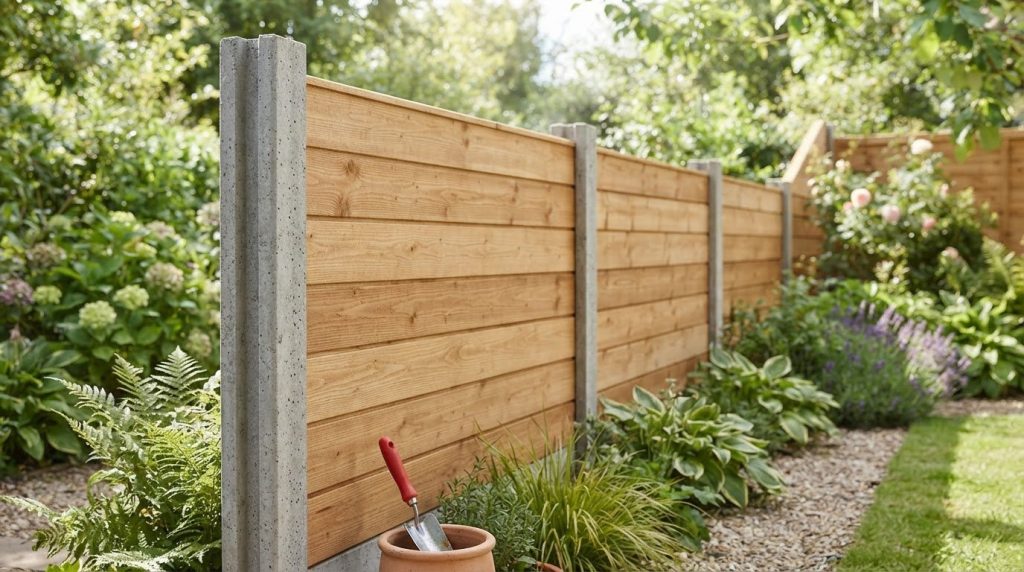
Fence Panels That Slot Into Concrete Posts for Your Fence
Replacing a fence doesn’t always mean replacing its concrete posts. Fence panels that slot into concrete posts can make use of the existing structure when the posts are sound and their slots suit the panels. The key is matching each panel to the bay and post layout.
It’s easy to focus on the panels themselves, but the post type matters too. End posts finish a run, intermediate posts support the join between bays, and corner posts accommodate a change in direction. Choosing the right type helps the fence fit together neatly.
This guide explains how slotted concrete posts work with replacement panels, what to consider when choosing end, intermediate and corner posts, and what premium post options are available. You’ll also learn how to assess an existing fence run and where a maintenance-free panel swap can make sense, so you can plan a practical replacement without overlooking the details that affect fit.
Key Takeaways
- Match the post to its position: end, intermediate and corner posts serve different parts of a fence run.
- A listed slotted-post installation requires two U-channel insert caps, so include the fittings when planning the build.
- Compare premium concrete posts by height and top style to find an option that suits your fence layout.
- Learn which panel materials can fit slotted posts and how a maintenance-free panel swap can refresh an existing fence.
Concrete slotted end posts
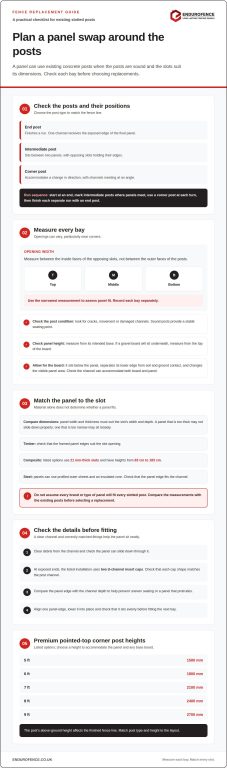
A slotted end post finishes a fence run, with its channel receiving the panel’s exposed edge. The other edge sits in an intermediate post, supporting the panel between fixed posts. Fence panels that slot into concrete posts work with existing structures when their slots align. Before choosing replacements, check the posts for cracks, movement or damaged channels. Sound posts provide a stable seating point for the panels.
Measure the opening between the inside faces of the opposing slots. Take measurements near the top, middle and bottom, since leaning posts can change the gap. Use the narrowest measurement to assess the panel fit. Measure the panel height from its intended base, including a gravel board if one will sit underneath. Record each bay separately, as openings can vary, particularly near corners.
End-post channels need a neat finish. The listed installation uses two U-channel insert caps to close exposed channels at the ends. Check that the cap shape matches the post channel. Also compare the panel edge with the channel depth to help prevent the panel from sitting unevenly or protruding.
Gravel boards sit below fence panels. They separate the panel’s lower edge from soil and ground contact. This can reduce direct exposure to damp earth and splashing. Boards also create a defined base beneath the fence. Their added height changes the visible panel area. Measure from the top of the board, not the ground. Check that the end-post channel can accommodate both board and panel. A board that does not fit can obstruct the panel.
Choose the end post to suit the fence line. At the end of a straight run, it supports one panel edge. Where the boundary changes direction, the post position affects the opening measurement. Check that the panel can slide down through the channel, clear debris from the slot, and compare the panel width with the opening. These checks can reveal fit issues before you handle replacement panels.
Intermediate, corner and end post types
Choose posts according to their position in the fence line. An intermediate post sits between two panels, with opposing slots holding their edges. An end post finishes a run, with one slot receiving the final panel. A corner post suits a change in direction, with channels meeting at an angle so the fence can continue around the corner.
Concrete slotted corner posts are available in several heights. Premium pointed-top options are listed at 5ft (1500mm), 6ft (1800mm), 7ft (2100mm), 8ft (2400mm) and 9ft (2700mm). Choose a height that accommodates the panel and any base board. The post’s above-ground height also affects the finished fence line. Match the post type to the layout before ordering.
For a straight run, plan the sequence from one end and mark each intermediate position where two panels meet. At a turn, use a corner post rather than treating both runs as one straight line. Finish each separate run with an end post. This makes it easier to count posts and identify the slots needed at each position.
Do fence panels fit all brands and types of slotted concrete posts? No, fit depends on dimensions, including the panel width and thickness, plus the post slot’s width and depth. Compare those measurements with the existing posts before selecting replacement panels.
Use this practical check for each bay:
- Identify whether each position needs an end, intermediate or corner post.
- Measure the opening between the relevant slot faces.
- Check slot depth and width against the panel edge.
- Note changes in direction and any gravel board beneath the panel.
A corner can expose mismatches that a straight bay hides. Check both channels and the angle between fence runs. If the posts remain in place, a panel replacement option for existing posts may help you plan a compatible refresh.
Premium concrete slotted fence posts
Premium posts come in different heights and top styles. Choose dimensions to suit the fence layout, not appearance alone. These are listed post prices, not panel prices.
Which materials suit panels for concrete slots? Timber, composite and steel panels are options, provided their edges fit the slot. Composite fencing uses 21 mm-thick slats, with listed heights from 83 cm to 183 cm. Steel panels can use profiled outer sheets and an insulated core. Match the panel material and edge dimensions to the existing channel.
What planning rules apply to fence height in the UK? Planning controls can depend on the fence’s position and local restrictions. Before choosing a height, consider whether the boundary or a nearby road affects your plans, and keep any existing permissions in view.
What are standard panel sizes for concrete posts in the UK? Panel width must match the gap between the post slots. Heights vary by panel type; listed composite options range from 83 cm to 183 cm. Measure each bay rather than assuming identical openings.
How do you install panels in slotted concrete posts? Clear the channels, align a panel edge, then lower it into place. Check that it sits evenly before fitting the next bay.
Can you replace one panel without removing concrete posts? Yes, if the posts are stable and the panel can slide clear of the channels. A damaged or obstructed slot can prevent removal.
How do you secure a loose panel? Check the panel edge and slot for damage or debris. Clear the channel, then reseat a panel of the correct size. If the concrete slot is broken, replacing the panel alone won’t secure it.
What types of fence panels fit into slotted concrete posts in the UK?
Material alone doesn’t determine whether a panel fits. Its edge must enter the post slot, and its width and height must suit the bay. Timber, composite and steel panels can be considered when their dimensions match. A panel that is too thick may not slide down properly; one that is too narrow may sit loosely between the posts.
Timber panels are a familiar option for UK gardens, but their framed edges need to suit the slot opening. Composite panels use separate slats, so check how the assembled panel meets each post. Steel systems can use profiled outer sheets around a high-density insulated core. Compare the complete panel edge, not just the main material.
Use the existing post layout to narrow your options. A straight bay needs panel edges that fit into opposing slots. At a corner, the post channels must face the adjoining runs. Check whether a gravel board affects the available panel height, then measure each opening, as adjacent bays may differ.
Before selecting a replacement, work through these checks:
- Measure the panel opening between the slot faces.
- Compare the panel edge thickness with the channel width.
- Check the panel height above any gravel board.
- Inspect the concrete slots for damage or obstructions.
These checks help distinguish a suitable panel from one that merely appears similar. A timber panel may need a different edge profile from a composite or steel system. Confirm that the panel can lower into the slot without catching. Consider how its finished surface will look beside the existing posts.
Replacing old panels while retaining sound posts? Explore steel panels for existing concrete posts as one practical option.
Post selection can also matter when matching a panel to an existing fence run.
Check the post type and top finish alongside the slot dimensions when planning a replacement.
EnduroFence: Maintenance-Free Fence Panels
EnduroFence offers maintenance-free steel panels for replacing fence panels while keeping suitable concrete posts. Each panel has profiled steel outer sheets on both sides with a high-density insulated core. The panels are powder-coated, with no painting or treating needed.
A Retro Fitting Panel Swap can suit an existing fence when the concrete posts are sound and their slots fit the replacement panels. Installation is straightforward: no training or qualification is needed. EnduroSmart Post Covers offer another way to update the appearance of existing posts.
Measure each bay and compare the panel edges with the slots before choosing a replacement. If you’re planning a fence refresh, contact EnduroFence to discuss Maintenance-Free Fence Panels and the Retro Fitting Panel Swap.
Plan your fence refresh with confidence
Choosing fence panels that slot into concrete posts can improve your garden without automatically replacing sound posts. Start by assessing the existing fence, then decide whether to refresh one bay or change the look of a longer run. A clear plan helps you choose a panel style that suits your boundary and how you use your outdoor space.
EnduroFence offers Maintenance-Free Fence Panels, EnduroSmart Post Covers and Retro Fitting Panel Swap options for updating an existing fence. The powder-coated steel panels need no painting or treating. Consider the finish you want and the existing post layout, then contact EnduroFence to plan your replacement.
Contact EnduroFence about your fence to discuss a suitable way to refresh your garden boundary. A well-planned panel replacement can help you move forward with a fence that feels right for your home.

Leave a Reply