

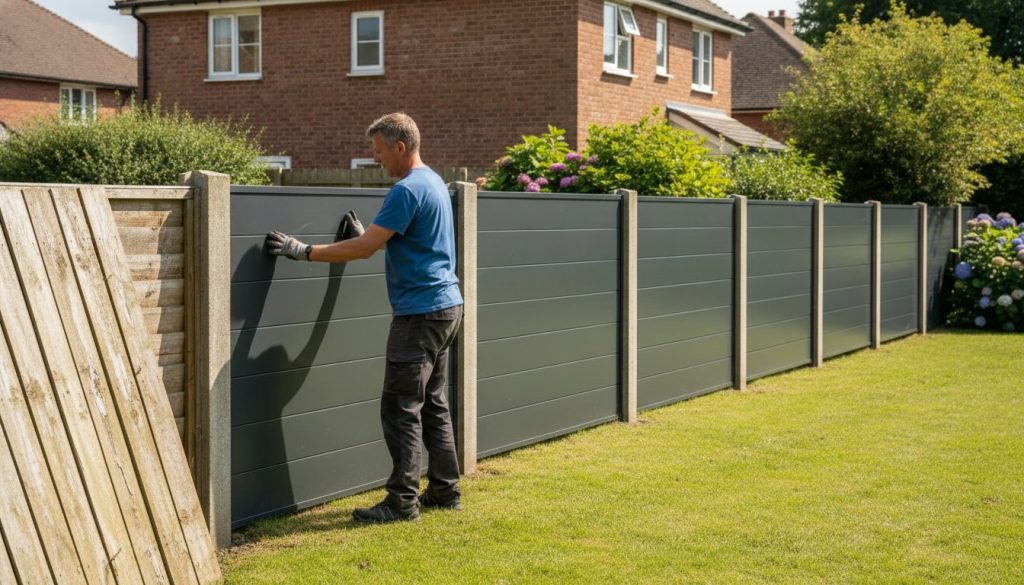
Fence Replacement Without New Posts: 2026 Retrofit Guide
Your garden’s concrete posts aren’t a liability to be dug up, but a permanent structural asset that most homeowners overlook when their timber panels fail. It’s frustrating to spend every spring painting weathered wood, only to hear those same panels rattle and groan whenever the wind picks up. You’ve likely considered a full rebuild, but the high cost and disruption of removing solid concrete often feel like too much effort for a simple aesthetic upgrade.
There’s a more practical way to achieve a modern look without the heavy lifting. This guide explores the process of retro fit fence panels, showing you how to transform your boundary by sliding durable steel alternatives into your existing setup. You’ll discover how a retrofitted panel swap eliminates the need for annual staining whilst providing a secure, rattle-free finish that lasts for decades. We’ll walk through the benefits of steel construction, from its maintenance-free nature to the clever use of post covers that hide aged concrete, ensuring your garden remains a place of relaxation rather than a source of ongoing labour.
Key Takeaways
- Check the structural integrity of your current concrete posts with a simple “Push Test” to confirm they can support a modern upgrade.
- Master the “Slot-and-Swap” technique for fence replacement without new posts, allowing you to upgrade to steel panels without any digging or heavy machinery.
- Understand the financial benefits of switching to maintenance-free materials that eliminate the need for annual painting, staining, or repairs.
- Learn the most efficient ways to remove stubborn, swollen timber panels whilst preparing your garden for a quick and tidy retrofit.
- Explore how to use matching steel post covers to mask aged concrete and achieve a sleek, premium aesthetic for your entire garden perimeter.
Assessing Your Existing Concrete Posts for a Retrofit Upgrade
Concrete posts are the unsung heroes of the British garden. Whilst timber panels are susceptible to damp and wind, a well-set concrete post provides a structural foundation that can last for many decades. This durability makes them the perfect candidate for a fence replacement without new posts. Instead of the labour-intensive task of digging out kilograms of old concrete, you can use these existing uprights as a framework for a modern, maintenance-free upgrade. When exploring different types of fencing, it’s clear that the combination of rigid concrete and modern steel panels offers a level of security that traditional timber struggles to match.
The Structural Integrity Check
Before ordering your new panels, you must ensure the foundations remain sound. Start with the “Push Test”. Stand at the centre of a fence run and apply firm, steady pressure to the post at waist height. A healthy post shouldn’t budge. If you feel a “give” or see the ground shifting at the base, the postcrete foundation may have failed. This usually happens if the original installation was too shallow or if the ground has eroded.
Next, look for signs of spalling. This occurs when moisture enters the concrete and freezes, causing the surface to flake or crack. Hairline cracks are common and usually only affect the appearance; they don’t typically compromise the strength of the post. However, deep fissures that expose the internal steel reinforcement bars are a sign of structural failure. If the metal inside is rusted and expanding, the post will eventually crumble. If the posts are straight and solid, they are ready for a Retro Fitting Panel Swap.
Measuring for Your New Panels
Precision is vital for a rattle-free finish. Standard UK concrete posts are designed to hold 6ft (1828mm) wide panels, but slight shifts in the ground over time can alter these gaps. Use a steel tape measure to check the distance between the inner slots of two adjacent posts. It’s a simple task that prevents installation headaches later.
Take three measurements for every section: one at the top, one in the middle, and one at the bottom. If the gap narrows significantly at the base, you might need to clear debris from the slot or slightly trim the panels to fit. Finally, consider your height requirements. If you are keeping your existing gravel boards, measure from the top of the board to the top of the post. This ensures your new steel panels sit flush and provide the privacy you expect from a fence replacement without new posts.
The Steel Panel Advantage: Why Retrofitting Beats Total Replacement
Choosing a fence replacement without new posts isn’t just about saving labour; it’s about selecting a material that ends the cycle of decay. Traditional timber panels are notoriously heavy and awkward to slide into narrow concrete slots. They often begin to rot the moment they’re exposed to the elements. Modern steel panels are engineered for a “Slot-and-Swap” installation. They’re lightweight enough for a single person to lift, yet they provide a level of structural integrity that wood cannot replicate. This method allows you to modernise your garden boundary in a fraction of the time it takes for a full rebuild.
Durability Amongst the Elements
Unlike wood, steel does not absorb moisture. This prevents the swelling and shrinking that causes timber to crack and split over time. While some homeowners look into professional fence restoration for historical metalwork, choosing a fence replacement without new posts using modern steel panels offers a similar level of longevity for the contemporary home. Profiled steel sheets are used to create a rigid surface that resists impacts and prevents sagging. These panels are finished with advanced coatings that resist UV fading and rust, ensuring the colour you choose today remains vibrant for years to come.
The Insulated Core Benefit
High-density insulation is the secret to a quiet, peaceful garden. Many people find that standard timber panels rattle incessantly during autumn gales, creating a constant nuisance. The thickness of an insulated steel panel ensures a snug fit within the concrete post slots, effectively dampening vibrations and preventing noise. This core also provides a significant acoustic benefit, reducing the intrusion of street noise or sounds from neighbouring properties. It makes your outdoor space feel more private and secure during every season.
The financial argument for steel is equally compelling. A timber fence has a lower upfront cost, but its lifetime expense is high. Consider these ongoing requirements for wood:
- Purchasing expensive stains and preservatives every two years.
- Replacing individual slats that warp, rot, or crack.
- The eventual labour cost of a full replacement every decade.
Steel represents a one-time investment. It’s a permanent solution that adds value to your property without demanding your weekends for maintenance. If you’re ready to stop the maintenance cycle, you can browse our range of maintenance-free fence panels to find the perfect fit for your existing posts.
Comparing Your Replacement Options: Timber vs. Modern Steel Panels
When planning a fence replacement without new posts, the decision usually comes down to initial price versus long-term value. Traditional timber panels are often chosen for their lower upfront cost, but this saving is frequently lost within the first five years. Wood is a dynamic material that reacts to the British climate; it absorbs moisture, swells in winter, and shrinks during dry spells. This constant movement leads to warped slats and the inevitable “fence rattle” that keeps many homeowners awake during windy nights. In contrast, steel panels remain dimensionally stable, ensuring the fit you achieve on day one remains identical for decades.
The weight of the materials also plays a significant role in the installation process. A standard wet timber panel can be incredibly heavy and difficult to manoeuvre, often requiring two people to lift it safely into a concrete slot. Steel panels are designed to be lightweight and manageable for a single person. This makes them an ideal choice for those following a DIY guide to replacing fence panels, as the physical strain is significantly reduced whilst the structural strength is increased.
Visual Transformation and Colour Choice
Modern garden design has shifted towards a more integrated look, where the boundary fence complements the home’s architecture. Whilst timber is limited to varying shades of brown or the effort of manual painting, steel panels come in a range of factory-finished colours. Popular choices like anthracite grey or deep olive allow you to match your fence to modern bifold doors or window frames. This creates a cohesive aesthetic across your property. Because the colour is bonded to the steel, you won’t see the peeling or flaking associated with painted wood, ensuring your garden maintains its premium look without any ongoing labour.
Security and Privacy Considerations
Security is a primary concern for any homeowner, and the material you choose for your fence replacement without new posts can make a significant difference. Timber panels, particularly cheaper lap-fencing, can be easily breached by kicking out individual slats or prying them apart. Steel panels offer a far more formidable barrier. Their solid construction and profiled design make them nearly impossible to climb or break through without specialist tools.
Privacy is also improved with steel. As timber ages and dries, gaps often appear between the boards, creating “peep holes” into your garden. Steel panels provide a consistent, opaque barrier that doesn’t degrade over time. This offers total peace of mind for families with young children or pet owners who need to ensure their garden remains a secure and private sanctuary.
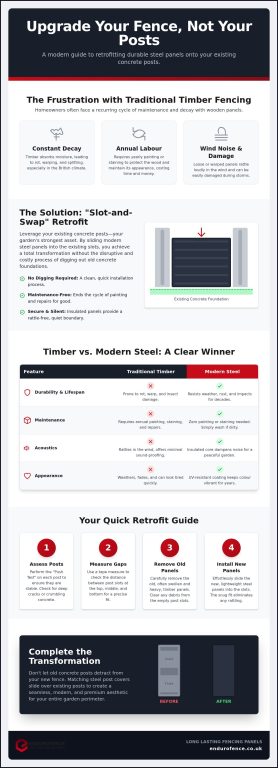
Step-by-Step Guide to Swapping Fence Panels Yourself
A successful fence replacement without new posts begins with a clear workspace. Before you touch the first panel, prune back any overhanging ivy or shrubs that have grown through the old timber slats. Clear away accumulated soil, moss, or decorative stones from the base of the concrete posts. This preparation ensures you have unrestricted access to the full length of the post slots, making the extraction of old materials much easier.
Removing the Old Fencing Safely
Old timber panels are rarely as cooperative as you’d hope. Whilst some might slide out with ease, many will be swollen from years of rain or secured with rusted nails. You’ll need a solid crowbar, a hammer, and heavy-duty work gloves to handle the job safely. If a panel is truly wedged, don’t try to force it from the top. Instead, use a crowbar to apply steady upward pressure from the bottom corner. In extreme cases, you may need to use a saw to cut the old panel into smaller sections to relieve the tension against the concrete.
When the wood is out, remember that treated timber requires specific disposal. In the UK, you should take old fencing to your local household waste recycling centre rather than burning it, as the preservatives can release harmful chemicals. Take this opportunity to check for any rusted brackets or nails left behind in the concrete slots. Removing these obstructions is essential to ensure a smooth path for your modern upgrade.
Fitting the New Steel Panels
Before sliding in your new panels, take a moment to clean the internal slots of the concrete posts. A stiff brush or a flat-head screwdriver can help clear out stones, moss, and old wood splinters. This small step prevents the new panels from catching or snagging during installation.
Whilst the steel panels are lightweight enough for one person to lift, having two people for the installation makes the process significantly faster and safer. One person can guide the panel into the slots from the top whilst the other ensures it seats correctly on the existing gravel board. Check that the panel is level as you go. If your garden has a slope, you might need to step the panels to maintain a tidy, professional appearance. Once seated, the snug fit of the insulated core should prevent any movement. If your concrete posts have unusually wide slots, you can add small spacers to ensure a perfectly rattle-free finish.
By following this methodical approach, you can transform your entire garden boundary in a single afternoon. If you’re ready to start your project, you can order your Retro Fitting Panel Swap kits to get everything you need for a maintenance-free garden.
Completing the Transformation with Post Covers and Modern Finishes
A successful fence replacement without new posts often hits a visual snag once the high-quality steel panels are in place. Whilst the new panels look pristine, the original concrete posts frequently appear weathered, stained, or cracked by comparison. This aesthetic clash can undermine the modern look you’re trying to achieve. Instead of leaving the grey, industrial-looking concrete exposed, you can complete the transformation by using matching steel post covers. These covers act as a final skin for your boundary, ensuring the entire structure looks like a bespoke, professional installation rather than a patchwork of old and new materials.
Beyond the visual benefits, post covers provide a practical layer of protection for your existing infrastructure. Concrete is a porous material that absorbs water; over time, this leads to freeze-thaw damage and spalling. By encasing the posts in the same durable steel as your panels, you shield the concrete from the worst of the British weather. This simple addition helps to halt further degradation, effectively extending the life of your structural foundations whilst maintaining a clean, uniform appearance across the entire garden perimeter.
Aesthetic Unity with Post Covers
Achieving a seamless finish is remarkably straightforward. Post covers are designed to match the specific colour and texture of your maintenance-free panels, whether you’ve chosen a contemporary anthracite grey or a more traditional finish. Most systems utilise a simple “slide-over” or “clip-on” method that requires no specialist tools or drilling into the concrete itself. This makes it an ideal task for a weekend DIY project.
These covers are particularly effective at hiding the common signs of age that concrete posts exhibit. They mask uneven surfaces, moss growth, and those stubborn orange rust stains that often bleed from internal reinforcement bars. Once fitted, the transition between the post and the panel becomes almost invisible, creating a sleek, continuous line that makes the garden feel larger and more organised.
The Final Result: A Maintenance-Free Garden
The primary reward for choosing a fence replacement without new posts is the total elimination of the traditional maintenance cycle. Once your steel panels and post covers are installed, you can say goodbye to the annual ritual of sanding, staining, and painting. The factory-applied coatings are designed to resist UV fading and scratches, meaning the fence looks as good in ten years as it does on the day of installation. This shift from “constant repair” to “permanent solution” significantly increases the kerb appeal of your property.
A well-maintained, modern boundary is a strong selling point for any home. It signals to potential buyers that the property has been upgraded with longevity in mind. More importantly, it gives you back your weekends. Instead of managing a decaying timber fence, you can enjoy a secure, rattle-free outdoor space that requires nothing more than an occasional wash with a garden hose. If you’re ready to upgrade your garden boundary with a professional, long-term solution, request a free quote for your retrofit project today.
Transform Your Garden Boundary Today
You’ve seen how easy it is to leverage your existing concrete posts to create a permanent, maintenance-free perimeter. By choosing steel over timber, you remove the need for annual staining and permanently solve the problem of rattling panels during UK storms. This methodical approach to a fence replacement without new posts is the most efficient way to modernise your outdoor space whilst avoiding the high cost and mess of a full rebuild.
Our solution is designed specifically for an easy DIY retrofit, featuring a high-density insulated core that ensures your boundary remains secure and silent. When paired with matching post covers, your weathered concrete posts disappear behind a sleek, contemporary finish that adds immediate kerb appeal to your property. It’s a pragmatic investment that pays off every time you look out of your window and realise the era of painting and repairs is finally over.
Ready to reclaim your weekends? Upgrade your garden with maintenance-free steel panels from EnduroFence. With a straightforward plan and the right materials, a beautiful and durable garden is well within your reach.
Frequently Asked Questions
Can I really fit new panels into my old concrete posts?
Yes, as long as your concrete posts are structurally stable and upright, they can support new steel panels. This process is known as a fence replacement without new posts, and it relies on the standard H-slot design found in most UK gardens. Our panels are specifically engineered to slide into these existing channels. This allows you to upgrade your garden boundary without the mess and labour of digging out old foundations.
What is the best material for replacement fence panels?
Steel is widely considered the best long-term choice because it eliminates the decay associated with timber. Unlike wood, steel won’t absorb water, rot, or require annual staining to maintain its appearance. Our panels use profiled steel sheets with an insulated core, providing a balance of structural strength and thermal stability. This makes them a permanent solution that outperforms traditional wood in both durability and lifetime value for the homeowner.
How do I stop my new fence panels from rattling in the concrete slots?
The insulated core of our steel panels provides a thicker profile than standard timber, which naturally reduces movement within the concrete slots. If your existing posts have particularly wide channels, you can use small rubber or plastic spacers to create a perfectly snug fit. This ensures that even during high winds, the panels remain silent. It’s a simple fix that addresses one of the most common complaints about traditional garden fencing.
Do I need to replace my concrete gravel boards as well?
There is no requirement to replace your gravel boards if they are in good condition. Steel panels are designed to sit directly on top of your existing concrete boards, maintaining the same height and alignment as your old fence. If you find the weathered look of the old boards clashes with your new panels, you can choose to cover or paint them, but they remain a perfectly functional part of the retrofit system.
Are steel fence panels heavier than timber ones to install?
Steel panels are surprisingly lightweight and are generally easier to handle than wet or pressure-treated timber. A single person can often lift and slide a steel panel into place, making the installation process much more accessible for DIY enthusiasts. This weight advantage doesn’t compromise strength; the internal high-density insulation provides the necessary rigidity and wind resistance whilst keeping the overall weight manageable for a quick and safe garden transformation.
Will steel fence panels rust over time in the UK weather?
Modern steel panels are finished with advanced, multi-layer coatings specifically designed to withstand the damp UK climate. These protective layers prevent oxidisation and rust, even in coastal areas or regions with high rainfall. Unlike iron or untreated metals, these maintenance-free panels don’t require painting or rust-proofing treatments. The colour is bonded to the surface, ensuring it stays vibrant and resistant to scratching or UV fading throughout its lifespan.
Can I install these panels myself or do I need a professional?
The Retro Fitting Panel Swap is designed specifically for DIY installation and requires no specialist tools or trade qualifications. Most homeowners find they can complete a standard garden run in a single afternoon. Whilst a professional isn’t necessary, having a second person to help guide the panels into the slots makes the job faster and safer. It is a straightforward process of removing the old timber and sliding in the new steel.
How do I measure my existing fence to ensure the new panels fit?
Measure the horizontal distance between the inner slots of your concrete posts at the top, middle, and bottom. Most UK posts are spaced for standard 6ft (1828mm) panels, but taking three measurements ensures you account for any slight leaning or ground movement. You should also measure the height from the top of the gravel board to the top of the post to ensure your new panels provide the desired level of privacy.

Leave a Reply