

Fencing to Keep Foxes Out of Gardens and Poultry Runs
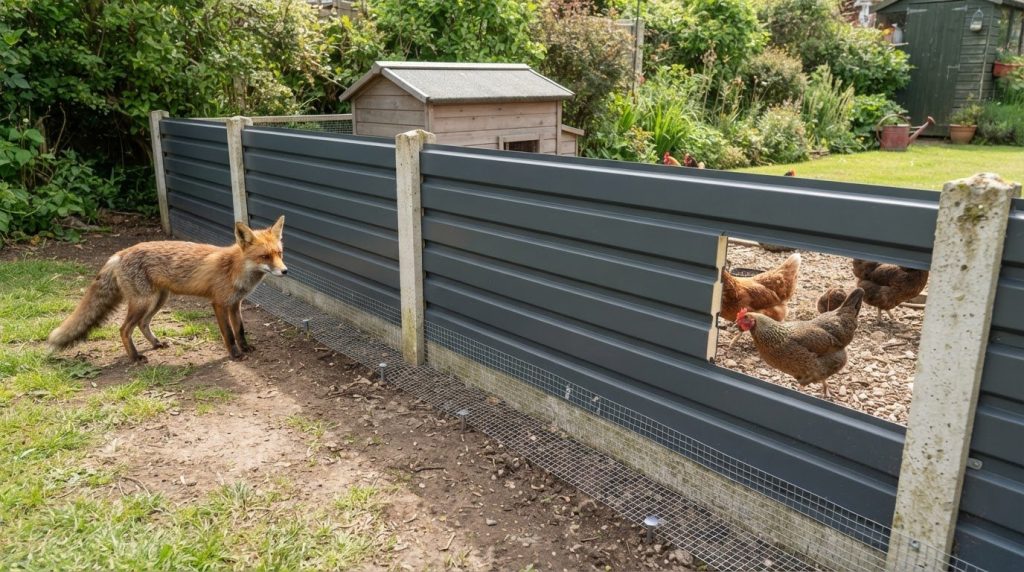
Ordinary chicken wire is unlikely to keep foxes out of a garden: foxes can scramble over fencing or dig underneath it. A fence at least 6 feet tall can help, but height alone won’t address weak points at ground level or around a poultry run.
It’s understandable to want a straightforward barrier that protects your garden and animals without adding more work. The right approach depends on what you’re protecting: a garden boundary needs to deter climbing and digging, while a coop or small-animal enclosure also needs mesh that stops foxes reaching through or forcing their way in.
This guide explains why standard chicken wire may fall short, how fence height and an overhang can help, and what to consider when securing poultry and small animals. You’ll also learn how a buried fence edge or mesh skirt can make digging underneath harder, helping you choose a barrier suited to the space and the protection needed.
Key Takeaways
- Standard chicken wire may not stop foxes from climbing over or digging beneath a garden fence; consider how you’ll secure the bottom edge as well as the top.
- A fence at least 6 feet tall can help deter jumping, while an angled overhang can make climbing more difficult.
- For poultry and small animals, focus on mesh strength, aperture size and a secure enclosure, including its roof, floor and door.
- Fencing can reduce access, but the right design depends on whether you’re protecting a garden boundary, crops or a smaller animal enclosure.
Can I use standard hexagonal chicken wire to fox-proof my garden or coop?
Standard chicken wire alone is unlikely to keep foxes out. Foxes can climb over a barrier or dig beneath it, so effective fencing needs to address both routes of entry.
Preventing Foxes from Digging Under Fences
To adapt an existing fence, inspect its full length for gaps, loose panels and disturbed ground. Close openings, secure loose sections, then protect vulnerable soil with a mesh skirt or suitable prickle strips. The RSPCA says foxes in the UK are not protected under the Wildlife and Countryside Act 1981. For boundary-height rules, fox-proofing advice does not itself grant permission to raise a fence; check the relevant planning requirements for your property.
Burying Fence Mesh
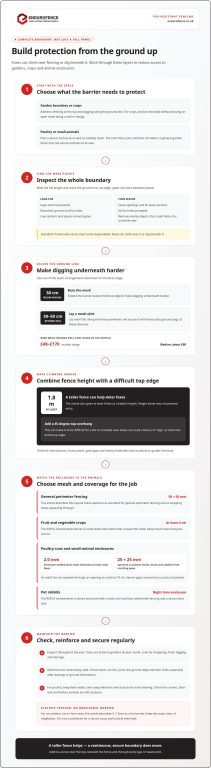
Burying mesh below the fence edge makes digging underneath harder. Extend the barrier 30 cm below ground, or lay a mesh skirt flat along the fence perimeter and fix it securely. Fill fox holes promptly, as the RHS advises, to prevent them deepening and potentially becoming a den. For a cost guide, wire mesh fencing rolls on the market typically range from £48 to £170, with a median of about £89.
Reducing Digging and Climbing Risks
Hexagonal chicken wire may not provide a dependable fox deterrent around a garden or coop: its structure can leave weak points, and foxes may climb over or dig under it. Check the top edge as well as the ground, and remove nearby objects that could help a fox scramble over. Scent or device deterrents may need ongoing attention. Look for droppings and fresh digging, then reinforce the route being used.
How high must a fence be to stop a fox jumping over?
A garden fence at least 6 feet tall can help deter foxes, but height alone may not prevent entry. Foxes are strong climbers and can scale a fence 2 m high, so combine suitable height with a top edge that’s harder to climb.
A fence at least 1.8 m high with a 45-degree top overhang can make it more difficult for a fox to scramble over. Check the whole boundary for low sections, loose panels and gaps around gates. A small opening can undermine a taller barrier, particularly where plants or garden furniture provide an easy foothold.
Protecting fruit and vegetable crops
For fruit and vegetable crops, the RSPCA recommends fences or solid weld-mesh with holes at least 4 cm wide. This gives plants a physical barrier without relying on netting alone. Keep mesh intact and joined securely at corners, where gaps can form and foxes may push through. Choose a layout that encloses the beds rather than leaving an open route along a wall or hedge.
Close gaps and secure the perimeter
Walk the enclosure and inspect the ground line, gate edges and joins between fence panels. Fill visible gaps and secure loose sections so the barrier stays continuous. A mesh skirt can also deter digging: lay it flat along the fence perimeter and fix it with heavy-duty ground pegs. Secure the pegs every 30 to 50 cm to keep the skirt in place.
Choose a humane design that addresses both climbing and access beneath the fence. An overhang can discourage scrambling, while a securely fixed skirt reduces opportunities to dig. If you’re updating a garden boundary, maintenance-free fence panels can provide a practical alternative to timber panels in existing concrete posts.
Protecting poultry and small animals from foxes
For a poultry run, use welded steel mesh that resists chewing and prevents paws reaching through. Mesh at least 2.0 mm thick helps resist foxes, while a 25 mm by 25 mm aperture protects chicks, ducks and rabbits from reaching paws. An adult fox can squeeze through an opening as small as 10 cm, so secure gaps around doors and joins as well as the main panels.
Electric fencing can help deter foxes around an outdoor enclosure when installed as a complete barrier. Use 5-7 lines for a fox barrier, and keep the route clear so vegetation doesn’t interfere with the wires. This can suit poultry runs or farm areas where a physical fence alone leaves vulnerable access points. It isn’t a substitute for a secure coop, particularly overnight.
For pet rabbits, the RSPCA recommends a secure enclosure at night with a solid roof and floor, weld-mesh fencing and a secure door lock. This combination helps protect against foxes entering from above, digging beneath the enclosure or pushing through a weak panel. Check the lock and mesh regularly, especially after damage or ground disturbance.
Protect pets without creating unnecessary risks for other wildlife. A properly enclosed run keeps poultry and small animals separate from foxes, while a general garden fence may not secure a rabbit or chicken on its own. Keep feed inside the enclosure and clear away leftovers that could attract foxes. Close doors each evening, and inspect the corners, floor and roof before leaving animals outdoors.
Electric barriers are most relevant to a defined run or farm perimeter, rather than as a stand-alone solution for every garden. Match the protection to the animals: chicks need small mesh openings, rabbits need a roof and floor, and poultry need a securely closed coop. These practical details reduce opportunities for entry and help protect animals without relying on deterrents alone.
Whether fencing can keep foxes out
Fencing can reduce fox access, but it works as a complete boundary rather than a single tall panel. Foxes are active in gardens all year round, so inspect for entry points and damage throughout the year. A 50 mm by 50 mm square mesh aperture is described as standard for general perimeter fencing and as stopping foxes squeezing through.
That mesh size addresses passage through the barrier, not every way a fox might get inside. Check the ground edge for digging, joins between panels for gaps, and gates for spaces underneath or beside them. A boundary with one loose panel can leave an easy route outside the enclosed area, even if the remaining fence is sound.
Foxes establish territories and may repeatedly use a familiar route. Look for fresh digging or other signs of activity near the same fence section, then reinforce that weak point. A mesh skirt, for example, can discourage digging along a boundary, while secure joins help close gaps between panels. Keep gates shut after garden access or deliveries.
Match the barrier to what needs protection. A general garden fence may help deter foxes from the garden, but rabbits or poultry need their own secure enclosure. Check its roof, floor, mesh and door: a perimeter fence won’t protect animals left in an open run. For crops, enclose the vegetable bed rather than relying on loose netting.
The practical takeaway is that fencing can make access harder, but its effectiveness depends on continuity, condition and the route a fox uses. Walk the boundary, address gaps and digging points, and reassess after damage or changes to the garden. To plan a more secure garden boundary, explore fence panel options.
EnduroFence
EnduroFence can help if you’re replacing worn garden panels and want a durable boundary with less routine upkeep. Its Maintenance-Free Fence Panels are designed to fit existing concrete posts, making them a practical option when timber panels need replacing without changing the posts.
The panels’ profiled steel outer sheets and high-density insulated core provide a robust garden boundary, with no painting or treating needed. EnduroSmart Post Covers can finish existing concrete posts, and the Retro Fitting Panel Swap lets you replace panels in place. These products can improve a garden fence, but a perimeter boundary is not a substitute for a secure poultry or rabbit enclosure with protected sides, roof and floor.
Planning a garden fence update? Contact EnduroFence to discuss options for your boundary.
Plan your next boundary improvement
Use signs of access in your garden to decide where the boundary needs attention. A damaged panel, worn post or route beneath a fence may call for a different fix. Planning fencing to keep foxes out of the garden starts by identifying the area you want to protect, rather than expecting one change to secure every animal or space.
For fencing to keep foxes out of a garden, consider how the boundary suits your property and what needs improving. EnduroFence offers Maintenance-Free Fence Panels, Post Covers and Retro Fitting Panel Swap for garden fence updates. These options can refresh an existing boundary, but poultry and small animals still need their own secure enclosure.
Contact EnduroFence about your fencing options and take the next step towards a more considered garden boundary.
Frequently Asked Questions
Should I choose flexible mesh rolls or rigid weld mesh panels?
Choose mesh rolls for a long perimeter run and rigid welded panels for a smaller, defined area. Panels can be quicker to install around a coop, while rolls suit extended boundaries. Consider the shape of the space, the number of corners and whether the mesh will stay taut. Rigid panels can cost more per metre than rolls.
What is a good fox deterrent?
A continuous physical barrier is a practical starting point, with secure gates and no open routes beneath or between sections. Garden repellents need frequent reapplication, and foxes may ignore some. Ultrasonic devices may deter foxes in the short term, but foxes can become accustomed to the sound. A plan for fencing to keep foxes out of a garden should address access routes rather than rely on sound or scent alone.
What mesh aperture (hole size) stops a fox from reaching through?
For chicks, ducks and rabbits, use a 25 mm by 25 mm aperture to prevent foxes reaching paws through the mesh. A 50 mm by 50 mm aperture is described as standard for general perimeter fencing and stops foxes squeezing through, but it may not provide the same protection against paws reaching into a small-animal enclosure. Match the opening to the animals inside.
What fence height is needed to keep foxes out of a garden in the UK?
A fence at least 6 feet tall can help deter foxes, but it isn’t a complete solution by itself. Foxes can climb, so the top edge and nearby footholds matter as well as the height. An overhang angled outwards can make scrambling harder. Keep bins, trellis and garden furniture away from the fence if they could help a fox climb.
How deep should fox-proof fencing be buried?
Bury fence mesh 30 cm below ground to make digging underneath harder. Where digging down isn’t practical, a mesh skirt can lie flat along the perimeter and extend outwards from the fence. Secure it to the ground and keep it continuous at corners and gates. Check after heavy weather or ground disturbance, when a skirt may shift or become exposed.
What mesh size and type of wire fencing stops foxes?
For fencing to keep foxes out of a garden, choose welded steel wire mesh at least 2.0 mm thick, with openings suited to the animals being protected. A 25 mm by 25 mm aperture helps stop paws reaching chicks, ducks or rabbits. Standard hexagonal chicken wire is less dependable as a fox barrier, so consider wire strength, joins and how securely the mesh is fixed.

Leave a Reply