

Fencing to stop neighbours seeing in: choose by budget
Privacy doesn’t have to mean replacing the whole boundary. Fencing to stop neighbours seeing in can be added as a separate screen on your own land, without your neighbour’s permission, provided it stays within the applicable height limits. Changing or attaching anything to a neighbour-owned fence is different and requires their permission. In England and Wales, most garden fences can be up to 2 metres high without planning permission, according to the UK Government; fences next to a highway or its pavement usually have a lower limit, often around 1 metre.
It’s understandable to want more privacy without risking a boundary dispute or choosing a screen that doesn’t suit your garden. This guide compares ways of fencing to stop neighbours seeing in, from planting and lattice to fabric and mesh, and explains what to consider before adding a screen. It also covers how permission and fence-height rules can affect your plans, helping you choose a practical way to create more privacy.
Key Takeaways
- Match screening to your garden: planting and wooden screens suit natural spaces, while metal or composite can complement a modern design.
- Choose lattice for climbing plants, or fabric and mesh for a flexible screen that can be moved or removed.
- Consider upkeep and damp conditions when comparing materials, as these can affect how well a screen suits your garden over time.
- EnduroFence Maintenance-Free Fence Panels can replace timber panels in existing concrete posts when you want a durable, lower-maintenance boundary.
1. Privacy and security from neighbours and passers-by
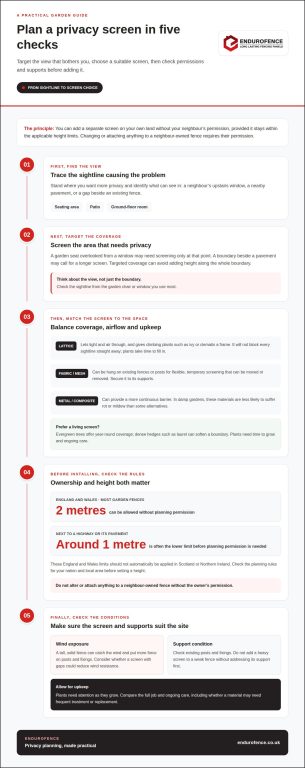
A solid screen can block direct views into seating areas, patios and ground-floor rooms, and make garden boundaries less exposed to passers-by. First, identify the sightline causing the problem: a neighbour’s upstairs window, a nearby pavement or a gap beside an existing fence. This helps you screen the area that needs privacy instead of adding height along the whole boundary. Trellis with climbing plants, evergreen trees and dense hedges such as laurel can provide softer screening.
Planning rules depend on where you live. In England and Wales, most garden fences can be up to 2 metres high without planning permission, according to the UK Government. Fences next to a highway or its pavement usually have a lower limit, often around 1 metre, before planning permission is needed. These England and Wales limits shouldn’t automatically be applied in Scotland or Northern Ireland; check the planning rules for your nation and local area before setting a height.
In a windy area, a tall, solid fence can catch the wind and put more force on its posts and fixings. If the supports loosen or fail, panels may lean or come down, creating a safety risk and exposing the garden again. Consider how exposed the boundary is, the condition of its posts and whether a screen with gaps could reduce wind resistance. Don’t add a heavy screen to a weak fence without addressing its support first.
For a practical privacy plan, trace the view from the spot you want to screen. A garden seat overlooked from a neighbour’s window may need coverage only at that point; a boundary beside a pavement may need a longer screen. Evergreen trees provide year-round coverage, while ivy or clematis can climb a trellis. Plants take time to fill in, so they won’t provide immediate screening. Also consider upkeep: plants need attention, while metal or composite screens can suit gardens where regular trimming or painting is unwelcome. Don’t alter or attach anything to a neighbour’s fence without the owner’s permission.
2. Choosing screening by garden style and budget
When choosing fencing to stop neighbours seeing in, start with the look of your garden, then compare materials and upkeep. A modern patio with clean lines may suit metal or composite screening, while a cottage-style border can pair naturally with plants or a wooden screen. Matching the screen to paving, raised beds and existing fence colours helps it feel like part of the design. Vertical planting systems create a living green wall, though plants need care as they grow.
For a lower-cost approach, reuse materials you already have. Recycled pallets, old wooden crates and spare fence panels can be adapted into screens, provided they’re sound and suitable for outdoor use. Bamboo screening is lightweight and straightforward to install, making it an option for covering a small section without building a full boundary. Freestanding screens also come in movable designs, from modern metal to rustic wood, so you can screen a seating area rather than the entire garden.
The installed cost of a 6ft privacy fence per metre depends on the material, the length of the run and the work required. Access to the boundary, ground preparation and removing an existing fence can all affect the total. Compare the full job, not just the material: a screen that needs frequent treatment or replacement may require more upkeep over time than a lower-maintenance alternative.
A practical approach to fencing to stop neighbours seeing in is to match the screen to how you use the space. A small courtyard may suit a movable screen that can be repositioned around a table, while a long garden boundary may call for a consistent material throughout. In a natural planting scheme, a wooden screen can support climbing greenery; in a contemporary garden, metal or composite can keep the finish simple. Damp conditions can affect which materials are suitable, so consider the exposure and the upkeep you’re prepared to manage.
3. Lattice screens, fabric and mesh
For a durable, more continuous privacy barrier, metal or composite screening can be practical choices. In damp gardens, these materials are less likely to suffer rot or mildew than some alternatives. Lattice offers a different balance: its grid lets light and air through while supporting climbing plants. It won’t block every sightline straight away, so consider how much coverage you need now and whether you’re happy to wait for plants to grow.
A lattice panel works well beside a patio or seating area, especially with ivy or clematis trained across it. Fabric screens and mesh can be hung on existing fences or posts for temporary screening. They’re useful if you want to cover a particular view, then move or remove the material later. Check that the screen is secure against its supports and covers the sightline from the garden chair or window you use most.
Alternatives to a full fence include trellis with climbing plants, evergreen trees and hedges. Laurel and boxwood offer dense growth, while evergreen trees can provide year-round coverage along a property line. These living screens bring greenery, but plants take time to grow and need ongoing care. For an adjustable option, outdoor curtains on a pergola or arbour can be opened for more light and closed when you need privacy.
Choose a screen by balancing privacy, airflow and upkeep. A screen with built-in gaps can admit light and air while limiting views; a denser panel gives more consistent coverage. In a damp spot, metal or composite may be better suited than materials vulnerable to rot or mildew. For a small seating nook, fabric or mesh can provide flexible cover; for a planted boundary, lattice gives climbers a frame to fill. Consider local conditions and how you use the space before settling on a material.
4. What fence height is allowed between neighbours in the UK?
In England and Wales, most garden fences can be up to 2 metres high without planning permission, according to the UK Government. Fences next to a highway or its pavement usually have a lower height limit, often around 1 metre before planning permission is needed, also according to the UK Government. Measure from ground level and consider how the fence sits beside a road or pavement, not only its height along the garden boundary.
These figures apply to England and Wales; they don’t establish the rules in Scotland or Northern Ireland. Planning requirements can also depend on the fence’s location and the property. Before choosing a taller screen, identify which nation the property is in and whether the boundary borders a highway. That distinction matters: a height suitable for a garden boundary may not be suitable beside a public route.
Height limits don’t determine who owns a neighbour’s fence. In England and Wales, there’s no universal rule assigning responsibility for a boundary fence to the property on its left. Property documents can help establish the boundary and identify who owns a wall or fence. If you want extra privacy, you can place a separate fence just inside your own boundary, provided it remains entirely on your land and meets applicable height limits.
A neighbour who owns a fence doesn’t have to make it higher because you want more privacy. Don’t raise, paint or attach screening to their fence without permission. If the boundary position is uncertain, discuss it before work begins; where neighbours disagree about the boundary, a surveyor can help resolve the property issue. Keeping a new screen on your land avoids treating someone else’s structure as your own.
For a privacy upgrade that fits existing concrete posts, explore fence panel options before planning a complete boundary replacement.
EnduroFence
If your existing fence needs a more private, lower-maintenance finish, EnduroFence’s Maintenance-Free Fence Panels are designed to slot into existing concrete posts. They’re a practical option for replacing worn timber panels without rebuilding the boundary. The panels have profiled steel outer sheets on both sides and a high-density insulated core. They’re powder-coated, with no painting or treating needed.
For a partial update, EnduroFence’s Retro Fitting Panel Swap lets you replace panels while retaining suitable posts. EnduroSmart Post Covers can also refresh the look of existing concrete posts. These options suit homeowners who want a durable boundary without painting or treating the panels. They won’t suit every screening preference: if you prefer a living hedge, lattice or a temporary fabric screen, those approaches may fit better.
If a panel replacement suits your garden and existing boundary, contact EnduroFence to discuss your options.
Make your next step a practical one
Planning fencing to stop neighbours seeing in starts with the view you want to screen and how you want your garden to feel. Before choosing a solution, decide whether you need privacy across a whole boundary or only around a particular spot. This can help you avoid changing more of the garden than necessary while keeping the result in line with your priorities for appearance and upkeep.
If your plans include an existing concrete-post fence, EnduroFence offers Maintenance-Free Fence Panels, EnduroSmart Post Covers and Retro Fitting Panel Swap. These options can refresh the boundary without turning a panel replacement into a complete redesign. Choose the approach that suits your garden, then explore the products and options on the EnduroFence website.
Contact EnduroFence about garden screening to discuss your fencing options and find a practical way to make your outdoor space feel more private.
Frequently Asked Questions
Can you put up a fence without your neighbour’s permission?
Generally, you can put a fence on your own land without your neighbour’s permission, provided you follow applicable planning rules. Keep the structure within your boundary and don’t fix it to a fence or wall that belongs to your neighbour. If the boundary is shared or its position is uncertain, discuss the proposal first to reduce the chance of a disagreement about ownership or access.
Garden Fence Panels – Which Way Should The “Good” Side Face?
In England and Wales, no specific law says the finished side must face you, your neighbour or the road. If the fence borders a road or public footpath, the usual convention is to face the finished side outwards, with posts and rails on the garden side. If you and your neighbour share the cost, agree on the orientation before ordering materials.
Which boundary is legally your responsibility?
There’s no universal rule in England and Wales that makes the boundary on the left of your property your responsibility. Check the legal documents provided when the home was bought, as they may show boundary ownership or require you to keep a wall or fence in good repair. If the documents don’t resolve a disagreement, a surveyor can help with the boundary issue.
What steps should I take before installing a fence along a shared boundary?
Start by reviewing your property documents for boundary details, ownership and any repair obligations. Then discuss the proposed position, height and appearance with your neighbour, especially if you’re sharing the cost. Keep the new structure on your land unless ownership and boundaries are clear. If planned work affects a party wall in England, written notice may be required before work begins.
Can my neighbour object to or remove a fence I install on my property?
Your neighbour can raise concerns, particularly if they believe the fence crosses the boundary or breaches planning rules. A disagreement doesn’t give them permission to remove a fence that belongs to you. Keep records showing the agreed position and ownership, and discuss concerns before they escalate. If the boundary is disputed, seek help resolving that question before either side alters the structure.

Leave a Reply