

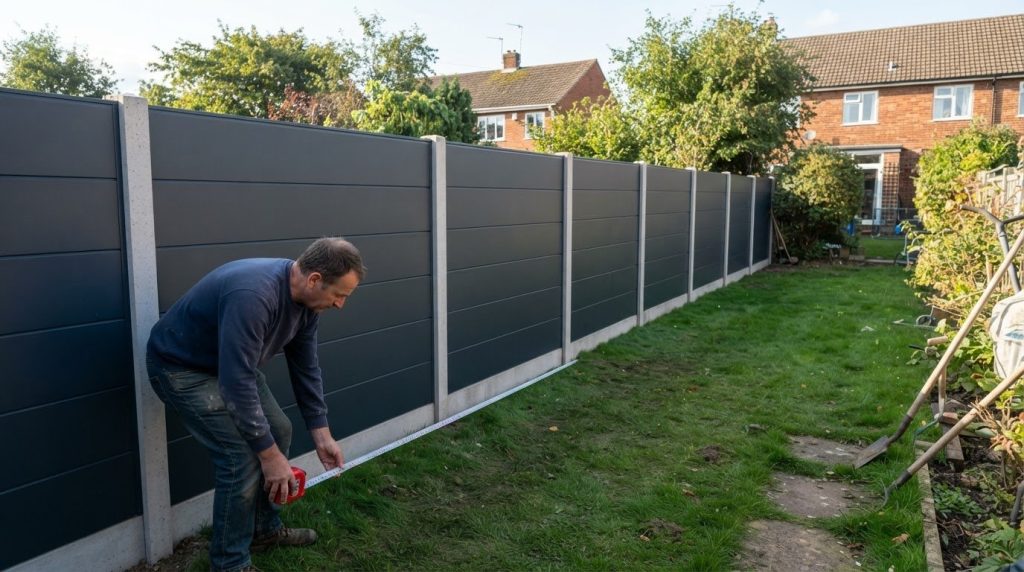
Garden fence replacement cost calculator for UK projects
The fence run is only the starting point. A garden fence replacement cost calculator for UK projects uses your measured length, fence style, height and post spacing to estimate materials and the overall project total. Measure each run separately so the estimate reflects your garden’s layout.
It’s sensible to want a clear figure before deciding what to replace. A calculator gives an estimate, not a fixed quote: material choice, fence height and the components required all affect the total. Adjusting the options also shows how your choices change the quantities.
Here, you’ll find typical UK fencing material and installation costs per metre, along with a straightforward way to estimate the materials for your project. Enter your fence-run lengths and account for panels, posts, gravel boards and post mix to build a more useful starting budget before deciding what to do next.
Key Takeaways
- Separate material estimates from installed costs, then account for fence height and the work involved when planning your budget.
- Use your fence style and measurements to estimate the panels, posts, gravel boards and post mix needed.
- Enter each straight fence run separately so the calculator can reflect your garden’s layout and calculate quantities more accurately.
- Compare your project needs with maintenance-free panel options to see whether a panel replacement could suit your existing fence structure.
Average fencing material cost per metre
Panel style, height, posts, gravel boards and fixings all affect the materials total. Estimate each component separately so a lower panel price doesn’t obscure the extra items needed to complete the fence run.
These figures are per panel, not per metre, so compare them only after checking how much fence each panel covers. For concrete, timber, metal or composite fencing, compare equivalent components and specifications. The available figures don’t establish like-for-like prices for every material.
To estimate composite fencing materials, measure the full run in metres and check the panel coverage and height. Divide the run length by the coverage of one panel, then allow for posts, end sections and any boards or fittings required by the chosen system. Use the product dimensions rather than assuming composite panels match timber sizes.
Start a fencing materials estimate with the fence length and style. Add panels, posts and gravel boards, then include post mix where posts need setting. Check for corners and ends, which affect the number of posts. For feather-edge fencing, include the boards and rails used to build each bay.
Compare replacement quotes by checking that each covers the same fence length, height, materials, posts and disposal. Ask for a clear breakdown of included items, so differences in scope are visible rather than hidden in a single total.
In England, permitted development rules allow a fence up to 1 metre high beside a highway, or up to 2 metres away from one, without planning permission. Those England thresholds shouldn’t be applied to Scotland, Wales or Northern Ireland; consider the applicable local rules there.
Responsibility for a shared boundary fence depends on the property documents and any agreement between neighbours; there isn’t one answer for every UK boundary. Access, ground conditions and gates can also change the work and materials required, so include them when assessing the project scope.
Average installed fencing cost per metre
This benchmark includes installation, while the final amount depends on the fence design and work involved.
Installed cost estimates
Compare estimates on the same basis: check that each covers the chosen panels, posts, fence height and installation work. A per-metre figure is useful for planning, but it won’t describe every project’s specification.
Labour costs and replacement time
A per-metre figure doesn’t show how much of the total pays for labour. The time needed to replace a garden fence also varies with the run’s length, height, access and ground conditions. A clear estimate should separate installation from materials and explain the included work, such as removing existing panels or preparing post positions.
Taller fencing can be harder to handle and fit, which may affect installation time. Two runs of equal length can therefore take different amounts of work. Difficult ground, restricted garden access or extra work around corners can also add steps to the job.
To assess an estimate, compare per-metre figures using the same fence length and height. Then review the stated scope: panel fitting, post work, removal and disposal should be clear, not assumed. A calculator can estimate costs, but it can’t determine the time required for a particular garden.
Calculating a fence project total
Start with the fence length, panel style, post type and whether you need gravel boards. A garden fence replacement cost calculator UK tool uses these choices to estimate fence panels, posts, gravel boards and post mix. Entering the right specifications helps build a materials list for a replacement or new fence.
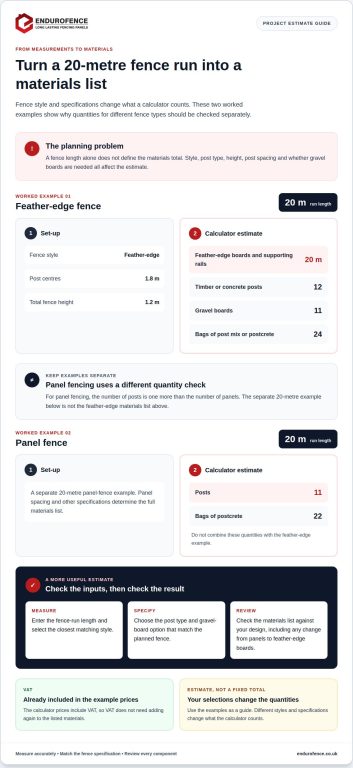
For an example, use a 20-metre feather-edge run, 1.8-metre post centres and a total fence height of 1.2 metres. The EnduroFence calculator example prices the following materials:
- Twenty metres of feather-edge boards and supporting rails
- Twelve timber or concrete posts spaced at 1.8-metre intervals
- Eleven gravel boards to protect the timber from ground moisture
- Twenty-four bags of post mix or postcrete to secure the uprights
The fencing prices shown by the calculator include VAT, so this example’s listed materials don’t need VAT added again. Use the quantities and prices as a worked example, not a fixed total for every 20-metre fence. Different styles and specifications change what the calculator counts.
Panel fencing uses a different quantity check: the number of posts is one more than the number of panels. A separate 20-metre panel-fence example requires 11 posts and 22 bags of postcrete. Don’t combine those quantities with the feather-edge example above, which uses rails and boards rather than standard fence panels.
To estimate your project, enter the run length and select the closest matching style, post type and gravel-board option. Check the resulting list against your intended design, including any change from panels to feather-edge boards. The calculator also estimates post mix, so you can include a material that might otherwise be missed. Treat the result as an estimate: the materials total depends on your selections and the layout entered.
Entering fence run lengths in the calculator
Measure each straight fence run along the line where the fence will stand. If your garden has several sides, record each length before adding them together. Don’t measure diagonally across a corner: that won’t represent the fence line or the materials it requires.
Enter the combined length in the calculator, unless it allows separate entries for each side. Include only the sections you intend to replace or install. If there’s a gap for a gate, exclude the opening from the panel length and account for the gate separately in your project plan.
Next, select the post-centre spacing that matches the planned fence: the calculator options are 1.8m, 2.4m and 3m. Post centres describe the distance between the middle of one post and the next. The choice affects how many posts and fence sections the calculator estimates, so match the spacing to the intended design.
Choose the total fence height from the available options: 1.2m, 1.5m or 1.8m. Keep the height consistent across the run if the garden uses one level. Where the layout changes height, calculate each section separately if the calculator allows it, rather than using one height for the entire boundary.
For example, a garden with a long back boundary and shorter side runs needs each straight length measured and recorded. Add them for a single total, or enter them separately if the tool allows. This ties the estimate to the actual fence layout rather than an approximate garden measurement.
Timber panels, feather-edge boards and other styles can use different layouts, so select the closest matching fence type before calculating. Check the total length, post spacing and height together: changing any of them can alter the quantities shown. A measured plan gives the calculator more useful inputs and makes the materials estimate easier to interpret.
EnduroFence: Maintenance-Free Fence Panels
EnduroFence sells Maintenance-Free Fence Panels for homeowners replacing timber panels while keeping their existing concrete posts. Each panel has profiled steel outer sheets on both sides and a high-density insulated core. The panels are powder-coated, weather-resistant and secure, with no painting or treating needed.
EnduroFence’s Retro Fitting Panel Swap suits projects where the existing concrete posts remain in place and only the panels need replacing. The panels are straightforward to install, and no training or qualification is needed. EnduroSmart Post Covers are another option for updating the appearance of existing posts.
If your fence measurements point towards a panel replacement, contact EnduroFence to discuss your project.
Turn your estimate into a practical next step
A garden fence replacement cost calculator for UK projects is most useful when it helps you decide what to replace, not just what to budget. Consider which parts of the existing boundary still suit your garden, the finish you want and how much ongoing upkeep you’re prepared to do. That gives your estimate a purpose: it becomes a way to shape the project around your priorities.
If you’re considering changing just the panels, first decide whether the existing structure suits that approach. If you want a different fence solution, consider the appearance and maintenance needs you want it to meet. A clear project scope makes it easier to identify the right option without committing to work before you’re ready.
For a considered next step, contact EnduroFence about your fence. A straightforward conversation can help you explore the options that fit your plans. Take the time to choose a solution that feels right for your garden and gives you confidence moving forward.
Frequently Asked Questions
How Does the Calculator Work?
A garden fence replacement cost calculator UK homeowners can use estimates materials and costs from the fence length and selected design options. Enter the length, then choose the panel style, post type and gravel-board option. The calculator estimates quantities, including post mix. If sections of a boundary have different heights or styles, calculate each separately to reflect its specifications.
How many posts for my fence run?
For standard panel fencing, allow one more post than the number of panels. A 20-metre panel run, for example, requires 11 posts and 22 bags of postcrete in the calculator example. Feather-edge layouts use different quantities: the example for a 20-metre run uses 13 posts. Use the figure for your fence type rather than applying one rule to every design.
How much does garden fence replacement cost per metre in the UK in 2026?
These are separate benchmarks, so don’t add them together as though both were materials charges. A garden fence replacement cost calculator UK households can use helps compare a project estimate with these averages; the selected design and project scope affect the total.
What is the average cost to replace a garden fence, including labour and materials?
Multiply it by the length being replaced to create a starting estimate.
How much do UK fence panels, posts and gravel boards cost by material and size?
Treat that as the example’s line item, not a universal rate.
How can I calculate the number of fence panels, posts and materials needed for replacement?
Measure the fence line, select the panel style and post spacing, then enter whether gravel boards are needed. The calculator estimates panels, posts, gravel boards and post mix. For feather-edge fencing, allow 10 boards per linear metre; for standard panels, calculate posts as one more than the panel count. A garden fence replacement cost calculator UK users can use gives more relevant quantities when separate runs with different designs are calculated individually.

Leave a Reply