

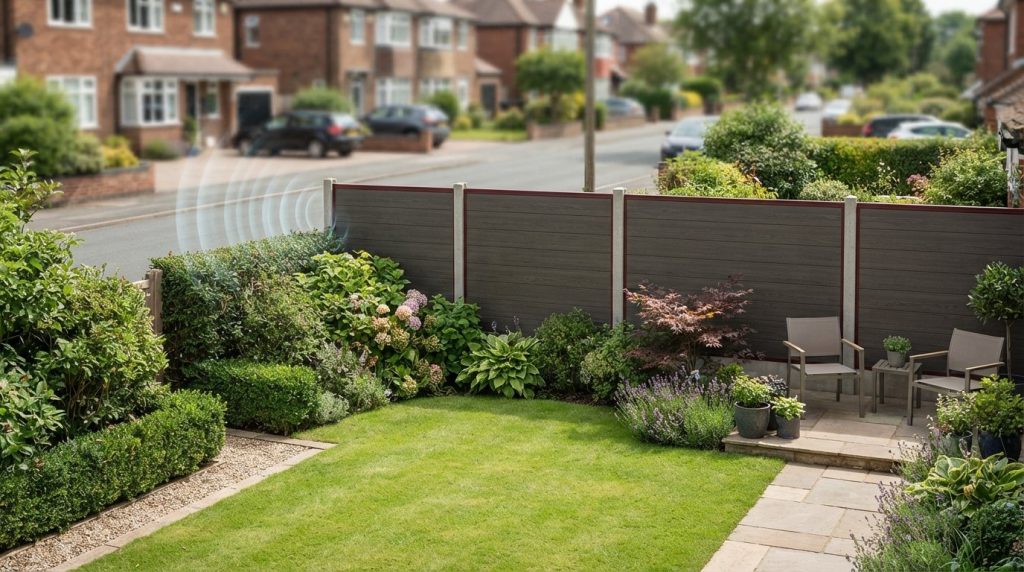
Noise-Reducing Garden Fences: A Homeowner’s Guide
Did you know that a structural gap covering just 1% of your fence’s surface area can reduce its noise-blocking performance by as much as 10 decibels? It is a frustrating reality for many UK homeowners who find their garden peace shattered by the constant hum of road traffic or the intrusive sounds of nearby neighbours. You likely feel that your outdoor space should be a sanctuary, yet standard timber fences often fail because they rot, warp, and develop the very gaps that let noise pour through. Finding the best garden fence for noise reduction requires moving beyond traditional wood toward materials engineered for silence.
We understand that you want a quieter garden without the exhausting cycle of painting and repairs. This guide explains how the latest acoustic fencing technology and high-density insulated materials can block out unwanted sound effectively. You will discover how to achieve a significant drop in volume by swapping old panels for modern, steel-faced alternatives. We will also show you how these solutions fit easily into your existing garden structure, providing a long-term, maintenance-free result that lets you finally enjoy the quiet you deserve.
Key Takeaways
- Understand the science of sound absorption and why surface mass is the most important factor in stopping noise from entering your garden.
- Compare different materials to find the best garden fence for noise reduction, weighing up the longevity of insulated steel against traditional timber.
- Learn how to identify and eliminate sound-leaking gaps using interlocking panel designs that maintain a permanent, airtight seal.
- Discover how to simplify your project by retrofitting acoustic panels directly into your existing concrete posts to save time and effort.
- Explore the benefits of maintenance-free materials that provide a “fit and forget” solution, ensuring your garden stays quiet for years without ongoing labour.
Understanding the Science: How Garden Fencing Reduces Noise
To find the best garden fence for noise reduction, you first need to understand how sound actually behaves when it hits a barrier. It isn’t enough to simply put up a taller version of a standard timber fence. Sound moves like a wave; if your barrier isn’t dense enough or contains even tiny gaps, those waves will simply pass through or around it.
Reflection vs. Absorption: Which Do You Need?
Most traditional garden fences rely solely on reflection. This occurs when sound waves hit a hard, flat surface and bounce back toward the source. Whilst this keeps some noise out of your garden, it can sometimes create a “ping-pong” effect in narrow spaces where sound echoes between walls. The most effective acoustic noise barriers use a dual-action approach that combines reflection with absorption.
Absorption happens when the energy of the sound wave is soaked up by the material rather than being reflected. This is where high-density insulated cores provide a significant advantage over hollow or thin timber panels. By using a dense core, the fence dampens vibrations and prevents the sound from travelling through the panel itself. For residential gardens, this combination of a hard outer shell and an insulating interior is the gold standard for creating a peaceful environment.
The Decibel Scale and Garden Noise
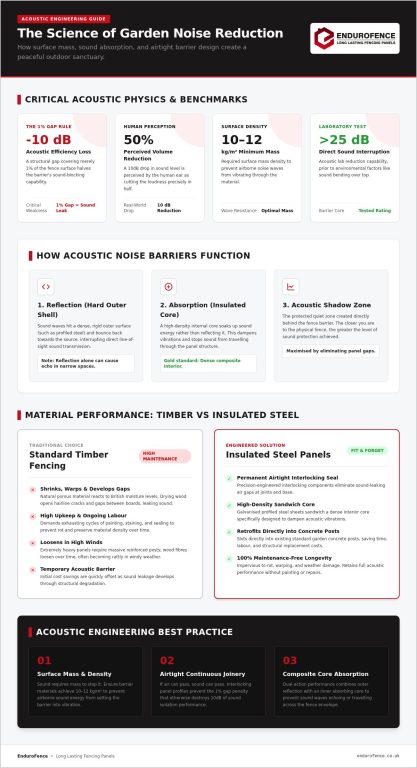
Understanding the decibel (dB) scale helps manage expectations for your project. Acoustic Fencing is a specialised barrier designed to interrupt the direct path of sound waves between a noise source and your home. In laboratory settings, high-quality panels can achieve reductions of over 25dB, but real-world results are usually closer to 10dB because sound bends over the top of the fence.
This 10dB drop might sound modest, but the human ear perceives it as cutting the loudness in half. Achieving this requires a total commitment to mass and seals. Consider these key scientific factors:
- The 1% Gap Rule: Engineering data shows that a gap covering just 1% of a fence’s surface can reduce its effectiveness by 10dB.
- Acoustic Shadow: This is the quiet zone created directly behind the fence. The closer you are to the barrier, the more protection you receive.
- Surface Density: Effective barriers typically require a density of at least 10 to 12 kg/m² to stop sound waves from vibrating through the material.
Any air gap, particularly at the base or between panels, acts like a leak in a bucket. If air can pass through, sound can too. This is why the best garden fence for noise reduction must feature interlocking components that create a permanent, airtight seal.
Comparing Materials: Timber vs. Composite vs. Insulated Steel
Selecting the right material is the most critical decision when searching for the best garden fence for noise reduction. While many homeowners instinctively look towards traditional timber, the material you choose determines more than just the look of your garden. It dictates how much sound is blocked, how well the panels withstand the British weather, and how much time you will spend on maintenance over the coming years.
The Hidden Flaw in Timber Acoustic Fencing
Timber is a natural, porous material that constantly reacts to moisture levels in the air. Even heavy-duty acoustic timber panels are susceptible to shrinking and warping as they age. When wood dries out, it develops hairline cracks and gaps between the boards. According to Federal Highway Administration noise barrier research, solid construction without openings is vital because even small gaps allow sound waves to leak through, compromising the barrier’s efficiency.
Beyond the acoustic leaks, timber requires significant upkeep. To prevent rot and maintain the density of the wood, you must commit to regular staining or painting. These panels are also incredibly heavy. They require massive, reinforced posts and often become “rattly” in high winds as the wood fibres loosen over time. For many, the initial cost saving of wood is quickly offset by the ongoing labour required to keep it functional.
Why Insulated Steel is the Quiet Modern Alternative
Insulated steel panels represent a shift toward industrial-grade performance for residential gardens. These panels consist of a high-density core sandwiched between two sheets of profiled, galvanised steel. This “sandwich” construction is specifically designed to dampen vibrations and block sound transmission. Unlike timber, steel is dimensionally stable; it does not shrink, warp, or split. This ensures that the interlocking tongue-and-groove seals remain airtight for decades.
Composite fencing is often considered for its mass, but it can be brittle and expensive to install. Insulated steel provides a much better weight-to-performance ratio. It is light enough for a simple DIY project yet dense enough to tackle heavy road noise. If you want a permanent solution, choosing maintenance-free fence panels allows you to enjoy a peaceful garden without the burden of annual repairs. This modern approach ensures your garden remains a quiet sanctuary regardless of the weather, making it a strong contender for the best garden fence for noise reduction in busy urban areas.
Key Features of the Best Garden Fence for Noise Reduction
When identifying the best garden fence for noise reduction, look beyond simple aesthetics. A fence that effectively blocks sound must possess specific engineering traits that standard garden panels lack. Height is your first consideration. For most residential gardens, a height of at least 6ft (1.8m) is essential to break the line of sight between the noise source and your ears. Without this elevation, sound waves roll over the top, rendering even the densest material ineffective.
To ensure your project succeeds, focus on these four critical features:
- Interlocking Panels: Eliminates the gaps that allow sound to leak through.
- High-Density Core: Provides the mass needed to absorb and dampen vibrations.
- Structural Stability: Prevents warping and shrinking over time.
- Sealed Footings: Blocks noise from travelling under the fence line.
The Importance of an Airtight Seal
Sound behaves remarkably like water. If there is a gap, it will flow through it. This is why traditional overlap or slatted fences fail; they are full of microscopic and visible holes. Interlocking designs, such as tongue-and-groove or modular steel panels, are essential for creating a permanent, gap-free barrier. These systems ensure that once the panels are stacked, they form a solid wall that sound waves cannot penetrate.
To complete the seal, you must also address the base. Using concrete gravel boards or ensuring your panels sit flush against a solid footing prevents noise from leaking under the fence line. Even a small gap at ground level can significantly degrade the acoustic performance of your entire boundary.
Mass and Density: The Core of the Matter
Mass is the primary enemy of sound. Lightweight materials vibrate easily, allowing sound energy to pass through the panel and emerge on the other side. According to residential noise barrier design guidelines, effective barriers require significant surface weight to achieve high transmission loss. This is why lightweight and noise reduction are rarely found in the same product description.
The high-density core in EnduroFence panels acts as a sound-dampening layer, providing the dead mass necessary to stop vibrations in their tracks. Unlike hollow composites, this insulated core ensures that the energy from road traffic or noisy neighbours is absorbed rather than transmitted. This internal dampening is what separates a professional acoustic solution from a standard decorative fence.
Durability is the final piece of the puzzle. A fence that stops noise today is of little use if it develops gaps in three years. You need a solution that maintains its structural integrity and airtight seals for a decade or more without warping. By choosing materials that don’t react to temperature changes or moisture, you ensure that your investment in peace and quiet remains effective for the long term.
Installation Factors: Height, Gaps, and Concrete Posts
Installing the best garden fence for noise reduction doesn’t always require a complete overhaul of your property boundary. If your garden already features concrete posts, you have the perfect foundation for an acoustic upgrade. The key to a successful installation lies in precision and the elimination of any path through which sound can travel. Even the most advanced material will fail if the setup allows for air gaps or structural instability.
Follow these four steps to ensure your installation provides maximum silence:
- Step 1: Assess Stability. Inspect your existing concrete posts for cracks or lean. They must be plumb and firmly set in the ground to support the mass of acoustic panels correctly.
- Step 2: Clear the Line of Sight. To block sound, the fence must physically hide the noise source. Aim for the maximum permitted height of 2.0 metres for rear boundaries; remember that roadside fences are usually limited to 1.0 metre without planning permission.
- Step 3: Secure the Fit. Ensure panels sit snugly within the post channels. Any loose movement allows sound to bypass the barrier and creates unwanted vibrations.
- Step 4: Seal the Base. Sound leaks under fences are common. Use a concrete gravel board or ensure your panels sit flush against the ground to create a dense, airtight seal.
Retrofitting for Noise Reduction
Many UK homeowners believe they need to dig up their entire garden to improve acoustics. However, a retro fitting panel swap allows you to replace old, warped timber with insulated steel whilst keeping your existing posts. Steel panels are engineered to fit standard UK concrete post slots perfectly, providing a far denser barrier than wood without the need for a full garden rebuild.
This approach is significantly more cost-effective than a total replacement. You save on labour and disposal costs while gaining a superior acoustic result. Since the panels are modular, you simply stack them until you reach your desired height. This ensures each section interlocks to maintain the integrity of the sound seal across the entire boundary.
Eliminating the “Rattle” Factor
Standard timber panels often rattle within concrete posts during high winds. This movement isn’t just annoying; it indicates a loose fit that lets sound through. The design of EnduroFence panels provides a more secure, silent fit that eliminates wind rattle entirely. For a more polished look, you can use post covers to hide weathered concrete and further tighten the seal around the panel edges. This small detail ensures your garden remains a peaceful sanctuary even on the windiest days, providing a long-term solution that looks as good as it performs.
The EnduroFence Advantage: Silence Without Maintenance
EnduroFence provides the best garden fence for noise reduction by combining industrial-grade acoustic performance with the everyday convenience of steel. While traditional timber barriers require constant attention to remain effective, these maintenance-free panels offer a “fit and forget” solution. You gain a quieter garden without the recurring costs of wood preservers or the labour of annual painting. It’s a practical choice for those who value their time as much as their peace and quiet.
The heavy-duty steel construction also brings an added layer of security to your property boundary. Unlike timber, which can be easily breached or weathered into fragility, these profiled steel sheets are incredibly resilient. You can also customise the look of your barrier to suit your home. These panels are available in various finishes, ensuring your noise reduction solution complements your existing garden colour scheme rather than clashing with it. This allows you to maintain a modern aesthetic whilst significantly dampening the sounds of the outside world.
A Solution Designed for the UK Homeowner
We have engineered this system specifically for the challenges of the UK climate. The panels are manufactured in the UK using pre-lacquered galvanised steel that offers up to a 25-year corrosion resistance rating. This durability is vital in Britain, where constant rain and wind quickly degrade standard wood. You don’t need specialised tools or professional qualifications to install them. The modular design means you can complete the project as a straightforward DIY task over a single weekend.
When you compare the long-term value, steel outlasts timber significantly. A standard wood fence might seem cheaper initially, but once you factor in the cost of treatment and the inevitable replacement every few years, the investment in steel becomes the more logical choice. It’s a one-time fix for a permanent problem. You are investing in a product that maintains its acoustic seal and structural integrity for decades.
Next Steps to a Quieter Garden
Measuring your garden for new panels is a simple process. Count your existing post sections and measure the height you wish to achieve, ensuring you stay within UK planning regulations. Once you have your dimensions, you can use our online quote tool to receive a bespoke pricing breakdown tailored to your specific project. This transparency ensures you know exactly what is required before you begin.
The path to a more peaceful outdoor space is straightforward. By focusing on mass, seals, and durability, you can reclaim your garden from the intrusion of road noise. Transform your garden with EnduroFence noise-reducing panels today and start enjoying the quiet sanctuary you deserve.
Secure Your Garden Sanctuary
You now understand that effective noise reduction requires more than just a tall barrier. It demands a combination of mass, density, and a perfectly airtight seal. While traditional timber often fails as it shrinks and warps, modern engineered materials provide a permanent fix that won’t degrade over time. Identifying the best garden fence for noise reduction involves moving away from high-maintenance wood towards durable, high-density insulated cores that soak up sound energy.
Our maintenance-free steel construction is specifically designed for a simple DIY retrofit into your existing concrete posts. This approach allows you to upgrade your garden acoustics without the cost or disruption of a full structural rebuild. By choosing a solution that is both resilient and easy to install, you can focus on enjoying your outdoor space rather than maintaining it. It’s time to stop tolerating intrusive road noise and start experiencing the quiet sanctuary your home was meant to be.
Get a free quote for your maintenance-free noise reduction panels and take the first step towards a more peaceful garden today.
Frequently Asked Questions
Does a garden fence really reduce road noise?
A well-constructed barrier can certainly reduce road noise, but results depend on mass and height. Breaking the direct line of sight between your ears and the traffic provides a baseline reduction of approximately 5 decibels. For more significant results, you need a gap-free barrier that absorbs vibrations. Whilst no garden fence creates total silence, high-density panels can make the environment feel twice as quiet by achieving a 10-decibel drop in perceived volume.
What is the best material for a noise-reducing fence?
Insulated steel is widely considered the best garden fence for noise reduction due to its high-density core and dimensional stability. Unlike timber, which shrinks and develops sound-leaking gaps, steel panels maintain an airtight seal for decades. The sandwich construction, featuring a dampening core between profiled steel sheets, provides the necessary mass to stop sound waves from vibrating through the barrier, ensuring long-term acoustic performance without the need for maintenance.
How high does a fence need to be to block noise?
To effectively block sound, a fence should be at least 1.8 metres (6 feet) high. The goal is to interrupt the direct path of sound waves from the source, such as car tyres on tarmac, to your garden. In the UK, you can typically install a fence up to 2.0 metres high on rear boundaries under permitted development rights. Any additional height helps reduce sound diffraction over the top, which further improves the quiet zone.
Can I fit noise-reducing panels into my existing concrete posts?
You can certainly retrofit acoustic panels into your existing slotted concrete posts. This Retro Fitting Panel Swap is a straightforward DIY task that avoids the effort and expense of a full garden rebuild. Our panels are engineered to slide directly into standard UK concrete post channels. This allows you to upgrade your garden’s acoustic performance quickly by simply removing old timber and stacking the new insulated steel sections until you reach the desired height.
Do steel fence panels echo or make more noise in the rain?
Modern steel panels don’t echo or create additional noise during heavy rain. The high-density insulated core bonded to the steel sheets acts as a powerful dampener, preventing the “drumming” effect associated with hollow metal structures. This internal insulation absorbs the energy from raindrops and prevents vibrations from travelling through the panel. The result is a solid, silent barrier that performs as quietly as a thick masonry wall during inclement British weather.
Will an acoustic fence block out my neighbours barking dog?
An acoustic fence is highly effective at reducing high-frequency sounds like a barking dog. Because these sound waves are shorter, they are more easily blocked by a dense, gap-free barrier. To ensure success, you must eliminate any gaps at the base of the fence where sound could leak through. Using a concrete gravel board or ensuring the panels are flush with the ground creates the airtight seal necessary to dampen intrusive neighbour noise.
Is planning permission required for a noise-reducing fence in the UK?
Planning permission is usually not required for fences up to 2.0 metres high on boundaries that don’t adjoin a highway. If your fence borders a road used by vehicles or a roadside footway, the maximum permitted height is typically 1.0 metre. If you wish to install a taller barrier to block significant road noise, you must apply for formal permission from your Local Planning Authority before starting any work on the project.
How much does a noise-reducing fence cost compared to standard timber?
While the initial purchase price of insulated steel is higher than standard timber, the long-term cost is often lower. Timber requires regular staining, painting, and eventual replacement as it rots or warps. Maintenance-free steel panels eliminate these ongoing expenses entirely. When you factor in the years of labour saved and the extended lifespan of the materials, the best garden fence for noise reduction provides superior value for money over its 25-year life.

Leave a Reply