

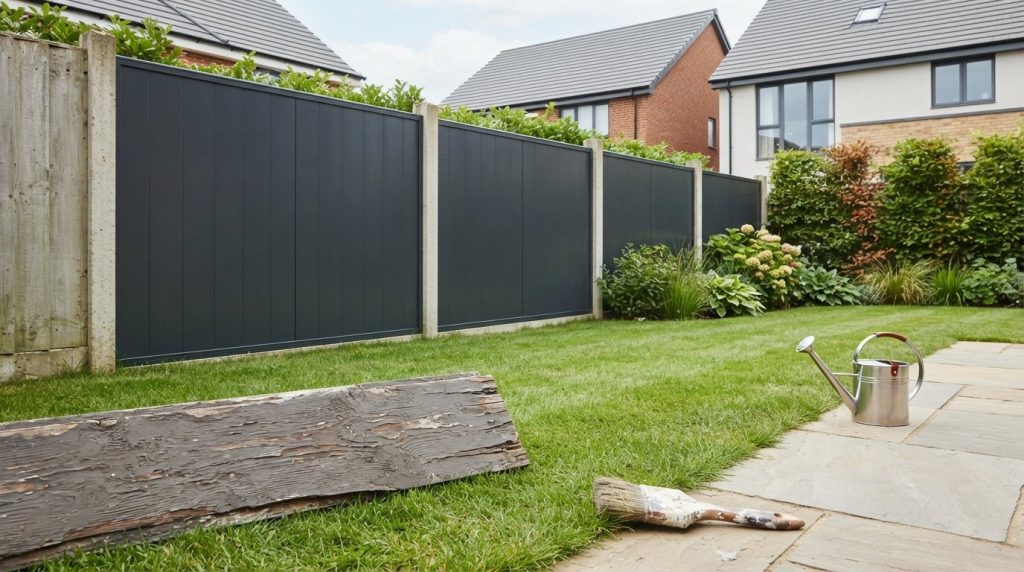
Fence Panels No Treatment Needed: Busting the Timber Maintenance Myth
What if the seasonal chore of spending sunny weekends recoating garden boundaries was entirely unnecessary? If you are searching for genuine fence panels no treatment needed, you have likely grown tired of the relentless cycle: buying tins of preservative, scrubbing away green algae, and watching timber boards split or warp regardless of your efforts.
You are not alone in that frustration. Most homeowners accept annual painting as an inevitable tax on their leisure time, having been told that pressure-treated timber looks after itself. In reality, porous wood will always absorb rainwater and suffer UV degradation, demanding regular chemical top-ups just to survive the damp British climate.
In this guide, you will discover why truly zero-maintenance boundaries require non-porous engineered materials, and how modern insulated steel panels eliminate garden timber upkeep for good. We will bust the common myths surrounding wood preservation, compare durable alternatives, and show you how to slot a permanent solution straight into your existing concrete posts.
Key Takeaways
- Understand why natural timber porosity makes truly zero-maintenance wooden fencing biologically impossible, even with pressure treatment.
- Discover engineered materials that provide genuine fence panels no treatment needed, eliminating the recurring expense and effort of stains and sealers.
- Compare how steel, composite, and uPVC stack up against structural warping, seasonal weather damage, and long-term durability.
- Learn the straightforward process of retrofitting maintenance-free steel panels straight into your existing concrete posts without digging up garden footings.
- Reclaim your free time with permanent boundary solutions that never require sanding, painting, or antifungal treatments.
The Treatment Myth: Can Timber Fence Panels Ever Be Maintenance-Free?
When homeowners search for fence panels no treatment needed, they want a simple outcome: install the boundary once and never touch a paintbrush again. The timber industry often markets treated timber as the answer to this demand. However, labeling wooden fencing as maintenance-free relies on a convenient half-truth that confuses rot resistance with zero upkeep.
Timber is an organic, porous material. By its very nature, it breathes, absorbs environmental moisture, and dries out under the sun. While chemical treatments protect against immediate biological decay, they cannot alter the natural cellular structure of wood. As wet autumns turn into frosty British winters, absorbed water freezes and expands within the grain. This continuous freeze-thaw cycle forces timber boards to cup, twist, split, and pull away from their fixings regardless of initial treatments.
Dip-Treated vs Pressure-Treated Wood: The Hidden Upkeep
Understanding the distinction between timber treatments reveals why both options still demand regular work:
- Dip-Treated Timber: Boards are briefly submerged in a preservative bath, coating only the outer surface. This thin protective barrier weathers away rapidly, requiring annual recoating with costly sealants to prevent fungal growth.
- Pressure-Treated (Tanalised) Timber: Preservative salts are forced deeper into the sapwood under vacuum pressure, aligning with Use Class standards for rot protection. While this guards against immediate subterranean rot, it provides zero defence against solar ultraviolet degradation or surface weathering.
Over time, driving rain gradually leaches chemical preservatives out of the surface timber. Meanwhile, solar UV breaks down surface lignin, leaving boards faded and brittle. Without routine application of protective stains, even tanalised wood deteriorates into a silvered, cracked state.
The Biological Reality: Why Wood Always Seeks Moisture
Wood never stops interacting with the atmosphere. During wet UK months, high ambient humidity causes timber panels to swell. When warmer weather arrives, the panels dry unevenly and shrink, loosening nails and weakening the structural frame.
These dimensional changes create fine micro-fissures across the grain. Rainwater penetrates these hairline cracks, bypassing surface preservatives and creating dark, damp pockets where fungal spores thrive. Topical sealers merely delay this moisture absorption; they do not eliminate it. Achieving true zero-maintenance performance requires stepping away from cellular organic materials entirely, opting instead for engineered solutions that are completely impervious to moisture.
The Real Cost of Annual Fence Maintenance: Time, Money, and Effort
Maintaining a traditional wooden fence is rarely a simple one-hour task. For an average 20-metre garden boundary, the job easily consumes six to eight hours of heavy manual labour every two to three years. That commitment demands roughly 15 to 20 litres of treatment across two coats, costing between £40 and £80 in materials alone before factoring in replacement brushes, rollers, or sprayers. Over a decade, ongoing stains, brushes, and minor repairs quietly drain hundreds of pounds.
The process itself involves far more than brushing liquid onto dry boards. It requires a sequence of disruptive steps:
- Surface Preparation: Jet washing or vigorously scraping away moss, lichen, and green algae.
- Mechanical Keying: Sanding down splintered grain and flaking residue so the new coat can adhere.
- Drying Periods: Waiting for porous timber to dry thoroughly, a challenging prospect in the temperamental UK climate where an unexpected shower ruins fresh stain.
- Double-Coating: Applying multiple coats methodically to ensure complete, even coverage across every slat.
The Spring Painting Ritual: Hours Lost to Garden Upkeep
Sunny spring weekends ought to be spent enjoying your outdoor space, not balanced precariously over flowerbeds. Reaching awkward corners, dodging prickly borders, and cleaning dried chemicals out of stiff bristles turn a pleasant afternoon into hard work.
Timber panels slotted into concrete posts present another headache. The hidden vertical edges sitting inside the post channels remain impossible to seal without lifting the heavy panels out. Moisture naturally collects in these unpainted recesses, accelerating rot from the inside out. Upgrading to engineered maintenance-free fence panels solves this dilemma permanently, removing the chore of annual painting entirely.
Environmental and Chemical Burdens of Timber Sealants
The liquids used to protect timber carry drawbacks beyond the physical effort required to apply them. Most commercial wood preservatives rely on synthetic fungicides, biocides, and solvent carriers engineered to kill biological organisms.
During application, chemical drips and overspray inevitably reach garden borders, threatening delicate root systems, soil microbiomes, and domestic pets. Even after drying, recurring rainfall gradually washes these chemicals down into surrounding lawns. Choosing non-porous engineered materials provides true fence panels no treatment needed, eliminating hazardous run-off and protecting your garden ecosystem for the long term.
Materials Compared: Which Fence Panels Truly Need No Treatment?
Evaluating fencing materials objectively means looking past marketing promises and examining three core criteria: real maintenance demands, dimensional stability, and resistance to harsh weather. When searching for genuine fence panels no treatment needed, homeowners generally consider four distinct material categories:
- Softwood Timber: Inexpensive initially, but requires ongoing chemical sealants and remains prone to rot, warping, and storm damage.
- uPVC Plastic: Resists biological rot, but suffers from brittle cracking during severe frost and tends to look synthetic.
- Wood-Plastic Composite (WPC): Blends recycled plastics and wood flour, offering better rot resistance than timber but carrying significant weight and thermal movement issues.
- Profiled Insulated Steel: High-tensile steel skins bonded to a dense structural core, delivering complete weatherproofing, high rigidity, and zero preservation needs.
Composite and PVC Fencing: Strengths and Common Pitfalls
Composite boards provide a partial step away from timber upkeep. However, because many composite formulations incorporate organic wood flour, their surfaces can still support mildew and green staining in shaded garden corners.
Thermal movement presents an even greater practical hurdle. Plastic-rich composite planks expand noticeably under direct summer heat and contract in winter cold. Over a six-foot span, this constant cycling causes unsupported boards to sag, bow, or twist out of post channels. Most 20 mm composite systems also require fiddly metal channel-reducing inserts just to sit inside standard 50 mm concrete posts without rattling loose in the wind.
Engineered Steel: The Ultimate Zero-Preservative Boundary
Profiled steel panels solve the structural and maintenance shortcomings of both timber and plastic composites. Built with durable galvanised steel outer skins, they present an entirely non-porous exterior that naturally repels moisture, mould spores, and burrowing insects. Driving rain simply washes away garden dust without soaking into the core.
Rather than relying on chemical top-coats, engineered steel panels feature factory-applied weather-resistant polyester coatings designed for decades of outdoor exposure. Inside, a high-density structural core provides impressive acoustic insulation and impact resistance. This composite construction prevents panels from flexing during 50 to 60 mph wind gusts, providing a permanent solution that needs no painting, oiling, or seasonal treatments.
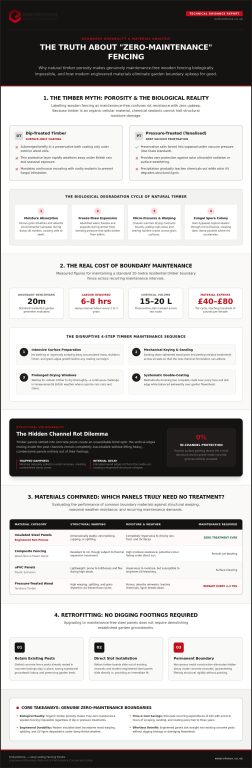
Fit Maintenance-Free Panels into Existing Concrete Posts
Replacing a rotting boundary does not mean digging up your garden. If your existing slotted concrete posts are solid and upright, you already have the foundation for a permanent upgrade. Upgrading to engineered fence panels no treatment needed can be completed in five practical steps:
- Inspect the Uprights: Check each concrete post with a spirit level to confirm it remains structurally plumb and firmly set in the ground.
- Measure the Bay Widths: Measure the distance between post channels at the top, centre, and bottom to identify any slight lean or variance. Standard UK posts feature roughly 50 mm channel slots.
- Remove the Old Timber: Slide out the degraded wooden panels and dispose of the rotted timber. Clear out any soil or debris compacted at the base of the post channels.
- Slide in the Modular Panels: Slide engineered, lightweight panels straight down the existing slots. Modular tongue-and-groove sections interlock cleanly to form a tight, rattle-free boundary.
- Install Matching Post Covers: Fit colour-matched steel post covers over the exposed concrete pillars to conceal aged, moss-stained posts without structural rebuilding.
Retrofitting Advantages: Save Days of Heavy Garden Labour
Excavating concrete footings is destructive, back-breaking work. Breaking out ballasts often destroys established flowerbeds, damages root networks, and risks cracking neighbouring patios.
Retrofitting preserves your landscaping completely. Because modern insulated steel panels are lightweight yet rigid, two people can slide an entire run into place using basic household tools in an afternoon. You bypass skip hire, messy concrete mixing, and days of hard labour while securing a fresh perimeter that never rots.
Eliminating Common Concrete Post Annoyances
Thin timber panels frequently rattle in slotted concrete during windy weather. Engineered steel panels, by contrast, fit snugly into standard 50 mm slots. Their composite core dampens vibration, stopping wind chatter and providing exceptional acoustic calm during blustery days.
Capping the concrete posts completes the transformation. Weathered concrete often looks grey, stained, and dated alongside new fencing. Applying purpose-made post covers wraps the concrete in the same clean, powder-coated finish as the panels. This creates an uninterrupted, contemporary architectural look across your entire boundary.
Ready to upgrade your garden without ground disruption? Organise a hassle-free retro fitting panel swap and enjoy durable, maintenance-free boundaries from day one.
The EnduroFence Solution: Lifetime Style Without the Paintbrush
Traditional timber fencing locks homeowners into an endless cycle of maintenance, but modern boundary design offers a permanent alternative. EnduroFence manufactures precision-engineered steel fence panels designed specifically for British gardens. By pairing robust materials with clean architectural styling, these systems solve the rot, warping, and seasonal upkeep inherent in wooden boundaries.
Each panel is built with profiled steel outer sheets bonded firmly to a high-density insulated core. This multi-layered composite construction provides structural strength without unnecessary bulk. Factory-applied, weather-resistant colour coatings protect the exterior against sun bleaching, frost, and driving rain. The surface stays vibrant year after year, giving you genuine fence panels no treatment needed from the moment they are installed.
Designed Specifically for Existing UK Concrete Posts
Switching your boundary does not require specialist building qualifications or heavy equipment. EnduroFence panels are engineered with a 40 mm profile, ensuring they slide smoothly into standard 50 mm concrete post channels without modifications or fiddly adapter brackets.
The interlocking tongue-and-groove design creates a continuous barrier that resists gale-force winds. Unlike brittle timber lap boards that blow loose during severe storms, these steel composite sections distribute wind pressure evenly down the concrete uprights. Adding matching steel post covers conceals weathered concrete pillars, unifying your garden perimeter with a clean, modern aesthetic.
Reclaim Your Weekends with Zero-Maintenance Fencing
Choosing an engineered steel boundary transforms how you spend your free time. You can pack away the paint trays, biocide sprays, and stiff brushes permanently. Because the non-porous exterior sheds water effortlessly, routine upkeep involves nothing more than an occasional spray with a garden hose to remove windblown dust or surface dirt.
Installing high-specification steel panels provides a lasting boundary that retains its shape, colour, and integrity through every season. Reclaim your weekends and put an end to recurring timber treatments by requesting a quote from EnduroFence today.
Reclaim Your Weekends with Truly Zero-Maintenance Fencing
The annual routine of scraping, sanding, and restaining timber is not an inescapable garden chore; it is simply the inevitable consequence of using porous organic materials outdoors. Securing genuine fence panels no treatment needed means stepping away from wood and investing in engineered durability.
Modern steel boundaries solve the timber problem entirely. Featuring a heavy-duty profiled steel exterior bonded to a high-density insulated acoustic core, they resist rot, damp, and ferocious storm winds without ever needing a drop of preservative. Their seamless slide-in retrofit design fits directly into standard UK concrete posts, completely removing the hassle and expense of digging up established garden beds.
Take back your sunny afternoons and protect your boundary with a permanent architectural upgrade. Upgrade to zero-maintenance steel fencing with a free quote from EnduroFence and enjoy lasting peace of mind.
Frequently Asked Questions
Do pressure-treated timber fence panels really need no treatment?
No, pressure-treated timber still demands regular maintenance. Vacuum-infused biocides prevent immediate fungal rot deep in the sapwood, but they offer no protection against sun exposure, atmospheric moisture, or freeze-thaw cycles. Without regular water-repellent sealants, the surface fibres split, turn silver-grey, and warp. Truly achieving fence panels no treatment needed requires non-porous engineered materials rather than organic timber.
What is the best alternative to timber fence panels that never rots?
Engineered steel composite panels offer the most durable, rot-free alternative to traditional timber. Unlike plastic-heavy composites that can bow in summer heat or uPVC that turns brittle in freezing conditions, steel panels do not absorb water, crack, or degrade under ultraviolet light. They provide a rigid, permanent perimeter that completely removes the need for fungicides, oils, or paints.
Can maintenance-free fence panels fit into my existing concrete posts?
Yes, modern maintenance-free panels are built specifically to retrofit into standard UK slotted concrete posts. With a 40 mm profile designed to slot smoothly into standard 50 mm channels, they slide straight down the uprights without requiring bracket alterations or channel-reducing conversion kits. This allows you to upgrade your garden perimeter cleanly without disturbing established concrete foundations.
Will steel fence panels rust or lose their colour in wet British weather?
No, engineered steel panels are designed to resist rust and fading throughout decades of damp British weather. Outer skins are manufactured from galvanised steel, treated with protective primers, and finished with thick architectural-grade polyester coatings. This multi-layered barrier completely isolates the metal from moisture and UV rays, ensuring the colour remains uniform without peeling or flaking.
How do you clean fence panels that require no treatment or painting?
Cleaning engineered zero-maintenance panels requires only basic household water and minimal effort. Because the smooth exterior coating repels moss, algae, and garden dirt, you simply spray the panels down with a standard garden hose once or twice a year. For stubborn mud splatters, a soft sponge and mild soapy water will wipe the surface clean in seconds.
Are steel maintenance-free fence panels noisy or prone to rattling in high winds?
No, high-quality steel panels are remarkably quiet and structurally stable during stormy weather. Each panel features a high-density insulated structural core that absorbs sound and deadens vibrations, preventing tinny echoes. Furthermore, the interlocking modular sections sit snugly within the concrete post channels, stopping wind chatter and eliminating the annoying rattles common to lightweight wooden lap fencing.
Can I replace my old timber fence panels myself without professional tools?
Yes, retrofitting engineered steel panels is a straightforward DIY project that requires no specialised building tools or qualifications. After sliding out the deteriorated wooden panels and clearing the channels, two adults can easily lift and slide the lightweight modular sections into your existing posts. Adding matching clip-over post covers finishes the job in an afternoon, avoiding professional labour costs.

Leave a Reply